Kioxia and SanDisk: How the Two NAND Makers Share Their Fabs
Kioxia, listed in Tokyo, and SanDisk, listed on Nasdaq, compete for NAND customers, yet nearly all their memory wafers come out of the same factories in Yokkaichi and Kitakami.
Kioxia and SanDisk are rivals in selling NAND flash memory, the chips inside SSDs, phones and memory cards. They are also partners: almost all of the memory wafers either company sells are made in the same factories in Japan, through a joint venture that has run for more than 25 years. For anyone following Kioxia in Tokyo or SanDisk on Nasdaq, the venture explains why the two often move on the same news.
What is Flash Ventures?
Three joint companies, Flash Partners, Flash Alliance and Flash Forward, which SanDisk calls Flash Ventures. According to SanDisk’s annual report for the year ended July 3, 2026:
- The ventures operate “across eight flash-based manufacturing facilities in Japan, six of which are located in Yokkaichi, Japan and two of which are located in Kitakami, Japan.”
- Kioxia owns 50.1% of each venture and SanDisk 49.9%.
- “Kioxia owns the facilities and provides wafer manufacturing services to Flash Ventures at cost,” using equipment owned or leased by the ventures. Flash Ventures accounts for about 80% of the manufacturing capacity in Kioxia’s own facilities.
- The two partners co-develop the flash technology and jointly own it.
Each venture was formed for a new fab in Yokkaichi:
| Venture | Formed | Built around |
|---|---|---|
| Flash Partners | 2004 | Kioxia’s Y3 fab |
| Flash Alliance | 2006 | Y4 |
| Flash Forward | 2010 | Y5 |
Later fabs were added through separate facility agreements: New Y2 and Y6 in Yokkaichi, K1 and K2 in Kitakami, and Y7 in Yokkaichi, where production started in 2022. Output from K2 began in SanDisk’s latest fiscal year.
How the two split output and costs
Roughly in half. SanDisk’s 10-K says the two “are entitled to purchase a share of Flash Ventures’ output, which generally equals 50% each,” at “cost plus a small markup.” SanDisk is “obligated to pay for half of Flash Ventures’ fixed costs regardless of the output we choose to purchase,” and “all of our flash memory wafers are currently obtained from Flash Ventures.” The agreements also limit SanDisk from making flash memory outside the Yokkaichi and Kitakami facilities.
In Kioxia’s results, sales to SanDisk through the three ventures appear in its “Other” revenue line, alongside SD cards and USB drives.
How long the partnership runs
Until the end of 2034 for now. On January 29, 2026, the partners extended Flash Partners and Flash Alliance from December 31, 2029 to December 31, 2034, so “all three of the joint ventures that comprise the Flash Ventures are scheduled to co-terminate on December 31, 2034,” SanDisk’s 10-K says. With the extension, SanDisk agreed to pay Kioxia $1.2 billion over 2026 through 2029 “in consideration of Kioxia’s manufacturing services and the continued availability of supply.”
On August 27, 2026, the two announced planned investments in Japan of “over $31 billion (approximately 5 trillion yen) contingent upon government support” through 2032, for the Yokkaichi and Kitakami plants. The release says the partnership has invested “over $50 billion (approximately 9 trillion yen) in Japan over the past 25 years.”
The two companies
Kioxia was Toshiba’s memory business. Its company history lists the invention of NAND flash in 1987, the Yokkaichi plant in 1992, Toshiba Memory Corporation’s establishment in April 2017, the name Kioxia from October 2019, and its listing on the Prime Market of the Tokyo Stock Exchange in December 2024, under the code 285A. Its Kitakami plant is run by a subsidiary, Kioxia Iwate, which Kioxia decided on October 30, 2026 to merge into Kioxia Corporation on April 1, 2027.
SanDisk was part of Western Digital until February 21, 2025, when it “separated from WDC” and began trading as SNDK on the Nasdaq Global Select Market. It sells SSDs and other flash products under its own brand.
How each reports its results
On different calendars and accounting standards:
| Kioxia Holdings | SanDisk | |
|---|---|---|
| Listing | Tokyo Stock Exchange Prime, 285A | Nasdaq, SNDK |
| Fiscal year | Ends March 31 | Ends on the Friday nearest June 30 |
| Accounting | IFRS, yen | US GAAP, dollars |
| Latest quarter | July–September 2026: revenue ¥2,480.0 billion | Ended October 2, 2026: revenue $11.03 billion |
| Released | October 30, 2026 | October 29, 2026 |
| Outlook | ¥6,747.2 billion for April–December 2026, implying about ¥2.50 trillion for October–December | $12.2 billion to $12.6 billion for the next quarter |
Kioxia gives no full-year plan: “the Group does not provide plans or progress reports for the full fiscal year,” its results release says, so its outlook covers the next quarter as part of a cumulative figure. SanDisk records its 49.9% share of the ventures’ earnings “one quarter in arrears.”
Because their quarters nearly line up, the two report within days of each other: on October 29 and October 30 this season. Both also split their shares this fall: Kioxia 3-for-1 on October 1, 2026, and SanDisk 8-for-1, with trading on a split-adjusted basis expected from November 20, 2026. Kioxia’s 3-for-1 Split explains how to read Kioxia’s price history.
What does the venture mean for their stocks?
That the two share both their factories and their exposure. Both make only NAND flash, from the same plants, so a change in NAND prices or in Japanese manufacturing reaches both. Where they differ is in what they sell and to whom, how they report and in which currency. For where NAND fits next to DRAM and HBM, see Who Makes What in Memory; for buying Kioxia’s shares from outside Japan, see Kioxia Outside Japan.
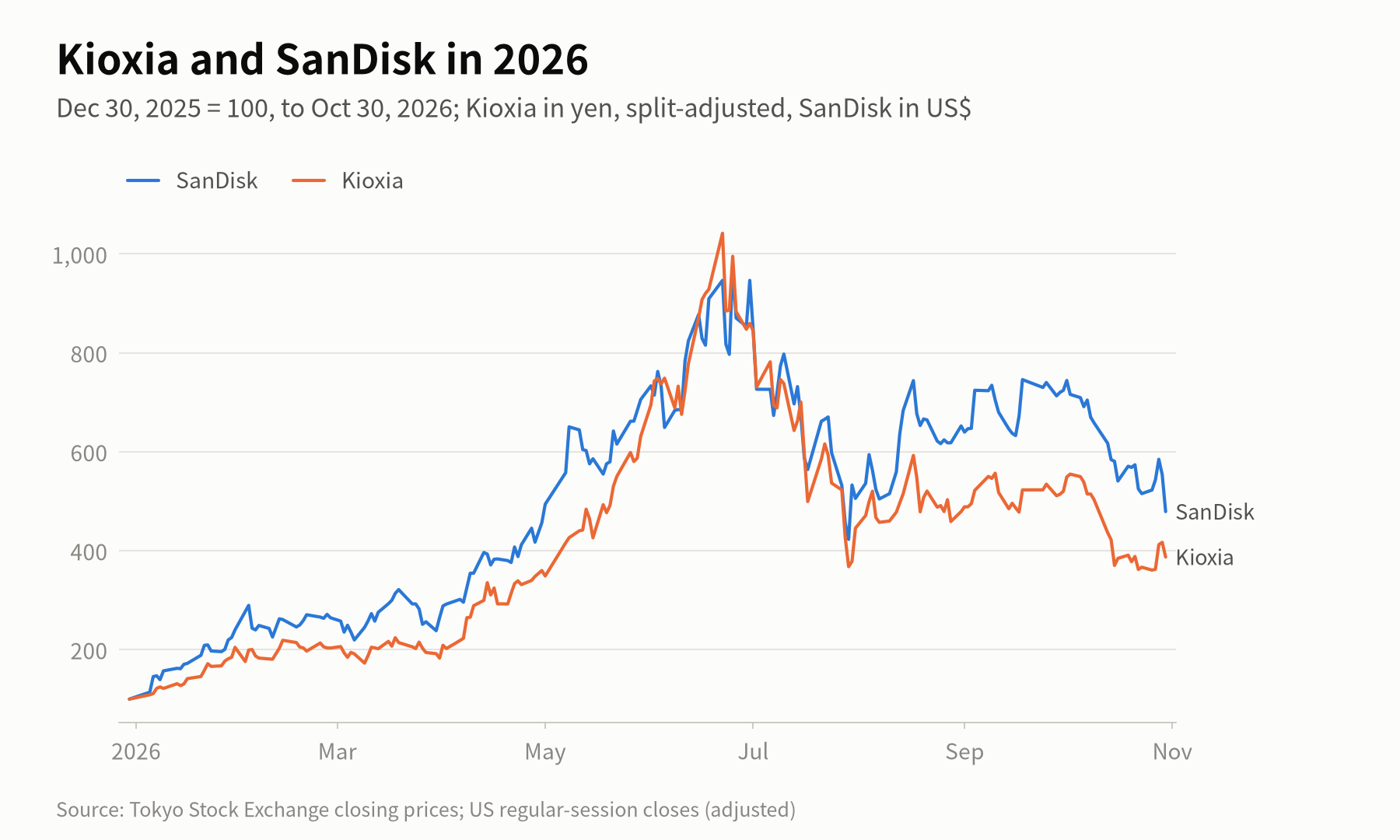
Their share prices have moved in the same direction this year, though not by the same amount. From December 30, 2025 to October 30, 2026, Kioxia rose 287.3% in Tokyo and SanDisk 379.1% in New York.
Sources
- SanDisk Corporation annual report (Form 10-K) for the fiscal year ended July 3, 2026
- Sandisk Reports Fiscal First Quarter 2027 Financial Results (October 29, 2026)
- Kioxia and Sandisk to Invest Over $31 Billion in Japan, Extending Leadership in Memory Industry (August 27, 2026)
- Consolidated Financial Results for the Six Months Ended September 30, 2026 (October 30, 2026)
- Company Information and KIOXIA Group History
- IR Calendar
- Annual Securities Report for the Fiscal Year Ended March 2026
Related reading
More in Explainers
- Chip Stock Heatmap Explained: How to Read the Asia-Pacific Chips MapMarket Map
- Asia Chip Stocks From a US Account: SKHY, TSM, KXIAY and Other TickersExplainers
- Who Makes What in Memory: DRAM, NAND and HBM Across Asia and the USExplainers
- After a Big SOX Day: How Seoul, Tokyo and Taipei Chip Stocks FollowedExplainers
- Taiwan's Foreign Investor Flows: Reading TWSE's Daily Net-Buy DataExplainers
- How to Read a Japanese Kessan Tanshin (Earnings Summary)Explainers
- Advantest Explained: The Chip-Tester Maker That Moves the NikkeiExplainers
- Why US Chip Earnings Come After the Bell, and What Asia Sees NextExplainers
- Korea's 10-Day Export Data: How Chip Exports Are CountedExplainers
- TSMC's Quarterly Dividend: Ex-Dividend Dates for 2330 and TSMExplainers
- Korean Preferred Shares: Why Samsung's 005935 Trades Below Its CommonExplainers
- SOX and the Nikkei 225: How US Chip Stocks Reach Tokyo's Next SessionExplainers
- Stock Split vs Reverse Split: From SOXX and SanDisk to Penny StocksExplainers
- What Is Rapidus? Japan's 2nm Chipmaker and the Companies Behind ItExplainers
- Samsung vs SK hynix: How Korea's Two Memory Giants DifferSamsung & SK hynix
- TSMC in Japan: What Is JASM, the Kumamoto Chip Plant?Explainers
- What Is HBM? High-Bandwidth Memory vs DRAM, HBM3E and HBM4Explainers
- SOXL and SOXS Explained: 3x Leveraged and Inverse Chip ETFsExplainers
- Custom AI Chips Explained: Google TPU, Amazon Trainium and ASICsExplainers
- Where Japan Fits in the Chip Supply Chain, Next to Taiwan and KoreaExplainers
- Taiwan's Chip Stocks: Who Makes WhatExplainers
- What Samsung Electronics Makes: Chips, Phones, Displays and MoreSamsung & SK hynix
- Japan's Chip Stocks: Who Makes WhatExplainers
- Why Nvidia's Earnings Move Memory StocksExplainers
- Chip Equipment Makers: ASML, Applied, Lam, KLA and Tokyo ElectronExplainers
- SOX Heatmap Explained: How to Read the US Chip Index MapMarket Map
- Memory Stock Map Explained: DRAM, NAND and HBM Makers in One ViewMarket Map
- S&P 500 Heatmap Explained: How to Read the US Market MapMarket Map
- How to Buy Japanese Chip Stocks: Tokyo Shares, OTC ADRs and ETFsGuides
- How to Buy Taiwan Stocks From Abroad: TWSE Shares, TSM and ETFsGuides
- What Do 3nm and 2nm Mean? Chip Process Nodes ExplainedExplainers
- US Chip Export Controls on China, ExplainedExplainers
- What Is CoWoS? TSMC's Advanced Packaging and the AI Chip BottleneckExplainers
- Foundry, Fabless and IDM: How Chipmakers Split the WorkExplainers
- Why Samsung Reports Earnings Twice, and How Other Chipmakers ReportSamsung & SK hynix
- SOXX vs SMH vs SOXQ: How Three Semiconductor ETFs DifferExplainers
- How a Stock Gets Into the S&P 500 and the Nasdaq-100Explainers
- US Stock Futures Overnight: What Dow, S&P 500 and Nasdaq Futures ShowExplainers
- One Chip Day, Four Closes: Seoul, Taipei, Tokyo and New YorkExplainers
- Japan's Margin Trading Data: What It Says About KioxiaExplainers
- Kioxia Outside Japan: 285A in Tokyo vs KXIAY Over the CounterExplainers
- Kioxia's 3-for-1 Split: How to Read Its Price HistoryExplainers
- Micron's Fiscal Calendar: Why Its Quarters Don't Match Samsung'sExplainers
- Nikkei 225 vs TOPIX: Why Chip Stocks Move Them So DifferentlyExplainers
- The Philadelphia Semiconductor Index (SOX) and Why Asia Watches ItExplainers
- Taiwan's 10% Daily Price Limit and Other Rules for Foreign InvestorsExplainers
- TSM vs 2330: Why TSMC's US Shares Trade Above TaipeiExplainers
- TSMC's Monthly Sales: How Taiwan's Monthly Revenue Reports WorkExplainers
- Why One Stock Moves Taiwan's Market: TSMC and the TAIEXExplainers
- How Foreign Investors Move the KOSPI, and Where to See the Daily DataExplainers
- How to Buy Korean Stocks in 2026: 4 Routes for US, Singapore, UKGuides
- How to Buy Samsung Stock Outside Korea: Shares, London GDR and ETFsGuides
- Korea Discount and the Value-up Program, Explained SimplyExplainers
- KOSPI Heatmap Explained: How to Read Korea's Market MapMarket Map
- Why MSCI Still Hasn't Upgraded Korea, and What Would Change ItExplainers
- How Samsung and SK hynix Compare in HBMSamsung & SK hynix
- SKHY vs 000660: How the Two Ways to Own SK hynix DifferSamsung & SK hynix
- Why Is the KOSPI So Volatile? Chips, Foreign Money and the WonExplainers