Why Samsung Reports Earnings Twice, and How Other Chipmakers Report
Every quarter Samsung Electronics puts out its numbers twice: a one-line estimate about a week after the quarter ends, then full results about three weeks later. Here is what each release contains, how far the two have differed since 2024, and how the other big chipmakers in Asia and the US report instead.
Most large companies report a quarter once. Samsung Electronics reports it twice. About a week after a quarter ends, it publishes a short estimate of two numbers, consolidated sales and operating profit. About three weeks later it publishes full results, with earnings per share, results for each business and a conference call. Its quarterly report to regulators follows within 45 days of the quarter’s end.
For the third quarter of 2026, Samsung’s estimate came out on October 8: sales of about 195 trillion won and operating profit of about 107.4 trillion won. Samsung’s investor relations calendar lists the full results and conference call for October 29.
What is in the early estimate?
Samsung calls it “earnings guidance.” It is filed with the Korea Exchange as a provisional results disclosure, and it contains:
- Consolidated sales and operating profit only. The rows for pre-tax profit and net profit in the filing are left blank, and there is no split by business.
- One figure for each, not a range. Samsung’s release says “Korean disclosure regulations do not allow earnings estimates to be offered as a range,” and that its figures “represent the median of the estimate ranges.” For the third quarter of 2026 the ranges were 194 to 196 trillion won for sales and 107.3 to 107.5 trillion won for operating profit.
- Unaudited numbers. Samsung says the guidance is “provided for the convenience of our investors before the external audit” is completed, and the filing says the company will disclose again when its board approves the quarter’s results.
The Korea Exchange’s fair disclosure rules cover “information regarding provisional business results” and require it to be reported to the exchange before it is given to anyone else. That is why the estimate appears as an exchange filing first.
The practice is not new. The earliest early-month estimate in Samsung’s filings on DART, Korea’s disclosure system, is dated July 6, 2009, for the second quarter of that year, and it gave ranges: sales of 31 to 33 trillion won and operating profit of 2.2 to 2.6 trillion won. Other Korean companies do the same; LG Electronics, for one, released preliminary third-quarter results on October 7, 2026.
What do the full results add?
The second release comes on the day of the conference call. For the second quarter of 2026, Samsung’s July 30 release added:
- earnings per share (10,849 won for that quarter);
- results by division: DS (semiconductors, covering Memory, System LSI and Foundry), SDC (displays), MX and Networks (mobile), VD and DA (TVs and appliances) and Harman;
- an outlook for the coming quarter and a conference call.
On the same day Samsung files the provisional results again with the exchange, now with net profit. The quarterly report, with the full financial statements, must reach regulators within 45 days of the quarter’s end under Article 160 of Korea’s Capital Markets Act; Samsung filed its 2026 half-year report on August 14.
How close has the estimate been?
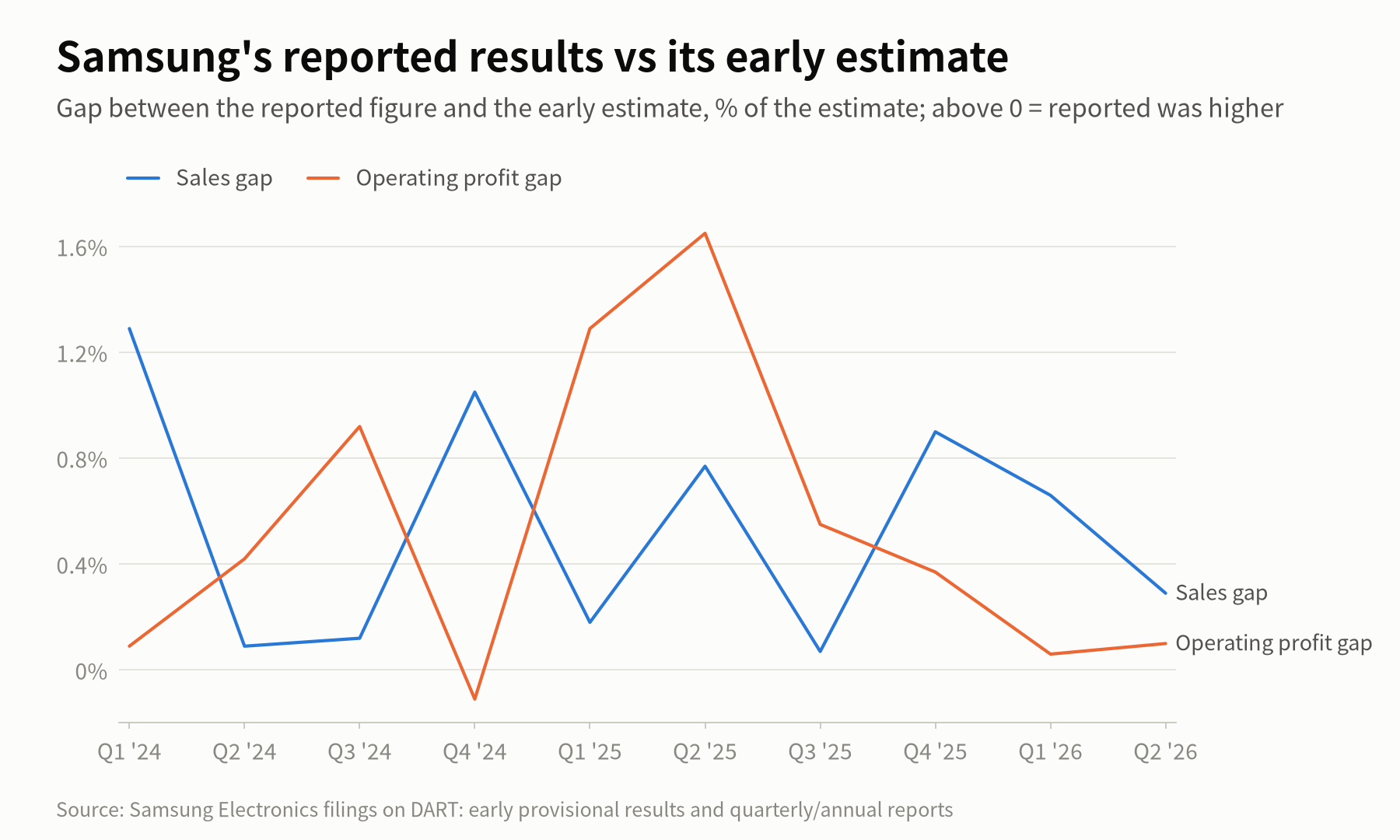
We compared each early estimate with the figures in Samsung’s quarterly and annual reports for the ten quarters from the first quarter of 2024 to the second quarter of 2026. Figures are consolidated, in trillion won; the fourth quarter is the full year less the first nine months.
| Quarter | Estimate filed | Sales: estimate → reported | Gap | Operating profit: estimate → reported | Gap |
|---|---|---|---|---|---|
| Q1 2024 | Apr 5, 2024 | 71.0 → 71.92 | +1.29% | 6.6 → 6.61 | +0.09% |
| Q2 2024 | Jul 5, 2024 | 74.0 → 74.07 | +0.09% | 10.4 → 10.44 | +0.42% |
| Q3 2024 | Oct 8, 2024 | 79.0 → 79.10 | +0.12% | 9.1 → 9.18 | +0.92% |
| Q4 2024 | Jan 8, 2025 | 75.0 → 75.79 | +1.05% | 6.5 → 6.49 | −0.11% |
| Q1 2025 | Apr 8, 2025 | 79.0 → 79.14 | +0.18% | 6.6 → 6.69 | +1.29% |
| Q2 2025 | Jul 8, 2025 | 74.0 → 74.57 | +0.77% | 4.6 → 4.68 | +1.65% |
| Q3 2025 | Oct 14, 2025 | 86.0 → 86.06 | +0.07% | 12.1 → 12.17 | +0.55% |
| Q4 2025 | Jan 8, 2026 | 93.0 → 93.84 | +0.90% | 20.0 → 20.07 | +0.37% |
| Q1 2026 | Apr 7, 2026 | 133.0 → 133.87 | +0.66% | 57.2 → 57.23 | +0.06% |
| Q2 2026 | Jul 7, 2026 | 171.0 → 171.50 | +0.29% | 89.4 → 89.49 | +0.10% |
Over these ten quarters, reported sales came in above the estimate every time, by 0.07% to 1.29%; the estimates were stated in whole trillions of won. Reported operating profit was above the estimate nine times and 0.11% below it once, with the widest gap 1.65%. The full results changed the picture less than they filled it in: the estimate gives the size of the quarter, and the full release shows where the profit came from.
The date of the estimate moves a little. Most fell in the first week or so of the month after the quarter; for the third quarter of 2025 it came on October 14.
How do other chipmakers report?
The other large chipmakers in Asia and the US each report on their own pattern:
| Company | Early figure | Quarterly results | Outlook |
|---|---|---|---|
| Samsung Electronics | Sales and operating profit about a week after the quarter | About three weeks later, with a call (Oct 29 for Q3 2026) | Description of the coming quarter in the release |
| SK hynix | None | Once, about four weeks after the quarter (Oct 28 for Q3 2026, before 9:00 a.m. KST, call at 9:00) | — |
| TSMC | Revenue every month, within the first ten days | Mid-month after the quarter (Oct 15 for Q3 2026) | Ranges for next quarter’s revenue, gross margin and operating margin |
| Micron | None | Weeks after a fiscal quarter ends (27 days for fiscal 2026); the fiscal year ends on the Thursday closest to August 31 | Ranges for next quarter’s revenue, gross margin and earnings per share |
| Kioxia | None | Quarterly results under Japan’s disclosure rules | A single figure for the next quarter; no full-year plan |
A few details from their own filings:
- SK hynix files one provisional results disclosure a quarter, on the day of its call. Since its American depositary shares (SKHY) listed on Nasdaq in July 2026, it also files the same table with the SEC on Form 6-K.
- TSMC’s monthly revenue reports follow Article 36 of Taiwan’s Securities and Exchange Act, which requires the previous month’s operating figures within the first ten days of each month. With its third-quarter 2026 results on October 15, TSMC guided fourth-quarter revenue of US$52.3 billion to US$54.3 billion, a gross margin of 65% to 67% and an operating margin of 56.5% to 58.5%. Our TSMC monthly sales explainer covers those reports.
- Micron’s fiscal 2026 ended September 3, 2026, and it reported 27 days later, on September 30, with fiscal first-quarter 2027 revenue guidance of US$61.5 billion, plus or minus US$1.5 billion. Micron’s fiscal calendar explains why its quarters do not match the calendar.
- Kioxia’s results for the quarter to June 30 said “the Group does not provide plans or progress reports for the full fiscal year,” and gave a single outlook for the next quarter: revenue of 2,390.0 billion yen for the three months to September.
So “Samsung’s earnings” can refer to either of two days, and the first is an estimate of two numbers. For the other chipmakers, one results day carries everything, and the outlook for the next quarter is what each gives in its own form.
Sources
- Samsung Electronics Announces Earnings Guidance for Third Quarter 2026 (October 8, 2026)
- 3Q 2026 Pre-Earnings Guidance
- IR events and presentations (2026 guidance and conference call dates)
- Samsung Electronics Announces Second Quarter 2026 Results (July 30, 2026)
- Samsung Electronics provisional results filing for Q3 2026 (연결재무제표기준영업(잠정)실적(공정공시), October 8, 2026)
- Samsung Electronics provisional results filing for Q2 2009 (영업(잠정)실적(공정공시), July 6, 2009)
- Samsung Electronics quarterly, half-year and annual reports, 2024 to 2026 (consolidated revenue and operating profit)
- Fair Disclosure
- Financial Investment Services and Capital Markets Act, Article 160 (quarterly reports)
- SK hynix Q3 2026 Earnings Conference Call Invitation (October 21, 2026)
- TSMC Reports Third Quarter EPS of NT$29.43 (Form 6-K, exhibit 99.1, October 15, 2026)
- Securities and Exchange Act, Article 36
- Micron annual report (Form 10-K), fiscal 2026
- Micron Form 8-K, fiscal fourth quarter 2026 results (September 30, 2026)
- Kioxia consolidated results for the three months ended June 30, 2026 (July 31, 2026)
- LG Electronics Releases Preliminary Earnings for Third Quarter 2026 (October 7, 2026)
See today’s Korea market map →
Related reading
More in Explainers
- Chip Stock Heatmap Explained: How to Read the Asia-Pacific Chips MapMarket Map
- Asia Chip Stocks From a US Account: SKHY, TSM, KXIAY and Other TickersExplainers
- Who Makes What in Memory: DRAM, NAND and HBM Across Asia and the USExplainers
- How to Buy Japanese Chip Stocks: Tokyo Shares, OTC ADRs and ETFsGuides
- How to Buy Taiwan Stocks From Abroad: TWSE Shares, TSM and ETFsGuides
- What Do 3nm and 2nm Mean? Chip Process Nodes ExplainedExplainers
- US Chip Export Controls on China, ExplainedExplainers
- What Is CoWoS? TSMC's Advanced Packaging and the AI Chip BottleneckExplainers
- Foundry, Fabless and IDM: How Chipmakers Split the WorkExplainers
- SOXX vs SMH vs SOXQ: How Three Semiconductor ETFs DifferExplainers
- How a Stock Gets Into the S&P 500 and the Nasdaq-100Explainers
- Dow, S&P 500 and Nasdaq: What Each US Stock Index MeasuresExplainers
- US Stock Futures Overnight: What Dow, S&P 500 and Nasdaq Futures ShowExplainers
- One Chip Day, Four Closes: Seoul, Taipei, Tokyo and New YorkExplainers
- Japan's Margin Trading Data: What It Says About KioxiaExplainers
- Kioxia Outside Japan: 285A in Tokyo vs KXIAY Over the CounterExplainers
- Kioxia's 3-for-1 Split: How to Read Its Price HistoryExplainers
- Micron's Fiscal Calendar: Why Its Quarters Don't Match Samsung'sExplainers
- Nikkei 225 vs TOPIX: Why Chip Stocks Move Them So DifferentlyExplainers
- The Philadelphia Semiconductor Index (SOX) and Why Asia Watches ItExplainers
- Taiwan's 10% Daily Price Limit and Other Rules for Foreign InvestorsExplainers
- TSM vs 2330: Why TSMC's US Shares Trade Above TaipeiExplainers
- TSMC's Monthly Sales: How Taiwan's Monthly Revenue Reports WorkExplainers
- Why One Stock Moves Taiwan's Market: TSMC and the TAIEXExplainers
- How Foreign Investors Move the KOSPI, and Where to See the Daily DataExplainers
- How to Buy Korean Stocks in 2026: 4 Routes for US, Singapore, UKGuides
- How to Buy Samsung Stock Outside Korea: Shares, London GDR and ETFsGuides
- Korea Discount and the Value-up Program, Explained SimplyExplainers
- KOSPI Heatmap Explained: How to Read Korea's Market MapMarket Map
- Why MSCI Still Hasn't Upgraded Korea, and What Would Change ItExplainers
- How Samsung and SK hynix Compare in HBMSamsung & SK hynix
- SKHY vs 000660: How the Two Ways to Own SK hynix DifferSamsung & SK hynix
- Why Is the KOSPI So Volatile? Chips, Foreign Money and the WonExplainers