Foundry, Fabless and IDM: How Chipmakers Split the Work
A chip is designed, made on a silicon wafer, then packaged and tested, and different companies often do each step. Here is what fabless, foundry, IDM and OSAT mean, which chipmakers in Asia and the US fit each label, and where the labels blur.
Every chip goes through three broad steps. It is designed, it is manufactured on a silicon wafer in a fabrication plant, or fab, and it is assembled, packaged and tested before it ships. Few companies do all three for every product. The Semiconductor Industry Association (SIA) reports that global chip sales reached US$791.7 billion in 2025, up 25.6%, and that market is split among companies that take on different parts of the work.
The labels for those parts come up constantly in market reports: Nvidia is “fabless,” TSMC is a “foundry,” Micron is an “IDM.” This explainer sets out what each term means and where the chipmakers that Asian and US readers follow fit, using the companies’ own annual reports.
What do the four labels mean?
The SIA’s glossary defines them this way:
| Label | SIA definition | Examples below |
|---|---|---|
| Fabless | “A semiconductor design company with no or limited wafer fabrication capability.” | Nvidia, AMD, Qualcomm, MediaTek |
| Foundry | A factory that makes chips on wafers, usually “available on a contract basis to companies that do not have wafer fab capability of their own, or that wish to supplement their own capabilities.” | TSMC, UMC, GlobalFoundries, SMIC |
| IDM (integrated device manufacturer) | “A vertically integrated semiconductor company that designs, manufactures, and sells integrated circuits (ICs).” | Micron, SK hynix, Kioxia, Intel |
| OSAT (outsourced semiconductor assembly and test) | “Vendors that provide third-party semiconductor assembly, test, and packaging (ATP) services.” | ASE Technology |
A fifth group sells the tools rather than the chips. Equipment makers such as ASML in the Netherlands and Tokyo Electron in Japan build the machines that fabs use. ASML’s annual report says it is “currently the world’s only manufacturer of EUV lithography systems,” the machines used for the finest chip patterns.
Fabless: design without a fab
A fabless company spends on engineers and design, and pays a foundry to make its wafers. The companies’ 10-K reports spell out who makes their chips:
- Nvidia says it uses “a fabless and contracting manufacturing strategy” and names its foundries: “Taiwan Semiconductor Manufacturing Company Limited, or TSMC, and Samsung Electronics Co., Ltd.”
- AMD uses “third-party wafer foundries to fabricate the silicon wafers for all of our products,” and relies on TSMC “for the production of all wafers for microprocessor and GPU products at 7 nanometer (nm) or smaller nodes.”
- Qualcomm says its chip unit “utilizes a fabless production model,” other than for some radio-frequency parts, and names TSMC, Samsung Electronics and GlobalFoundries as its main foundries.
- MediaTek of Taiwan says that “wafer fabrication is outsourced to foundries,” and that it taped out its flagship chip on TSMC’s 2-nanometer process in 2025.
Broadcom shows that the label is not always absolute. Its 10-K says “the majority” of its front-end wafer manufacturing is outsourced, and that about 95% of the wafers its contract manufacturers produced came from TSMC.
Foundry: manufacturing for others
A foundry makes chips that other companies design. TSMC, incorporated in Taiwan on February 21, 1987, calls itself “a dedicated foundry” in its annual report, and its company profile says it “pioneered the pure-play foundry business model with an exclusive focus on manufacturing its customers’ products.” Its own figures show the scale:
| TSMC in 2025 | Figure |
|---|---|
| Customers | 534 |
| Different products made | 12,682 |
| Distinct process technologies | 305 |
| Revenue from high-performance computing | 58% |
| Revenue from smartphones | 29% |
| Revenue from IoT, automotive and others | 13% |
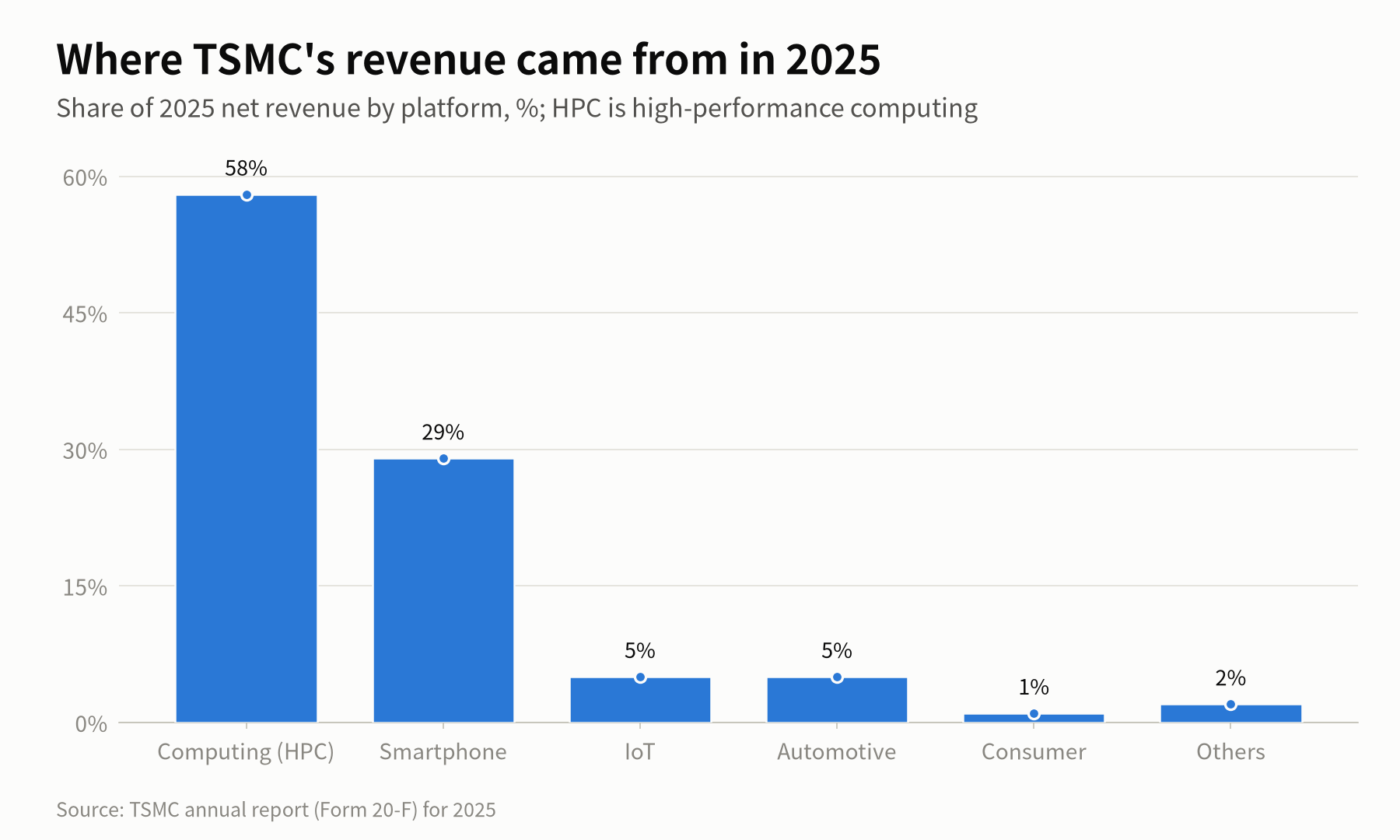
Because a foundry’s customers are the fabless designers and others, its revenue mix follows their products. In 2025, the high-performance computing platform was the largest part.
TSMC is not the only one. UMC, also in Taiwan, describes itself as “an independent semiconductor foundry” whose customers include “fabless design companies, such as MediaTek, Realtek and Novatek.” GlobalFoundries, based in the US, counts itself among “four scaled pure-play foundries,” which it defines as companies that make chips for others, “rather than those of its own design,” with more than US$3 billion of annual foundry revenue. SMIC in China says it provides foundry services on 8-inch and 12-inch wafers.
IDM: design, make and sell
An integrated device manufacturer owns the whole chain. Memory makers are the clearest case, because memory chips depend closely on the manufacturing process:
- Micron lists its own wafer fabs in Taiwan, Singapore, the United States and Japan, and assembly and test sites in Malaysia, China and India.
- SK hynix’s 2025 business report names its plants in Icheon and Cheongju in Korea and in Wuxi, Chongqing and Dalian in China.
- Kioxia describes itself as “one of the largest manufacturers of NAND flash memory,” with its main plant in Yokkaichi, Japan.
SanDisk is a memory maker without fabs of its own: its 10-K says “all of our flash-based memory is obtained from our joint ventures with Kioxia,” which run eight plants in Japan, six in Yokkaichi and two in Kitakami. Who Makes What in Memory covers which companies make DRAM, NAND and HBM.
Where do the labels blur?
Several large chipmakers fit more than one box:
- Samsung Electronics has all three in one division. Its 2025 business report says its Memory business “manufactures and sells DRAM and NAND products,” its System LSI business “designs and sells mobile application processors,” and its Foundry business “is in charge of consignment production of semiconductors.” The report lists a long-term foundry contract with Tesla signed on July 26, 2025, running to December 31, 2033.
- SK hynix, known for memory, also runs a foundry business, according to its business report.
- Intel designs its chips, makes most of them in its own fabs through its Intel Foundry segment, and offers manufacturing to outside customers. Its 10-K also says it has used “third-party foundry manufacturing capacity, including at one of our key foundry competitors, TSMC,” and that “we have been unsuccessful to date in securing any significant external foundry customers for any of our nodes.”
So a company’s label describes its main way of working, not everything it does.
How do packaging and testing fit in?
After a wafer is made, it is cut into chips, packaged and tested. Many companies hand this to an OSAT. ASE Technology of Taiwan calls itself “a leading provider of semiconductor manufacturing services in assembly and testing,” and its annual report says “TSMC designates us as its non-exclusive preferred provider of packaging and testing services.” Foundries and IDMs also package chips themselves; the SIA’s glossary notes that fabless companies “outsource their packaging to the OSATs and/or foundries.”
What the labels mean for reading the news
The model shapes which news moves a company:
- A fabless company depends on its foundry for supply, so foundry capacity and process technology appear in its own filings as risks and plans.
- A foundry depends on its customers’ products; TSMC’s revenue mix in 2025 shows how much of it came from computing.
- An IDM carries its own factories, so its results reflect both demand for its chips and the running of its fabs.
On the Chips map, each company’s daily move sits next to the others, whatever its model. For the US-traded tickers of Asian chipmakers, including TSMC and SK hynix, see What Is an ADR? SKHY, TSM, KXIAY and Asian Chip Stocks.
Sources
- Semiconductors 101: Industry Impact (glossary)
- Global Annual Semiconductor Sales Increase 25.6% to $791.7 Billion in 2025 (February 6, 2026)
- TSMC annual report (Form 20-F) for 2025
- TSMC company profile
- NVIDIA annual report (Form 10-K), fiscal 2026
- AMD annual report (Form 10-K), fiscal 2025
- Qualcomm annual report (Form 10-K), fiscal 2025
- Broadcom annual report (Form 10-K), fiscal 2025
- MediaTek 2025 annual report (English)
- Intel annual report (Form 10-K), fiscal 2025
- Samsung Electronics 2025 business report (English)
- SK hynix 2025 business report (사업보고서), filed March 17, 2026
- Micron annual report (Form 10-K), fiscal 2026
- SanDisk annual report (Form 10-K), fiscal 2026
- About KIOXIA
- UMC annual report (Form 20-F) for 2025
- GlobalFoundries annual report (Form 20-F) for 2025
- SMIC company information
- ASE Technology annual report (Form 20-F) for 2025
- ASML annual report (Form 20-F) for 2025
- About Tokyo Electron
Related reading
More in Explainers
- Chip Stock Heatmap Explained: How to Read the Asia-Pacific Chips MapMarket Map
- Asia Chip Stocks From a US Account: SKHY, TSM, KXIAY and Other TickersExplainers
- Who Makes What in Memory: DRAM, NAND and HBM Across Asia and the USExplainers
- How to Buy Japanese Chip Stocks: Tokyo Shares, OTC ADRs and ETFsGuides
- How to Buy Taiwan Stocks From Abroad: TWSE Shares, TSM and ETFsGuides
- What Do 3nm and 2nm Mean? Chip Process Nodes ExplainedExplainers
- US Chip Export Controls on China, ExplainedExplainers
- What Is CoWoS? TSMC's Advanced Packaging and the AI Chip BottleneckExplainers
- Why Samsung Reports Earnings Twice, and How Other Chipmakers ReportExplainers
- SOXX vs SMH vs SOXQ: How Three Semiconductor ETFs DifferExplainers
- How a Stock Gets Into the S&P 500 and the Nasdaq-100Explainers
- Dow, S&P 500 and Nasdaq: What Each US Stock Index MeasuresExplainers
- US Stock Futures Overnight: What Dow, S&P 500 and Nasdaq Futures ShowExplainers
- One Chip Day, Four Closes: Seoul, Taipei, Tokyo and New YorkExplainers
- Japan's Margin Trading Data: What It Says About KioxiaExplainers
- Kioxia Outside Japan: 285A in Tokyo vs KXIAY Over the CounterExplainers
- Kioxia's 3-for-1 Split: How to Read Its Price HistoryExplainers
- Micron's Fiscal Calendar: Why Its Quarters Don't Match Samsung'sExplainers
- Nikkei 225 vs TOPIX: Why Chip Stocks Move Them So DifferentlyExplainers
- The Philadelphia Semiconductor Index (SOX) and Why Asia Watches ItExplainers
- Taiwan's 10% Daily Price Limit and Other Rules for Foreign InvestorsExplainers
- TSM vs 2330: Why TSMC's US Shares Trade Above TaipeiExplainers
- TSMC's Monthly Sales: How Taiwan's Monthly Revenue Reports WorkExplainers
- Why One Stock Moves Taiwan's Market: TSMC and the TAIEXExplainers
- How Foreign Investors Move the KOSPI, and Where to See the Daily DataExplainers
- How to Buy Korean Stocks in 2026: 4 Routes for US, Singapore, UKGuides
- How to Buy Samsung Stock Outside Korea: Shares, London GDR and ETFsGuides
- Korea Discount and the Value-up Program, Explained SimplyExplainers
- KOSPI Heatmap Explained: How to Read Korea's Market MapMarket Map
- Why MSCI Still Hasn't Upgraded Korea, and What Would Change ItExplainers
- How Samsung and SK hynix Compare in HBMSamsung & SK hynix
- SKHY vs 000660: How the Two Ways to Own SK hynix DifferSamsung & SK hynix
- Why Is the KOSPI So Volatile? Chips, Foreign Money and the WonExplainers