US Chip Export Controls on China, Explained
Since October 2022 the US has limited what advanced chips, chipmaking equipment and, later, high-bandwidth memory can go to China. The rules have changed many times, and China has answered with controls of its own. Here is what they cover as of October 26, 2026, how they reached this point, and what they have meant for chipmakers in the US and Asia.
Since October 2022 the United States has limited which advanced chips and chipmaking tools can be shipped to China, and to which Chinese companies. The rules are written by the Commerce Department’s Bureau of Industry and Security (BIS) in the Export Administration Regulations, and they have been rewritten many times since. China has answered with export controls of its own on minerals used in chips, and with steps aimed at individual US companies.
This explainer sets out what the rules cover as of October 26, 2026, how they got here, and what the companies affected have said in their filings. It describes the rules; it takes no position on them.
What do the US rules control?
Three kinds of items, plus rules about who may receive them:
- Advanced AI chips. The control list entry 3A090 covers chips by a performance measure called total processing performance (TPP), defined as “2 × ‘MacTOPS’ × ‘bit length of the operation’.” A chip is covered if its TPP is 4,800 or more, or 1,600 or more with a “performance density” of 5.92 or more. Computers that contain such chips are covered too (4A090).
- Chipmaking equipment. Certain tools for making advanced chips are controlled under category 3B of the control list, in entries such as 3B001.
- High-bandwidth memory (HBM). Since the December 2024 rule, 3A090.c covers “high bandwidth memory (HBM) having a ‘memory bandwidth density’ greater than 2 gigabytes per second per square millimeter.”
Three mechanisms extend the reach of those lists:
- Foreign direct product (FDP) rules apply US controls to some items made outside the US with US technology or tools. The regulations now include an advanced computing FDP rule and a semiconductor manufacturing equipment FDP rule.
- The Entity List names companies that need a license to receive items subject to the regulations. A December 2024 rule added 140 entities at once.
- “US persons” rules require a license for Americans to support the development or production of advanced-node chips in China, including Macau, and some other countries.
How did the rules develop?
| Date | What happened | Source |
|---|---|---|
| Oct 7, 2022 | First controls on advanced computing chips and chipmaking items, wider FDP reach for 28 listed entities, limits on US persons | 87 FR 62186 |
| Oct 17, 2023 | Updated chip and equipment rules, effective November 17, 2023 | 88 FR 73458, 88 FR 73424 |
| Dec 2, 2024 | HBM controls, more equipment, new FDP rules; 140 entities added to the Entity List | 89 FR 96790, 89 FR 96830 |
| Jan 15, 2025 | “AI Diffusion” rule with country tiers for AI chips | 90 FR 4544 |
| Apr 9, 2025 | License required for Nvidia’s H20 chip for China, by letter to Nvidia | Nvidia 10-Q |
| May 13, 2025 | BIS said it would rescind the AI Diffusion rule and not enforce it | BIS release |
| Aug 2025 | Licenses for some H20 shipments | Nvidia 10-K |
| Aug 29, 2025 | Validated end-user status removed for Samsung’s, SK hynix’s and Intel’s former fabs in China, effective December 31, 2025 | 90 FR 42321 |
| Sep 29, 2025 | Entity List extended to companies at least 50% owned by listed entities (“affiliates rule”) | 90 FR 47201 |
| Nov 12, 2025 | Affiliates rule suspended until November 9, 2026 | 90 FR 50857 |
| Jan 15, 2026 | Case-by-case license review for chips such as Nvidia’s H200 and AMD’s MI325X, with conditions | 91 FR 1684 |
Two details show how unsettled the picture has been. The AI Diffusion rule was never formally withdrawn: BIS said in May 2025 it would publish a rescission and told its enforcement officials “not to enforce,” but the text is still in the regulations as of October 2026. And for the H20 licenses in August 2025, Nvidia’s annual report says US officials “expressed an expectation that the USG will receive 15% or more” of the revenue, but “the USG did not publish a regulation.”
What changed in January 2026?
The January 15, 2026 rule moved license reviews for China “from a presumption of denial to a case-by-case review” for chips with a TPP “less than 21,000” and DRAM bandwidth “less than 6,500 GB/s, such as the NVIDIA H200 or AMD MI325X.” It set conditions: shipments to China and Macau of “no more than 50%” of the volume shipped to US customers, and testing by a third party in the US.
The opening did not lead to large sales. Nvidia said its government granted a license for “small amounts of H200” in February 2026. Its quarterly report of August 26, 2026 said such sales “were restricted by the PRC government,” that it took a US$0.4 billion charge associated with the H200, and that these shipments were less than 1% of its data center revenue.
What has it meant for US chip companies?
The companies’ own filings put numbers on it.
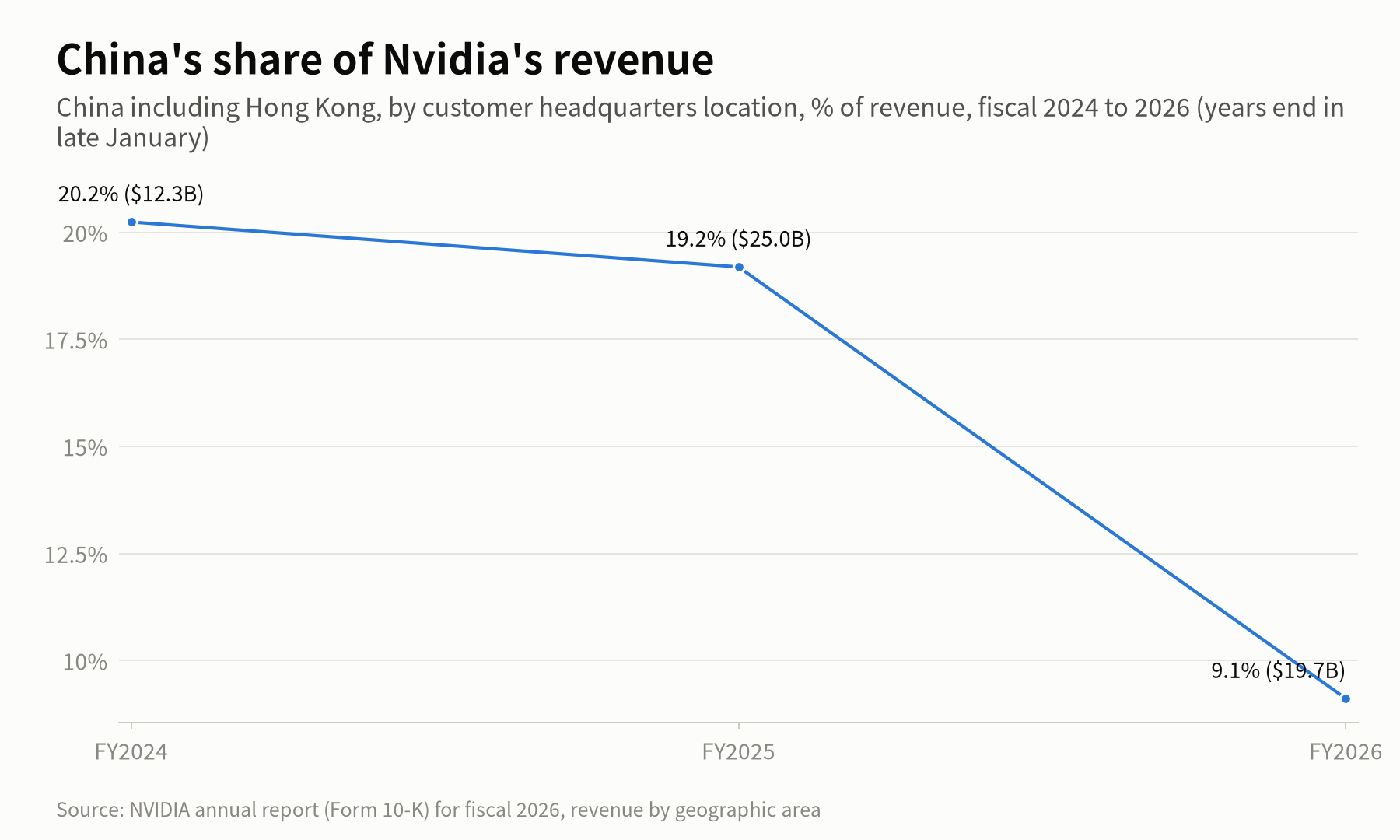
- Nvidia recorded a US$4.5 billion charge in the first quarter of fiscal 2026 related to the H20, when the April 2025 license requirement took effect. By the location of customers’ headquarters, China including Hong Kong was 9.1% of its fiscal 2026 revenue, down from 19.2% a year earlier. Nvidia’s fiscal years end in late January; its 2026 report changed the basis of its geographic figures and restated earlier years.
- AMD said it recorded about US$800 million of charges related to its MI308 chip and later reversed about US$360 million.
- Equipment makers still earned a large share of their revenue in China, according to their latest annual reports: about 30% of Applied Materials’ fiscal 2025 revenue, about 34% of Lam Research’s fiscal 2026 revenue and 29.8% of KLA’s. In February 2026 BIS said Applied Materials agreed to pay about US$252 million over illegal equipment exports, the “second-highest penalty ever” in its words.
What has it meant for Asian chipmakers?
The rules reach Asian companies in two ways: through their factories in China, and through the FDP rules on what they may ship there.
- Samsung and SK hynix. Their memory fabs in China had validated end-user (VEU) status, which let US equipment go to them without separate licenses. That status ended on December 31, 2025. BIS said it “intends to grant export license applications to allow former VEU participants to operate their existing fabs,” but “does not intend to grant licenses to expand capacity or upgrade technology.”
- TSMC. Its 2025 annual report says that although its VEU authorization for its Nanjing fab expired in December 2025, the Commerce Department “has granted TSMC Nanjing… an annual export license.”
- HBM. The December 2024 HBM control covers the memory that SK hynix, Samsung and Micron make for AI chips. Who Makes What in Memory explains HBM and its makers.
Other governments have added rules of their own. The Netherlands has required licenses for some deep ultraviolet (DUV) lithography equipment since September 1, 2023, widened them on September 7, 2024, and added certain measuring and inspection equipment from April 1, 2025. Taiwan added 601 entities to its own strategic high-tech list in June 2025, including Huawei and SMIC.
How has China responded?
China’s Ministry of Commerce (MOFCOM) has put export controls on minerals and materials used in chips and electronics, and other agencies have acted against US companies:
| Date | Measure | Status on October 26, 2026 |
|---|---|---|
| Jul 3, 2023 | Gallium and germanium exports need a license | No suspension found |
| May 21, 2023 | Cyberspace regulator says critical infrastructure operators may not buy Micron products | In force, per Micron’s 2026 annual report |
| Oct 20, 2023 | Graphite export controls | No suspension found |
| Aug 15, 2024 | Antimony export controls | No suspension found |
| Dec 3, 2024 | In principle no licenses for gallium, germanium, antimony and superhard materials to the US | Suspended until November 27, 2026, except for US military users |
| Apr 4, 2025 | Controls on seven medium and heavy rare earths | No suspension found |
| Sep 13, 2025 | Anti-dumping investigation into US analog chips | No ruling found |
| Sep 15, 2025 | Market regulator says a preliminary investigation found Nvidia violated China’s anti-monopoly law | No outcome found |
| Oct 9, 2025 | Wider rare earth and related controls | Suspended until November 10, 2026 |
As of October 26, 2026, no extension of any of the three suspensions (the US affiliates rule and China’s two measures) had been published.
Which dates come next?
- November 9, 2026: the US affiliates rule’s suspension ends “absent a future extension.”
- November 10, 2026: China’s suspension of its October 2025 rare earth measures ends.
- November 27, 2026: China’s suspension of its ban on gallium, germanium, antimony and superhard material exports to the US ends.
Each could be extended, allowed to lapse or replaced. For how the companies involved make chips, and which ones design rather than manufacture, see Foundry, Fabless and IDM. For the packaging behind AI accelerators, see What Is CoWoS?.
Sources
- Implementation of Additional Export Controls: Certain Advanced Computing and Semiconductor Manufacturing Items (87 FR 62186, October 13, 2022)
- Commerce Strengthens Restrictions on Advanced Computing Semiconductors and Semiconductor Manufacturing Equipment (October 17, 2023)
- Foreign-Produced Direct Product Rule Additions, and Refinements to Controls for Advanced Computing and Semiconductor Manufacturing Items (89 FR 96790, December 5, 2024)
- Department of Commerce Announces Rescission of Biden-Era Artificial Intelligence Diffusion Rule (May 13, 2025)
- Department of Commerce Closes Export Controls Loophole for Foreign-Owned Semiconductor Fabs in China (August 29, 2025; 90 FR 42321)
- Expansion of End-User Controls To Cover Affiliates of Certain Listed Entities (90 FR 47201) and its suspension (90 FR 50857, November 12, 2025)
- Department of Commerce Revises License Review Policy for Semiconductors Exported to China (January 13, 2026)
- Revision to License Review Policy for Advanced Computing Commodities (91 FR 1684, January 15, 2026)
- Export Administration Regulations, 15 CFR parts 730-774 (ECCN 3A090, 15 CFR 734.9, 744.6, supplement no. 7 to part 748), as of October 22, 2026
- Applied Materials to Pay $252 Million Penalty (February 12, 2026)
- NVIDIA annual report (Form 10-K), fiscal 2026, and quarterly reports (Form 10-Q) for the first quarter of fiscal 2026 and the second quarter of fiscal 2027
- AMD annual report (Form 10-K), fiscal 2025
- Applied Materials, Lam Research and KLA annual reports (Form 10-K), revenue by geography
- Micron annual report (Form 10-K), fiscal 2026
- TSMC annual report (Form 20-F) for 2025
- The Netherlands expands export control measures for advanced semiconductor manufacturing equipment (September 6, 2024)
- Strategic high-tech commodities entity list update (June 15, 2025)
- MOFCOM announcements on export controls: 2023 No. 23 (gallium, germanium), 2023 No. 39 (graphite), 2024 No. 33 (antimony), 2024 No. 46, 2025 No. 18, Nos. 55-58, 61-62, 70 and 72
- Cybersecurity review conclusion on Micron products (May 21, 2023)
Related reading
More in Explainers
- Chip Stock Heatmap Explained: How to Read the Asia-Pacific Chips MapMarket Map
- Asia Chip Stocks From a US Account: SKHY, TSM, KXIAY and Other TickersExplainers
- Who Makes What in Memory: DRAM, NAND and HBM Across Asia and the USExplainers
- How to Buy Japanese Chip Stocks: Tokyo Shares, OTC ADRs and ETFsGuides
- How to Buy Taiwan Stocks From Abroad: TWSE Shares, TSM and ETFsGuides
- What Do 3nm and 2nm Mean? Chip Process Nodes ExplainedExplainers
- What Is CoWoS? TSMC's Advanced Packaging and the AI Chip BottleneckExplainers
- Foundry, Fabless and IDM: How Chipmakers Split the WorkExplainers
- Why Samsung Reports Earnings Twice, and How Other Chipmakers ReportExplainers
- SOXX vs SMH vs SOXQ: How Three Semiconductor ETFs DifferExplainers
- How a Stock Gets Into the S&P 500 and the Nasdaq-100Explainers
- Dow, S&P 500 and Nasdaq: What Each US Stock Index MeasuresExplainers
- US Stock Futures Overnight: What Dow, S&P 500 and Nasdaq Futures ShowExplainers
- One Chip Day, Four Closes: Seoul, Taipei, Tokyo and New YorkExplainers
- Japan's Margin Trading Data: What It Says About KioxiaExplainers
- Kioxia Outside Japan: 285A in Tokyo vs KXIAY Over the CounterExplainers
- Kioxia's 3-for-1 Split: How to Read Its Price HistoryExplainers
- Micron's Fiscal Calendar: Why Its Quarters Don't Match Samsung'sExplainers
- Nikkei 225 vs TOPIX: Why Chip Stocks Move Them So DifferentlyExplainers
- The Philadelphia Semiconductor Index (SOX) and Why Asia Watches ItExplainers
- Taiwan's 10% Daily Price Limit and Other Rules for Foreign InvestorsExplainers
- TSM vs 2330: Why TSMC's US Shares Trade Above TaipeiExplainers
- TSMC's Monthly Sales: How Taiwan's Monthly Revenue Reports WorkExplainers
- Why One Stock Moves Taiwan's Market: TSMC and the TAIEXExplainers
- How Foreign Investors Move the KOSPI, and Where to See the Daily DataExplainers
- How to Buy Korean Stocks in 2026: 4 Routes for US, Singapore, UKGuides
- How to Buy Samsung Stock Outside Korea: Shares, London GDR and ETFsGuides
- Korea Discount and the Value-up Program, Explained SimplyExplainers
- KOSPI Heatmap Explained: How to Read Korea's Market MapMarket Map
- Why MSCI Still Hasn't Upgraded Korea, and What Would Change ItExplainers
- How Samsung and SK hynix Compare in HBMSamsung & SK hynix
- SKHY vs 000660: How the Two Ways to Own SK hynix DifferSamsung & SK hynix
- Why Is the KOSPI So Volatile? Chips, Foreign Money and the WonExplainers