Japan's Chip Stocks: Who Makes What
Japan's chip stocks are mostly the companies that chipmakers buy from: the machines, the silicon wafers and the chemicals. Only three of the 22 on our Japan map make chips themselves. Here is where each one fits, from its own reports, and when they report this season.
Japan has few companies that make chips, but many that chipmakers depend on. The Japan map on Pacific Tape shows 22 Tokyo-listed chip stocks, taken from Japanese semiconductor indexes and keeping companies whose main business is chips. Nineteen of them sell machines or materials to chipmakers. Only three, Kioxia, Renesas Electronics and Rohm, make chips themselves.
On October 28, 2026, the 22 added up to US$735 billion. Equipment makers were 56% of that, Kioxia 20%, materials suppliers 17%, and Renesas and Rohm 6%.
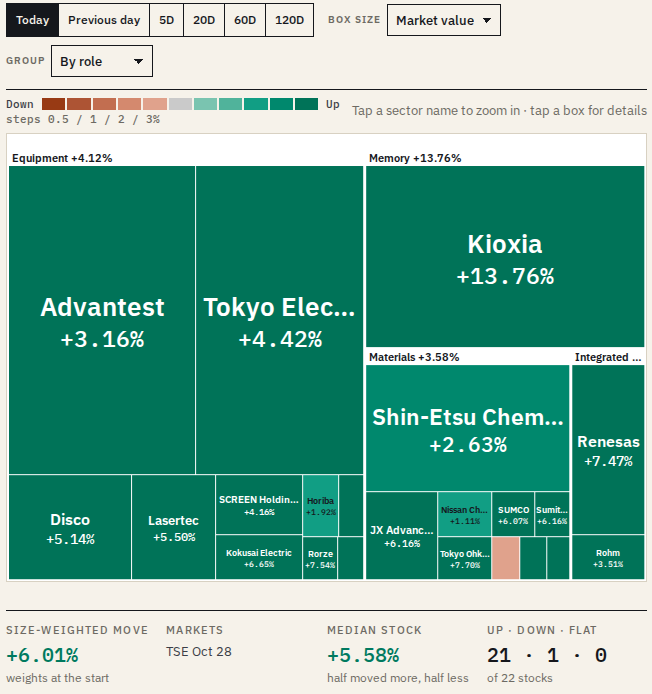
Where does each company fit?
Read across a chip’s life, from the bare wafer to the finished package:
| Stage | What happens | Japan map companies |
|---|---|---|
| Wafers | Pure silicon wafers are made | Shin-Etsu Chemical, SUMCO |
| Patterning | Masks are checked, light-sensitive films are coated and exposed | Lasertec (mask inspection), Tokyo Ohka Kogyo and Shin-Etsu (photoresists), Nissan Chemical (anti-reflective coatings), Tokyo Electron (coat and develop) |
| Building layers | Films are deposited and etched, wafers cleaned | Tokyo Electron, Kokusai Electric, SCREEN Holdings, JX Advanced Metals (sputtering targets for wiring) |
| Inside the tools | Parts and controls that the machines use | Horiba (gas flow control), Rorze (wafer-handling robots), Ferrotec (quartz, ceramics and vacuum seals) |
| Testing on the wafer | Each chip is probed before it is cut | Tokyo Seimitsu, Micronics Japan (probe cards), Advantest (testers) |
| Cutting and packaging | Wafers are thinned and cut, chips sealed and mounted | Disco, Tokyo Seimitsu, Sumitomo Bakelite (molding compounds), Taiyo Holdings (solder resist for circuit boards) |
| Chips | Memory, microcontrollers and power chips | Kioxia, Renesas Electronics, Rohm |
Dexerials, the 22nd, makes adhesive films used to mount chips in displays and camera modules; it has no semiconductor segment of its own.
The equipment makers
The two largest, Advantest and Tokyo Electron, are covered in Chip Equipment Makers: Advantest makes testers, and Tokyo Electron makes deposition, coat-and-develop, etch and cleaning tools. The rest are more specialized:
- Disco sells dicing saws, laser saws, grinders and polishers, and the blades and wheels they use, to cut wafers into chips and thin them. Net sales were ¥436.9 billion in the fiscal year ended March 2026, all in one precision-processing segment.
- Lasertec describes its “EUV mask blank inspection systems” as “regarded as the de facto industry standard.” Sales of semiconductor-related products were ¥168.1 billion of its ¥230.5 billion in the year ended June 2026.
- SCREEN Holdings says it provides “cleaning equipment with the world’s top market share”; its results presentation ranks it first in three kinds of cleaning tools for 2025, based on Gartner data. Semiconductor production equipment was ¥486.0 billion of its ¥605.7 billion in the year ended March 2026.
- Kokusai Electric makes batch deposition tools that process many wafers at once, and says it “achieved the top market share in the batch deposition equipment market in CY25,” from its own calculation on Gartner data.
- Horiba makes mass flow controllers that meter the gases used in deposition and etching, and puts its share at about 60% by its own research. Its Materials & Semiconductor segment had ¥156.5 billion of ¥333.1 billion in 2025.
- Rorze makes the robots and transfer units that move wafers into process and inspection tools; chip-related sales were 83% of the year ended February 2026.
- Tokyo Seimitsu offers “probing machines to test the electrical characteristics of chips on wafers, dicing machines to separate individual chips from wafers, and grinders to make wafers thinner and flatter.”
- Micronics Japan makes probe cards, which it says are “mainly used for memory testing on DRAM and flash memory.”
The materials suppliers
- Shin-Etsu Chemical produces “silicon wafers, a key semiconductor material, as well as photoresists, photomask blanks, and encapsulating materials.” Its electronics materials segment was about 40% of its ¥2.57 trillion in sales in the year ended March 2026.
- SUMCO makes only silicon wafers for chips. Its 2025 net sales were ¥409.7 billion.
- Tokyo Ohka Kogyo (TOK) makes photoresists, the light-sensitive coatings that carry the circuit pattern, and high-purity chemicals. It says it has the top global share in chip photoresists, citing Fuji Chimera Research.
- JX Advanced Metals makes sputtering targets, “used to form wiring within semiconductors,” and cites Fuji Keizai for a global share of about 64%.
- Nissan Chemical makes anti-reflective coatings for lithography under license from Brewer Science, and underlayers for EUV resists.
- Sumitomo Bakelite makes the epoxy compounds that seal chips in their packages, and puts its share at around 40% by in-house research.
- Taiyo Holdings makes solder resist, the protective ink on circuit boards. Its board backed a tender offer by a KKR-backed company in March 2026, which Taiyo said on October 9 is expected to start around late November 2026.
- Ferrotec supplies quartz, ceramics, vacuum seals and other parts for chip equipment, about ¥185.1 billion of its ¥288.9 billion in sales in the year ended March 2026.
The chipmakers
Kioxia makes NAND flash memory. “Kioxia invented NAND flash memory in 1987,” it says, and it runs its Yokkaichi and Kitakami plants jointly with Sandisk. Revenue was ¥2.34 trillion in the year ended March 2026. Kioxia Outside Japan covers its Tokyo shares and US receipts, and Who Makes What in Memory puts it next to Samsung Electronics, SK hynix, Micron and Sandisk.
Renesas Electronics “mainly supplies MCUs (microcontrollers), SoC (System-On-Chip), analog semiconductor devices and power semiconductor devices.” Its 2025 revenue was ¥1.32 trillion, about half from cars. Rohm “focuses primarily on power and analog semiconductors,” and cars are its largest market; it posted a net loss of ¥158.4 billion in the year ended March 2026 after write-downs in its silicon carbide business.
When do they report?
Most of the 22 end their fiscal year in March and report July-to-September results from late October to mid-November. The exceptions: Horiba, Micronics Japan, Tokyo Ohka Kogyo, SUMCO and Renesas end in December, Lasertec in June, and Rorze in February, while Ferrotec is moving its year-end from March to December. Dates the companies have posted for this season:
| Date | Company |
|---|---|
| October 29 | Renesas Electronics |
| October 30 | Tokyo Electron, SCREEN Holdings, Kioxia |
| November 4 | Tokyo Seimitsu, Sumitomo Bakelite |
| November 5 | Rohm |
| November 6 | Taiyo Holdings |
| November 9 | JX Advanced Metals, Nissan Chemical |
| November 10 | Tokyo Ohka Kogyo |
| November 12 | Micronics Japan |
| November 16 | Ferrotec |
Disco (October 22), Shin-Etsu Chemical (October 27) and Advantest (October 28) had already reported.
How do these stocks fit with the indexes?
Advantest and Tokyo Electron made up about 21% of the Nikkei 225 on September 30, 2026, but about 4% of TOPIX, so chip stocks move the two indexes very differently; Nikkei 225 vs TOPIX explains the difference. For buying them from outside Japan, see How to Buy Japanese Chip Stocks.
Sources
- What kind of company is DISCO?
- Company profile (November 2025)
- Group Profile 2025
- Consolidated financial report, fiscal year ended March 31, 2026 (May 13, 2026)
- Financial briefing, fiscal year ended March 2026 (May 13, 2026)
- FY2025 results summary (February 17, 2026)
- FY2025 financial briefing (April 9, 2026)
- Integrated Report 2025
- Company overview
- Annual Report 2026, At a Glance
- Consolidated financial results, fiscal year ended March 2026 (April 28, 2026)
- Product lineup
- Integrated Report 2025
- TOK at a glance
- Integrated Report 2026
- Financial results, fiscal year ended March 2026 (May 11, 2026)
- Notice on the tender offer schedule (October 9, 2026)
- Integrated Report 2025
- Annual Securities Report, fiscal 2025
- Earnings report, year ended December 31, 2025
- Financial results, fiscal year ended March 2026
Related reading
More in Explainers
- Chip Stock Heatmap Explained: How to Read the Asia-Pacific Chips MapMarket Map
- Asia Chip Stocks From a US Account: SKHY, TSM, KXIAY and Other TickersExplainers
- Who Makes What in Memory: DRAM, NAND and HBM Across Asia and the USExplainers
- Samsung vs SK hynix: How Korea's Two Memory Giants DifferSamsung & SK hynix
- TSMC in Japan: What Is JASM, the Kumamoto Chip Plant?Explainers
- What Is HBM? High-Bandwidth Memory vs DRAM, HBM3E and HBM4Explainers
- SOXL and SOXS Explained: 3x Leveraged and Inverse Chip ETFsExplainers
- Custom AI Chips Explained: Google TPU, Amazon Trainium and ASICsExplainers
- Where Japan Fits in the Chip Supply Chain, Next to Taiwan and KoreaExplainers
- Taiwan's Chip Stocks: Who Makes WhatExplainers
- What Samsung Electronics Makes: Chips, Phones, Displays and MoreSamsung & SK hynix
- Why Nvidia's Earnings Move Memory StocksExplainers
- Chip Equipment Makers: ASML, Applied, Lam, KLA and Tokyo ElectronExplainers
- SOX Heatmap Explained: How to Read the US Chip Index MapMarket Map
- Memory Stock Map Explained: DRAM, NAND and HBM Makers in One ViewMarket Map
- S&P 500 Heatmap Explained: How to Read the US Market MapMarket Map
- How to Buy Japanese Chip Stocks: Tokyo Shares, OTC ADRs and ETFsGuides
- How to Buy Taiwan Stocks From Abroad: TWSE Shares, TSM and ETFsGuides
- What Do 3nm and 2nm Mean? Chip Process Nodes ExplainedExplainers
- US Chip Export Controls on China, ExplainedExplainers
- What Is CoWoS? TSMC's Advanced Packaging and the AI Chip BottleneckExplainers
- Foundry, Fabless and IDM: How Chipmakers Split the WorkExplainers
- Why Samsung Reports Earnings Twice, and How Other Chipmakers ReportSamsung & SK hynix
- SOXX vs SMH vs SOXQ: How Three Semiconductor ETFs DifferExplainers
- How a Stock Gets Into the S&P 500 and the Nasdaq-100Explainers
- Dow, S&P 500 and Nasdaq: What Each US Stock Index MeasuresExplainers
- US Stock Futures Overnight: What Dow, S&P 500 and Nasdaq Futures ShowExplainers
- One Chip Day, Four Closes: Seoul, Taipei, Tokyo and New YorkExplainers
- Japan's Margin Trading Data: What It Says About KioxiaExplainers
- Kioxia Outside Japan: 285A in Tokyo vs KXIAY Over the CounterExplainers
- Kioxia's 3-for-1 Split: How to Read Its Price HistoryExplainers
- Micron's Fiscal Calendar: Why Its Quarters Don't Match Samsung'sExplainers
- Nikkei 225 vs TOPIX: Why Chip Stocks Move Them So DifferentlyExplainers
- The Philadelphia Semiconductor Index (SOX) and Why Asia Watches ItExplainers
- Taiwan's 10% Daily Price Limit and Other Rules for Foreign InvestorsExplainers
- TSM vs 2330: Why TSMC's US Shares Trade Above TaipeiExplainers
- TSMC's Monthly Sales: How Taiwan's Monthly Revenue Reports WorkExplainers
- Why One Stock Moves Taiwan's Market: TSMC and the TAIEXExplainers
- How Foreign Investors Move the KOSPI, and Where to See the Daily DataExplainers
- How to Buy Korean Stocks in 2026: 4 Routes for US, Singapore, UKGuides
- How to Buy Samsung Stock Outside Korea: Shares, London GDR and ETFsGuides
- Korea Discount and the Value-up Program, Explained SimplyExplainers
- KOSPI Heatmap Explained: How to Read Korea's Market MapMarket Map
- Why MSCI Still Hasn't Upgraded Korea, and What Would Change ItExplainers
- How Samsung and SK hynix Compare in HBMSamsung & SK hynix
- SKHY vs 000660: How the Two Ways to Own SK hynix DifferSamsung & SK hynix
- Why Is the KOSPI So Volatile? Chips, Foreign Money and the WonExplainers