Why Nvidia's Earnings Move Memory Stocks
Nvidia reports after the US close, which is before dawn in Seoul. So SK hynix and Samsung Electronics trade on Nvidia's numbers hours before Nvidia's own shares do in a regular session. Here is why the memory makers watch it, when it reports, and what their shares did after the last 12 reports.
Nvidia does not make memory, but it buys a great deal of it. Its AI accelerators carry high-bandwidth memory (HBM), stacks of DRAM chips, and Nvidia’s annual report names the companies it buys memory from: SK hynix, Micron Technology and Samsung. So when Nvidia reports, investors in those three read the numbers for what they say about memory demand.
How big is Nvidia’s memory bill?
Nvidia does not break out what it pays each supplier, but its filings show the scale. In the quarter ended July 26, 2026, data center products brought in $89.0 billion of its $96.2 billion revenue, or 92.5%. Its supply commitments grew “from $119 billion last quarter to $279 billion,” the company said, “primarily related to the procurement of memory.” The annual report adds that “to secure future supply and capacity, we have paid premiums, provided deposits, and entered into long-term supply agreements.”
The memory makers say the same from their side:
| Company | What it has said about Nvidia |
|---|---|
| SK hynix | “SK hynix’s HBM4 is slated to be adopted in NVIDIA’s next-generation Rubin platform” (March 17, 2026); a multiyear technology partnership with Nvidia was announced June 7, 2026 |
| Samsung Electronics | Began “the industry’s first mass product sales of HBM4 and SOCAMM2 for NVIDIA’s Vera Rubin platform” (April 30, 2026) |
| Micron | Its 12-high HBM3E “is also designed into” Nvidia’s GB300 NVL72 and HGX B300 platforms (March 18, 2025) |
None of the three discloses how much of its revenue comes from Nvidia. Micron’s annual report says no customer reached 10% of its revenue in fiscal 2026, after one customer was 17% in fiscal 2025, without naming either. How Samsung and SK hynix Compare in HBM covers the two Korean makers’ HBM businesses.
When does Nvidia report?
Nvidia’s fiscal year ends on the last Sunday of January, so its fiscal 2027 runs from January 26, 2026 to January 31, 2027, a 53-week year. Its quarters end in late April, July, October and January, and it has reported about three to five weeks later:
| Quarter ended | Reported (US Eastern date) |
|---|---|
| Late April | Late May (May 20, 2026) |
| Late July | Late August (August 26, 2026) |
| Late October | Third week of November (November 19, 2025) |
| Late January | Late February (February 25, 2026) |
Nvidia’s investor-relations site lists the results for its third fiscal quarter, which ends in late October, for November 17, 2026. The memory makers keep different calendars: Samsung and SK hynix use calendar quarters, and Micron’s fiscal year ends in late August or early September, as Micron’s Fiscal Calendar explains.
Why do Asian memory stocks trade on it first?
Nvidia releases results after the US close: in the last 12 quarters its filings reached the SEC between 4:20 and 4:31 p.m. New York time. That is about 5 or 6 a.m. the next morning in Seoul and Tokyo, depending on US daylight saving time. Nvidia’s shares can trade after hours in the US, but the Korea Exchange opens at 9 a.m. with the results already out, hours before Nvidia’s next regular session. So the first full session to react is in Seoul.
What did memory stocks do after the last 12 reports?
The table shows each stock’s move in its first regular session after the report: the next KRX session for SK hynix and Samsung, and the next US session for Micron and Nvidia.
| Nvidia quarter | Reported | SK hynix | Samsung | Micron | Nvidia |
|---|---|---|---|---|---|
| Q3 FY24 | Nov 21, 2023 | −0.53% | 0.00% | +0.50% | −2.47% |
| Q4 FY24 | Feb 21, 2024 | +5.03% | +0.14% | +5.42% | +16.39% |
| Q1 FY25 | May 22, 2024 | +1.16% | +0.77% | −0.01% | +9.32% |
| Q2 FY25 | Aug 28, 2024 | −5.35% | −3.14% | +0.75% | −6.38% |
| Q3 FY25 | Nov 20, 2024 | −1.06% | +1.99% | +4.47% | +0.54% |
| Q4 FY25 | Feb 26, 2025 | −1.87% | −0.53% | −6.03% | −8.48% |
| Q1 FY26 | May 28, 2025 | +1.92% | +0.36% | +0.65% | +3.25% |
| Q2 FY26 | Aug 27, 2025 | +3.27% | −1.42% | +3.62% | −0.79% |
| Q3 FY26 | Nov 19, 2025 | +1.60% | +4.25% | −10.87% | −3.15% |
| Q4 FY26 | Feb 25, 2026 | +7.96% | +7.13% | −3.13% | −5.45% |
| Q1 FY27 | May 20, 2026 | +11.17% | +8.51% | +4.11% | −1.77% |
| Q2 FY27 | Aug 26, 2026 | +2.49% | +1.72% | −0.32% | +8.74% |
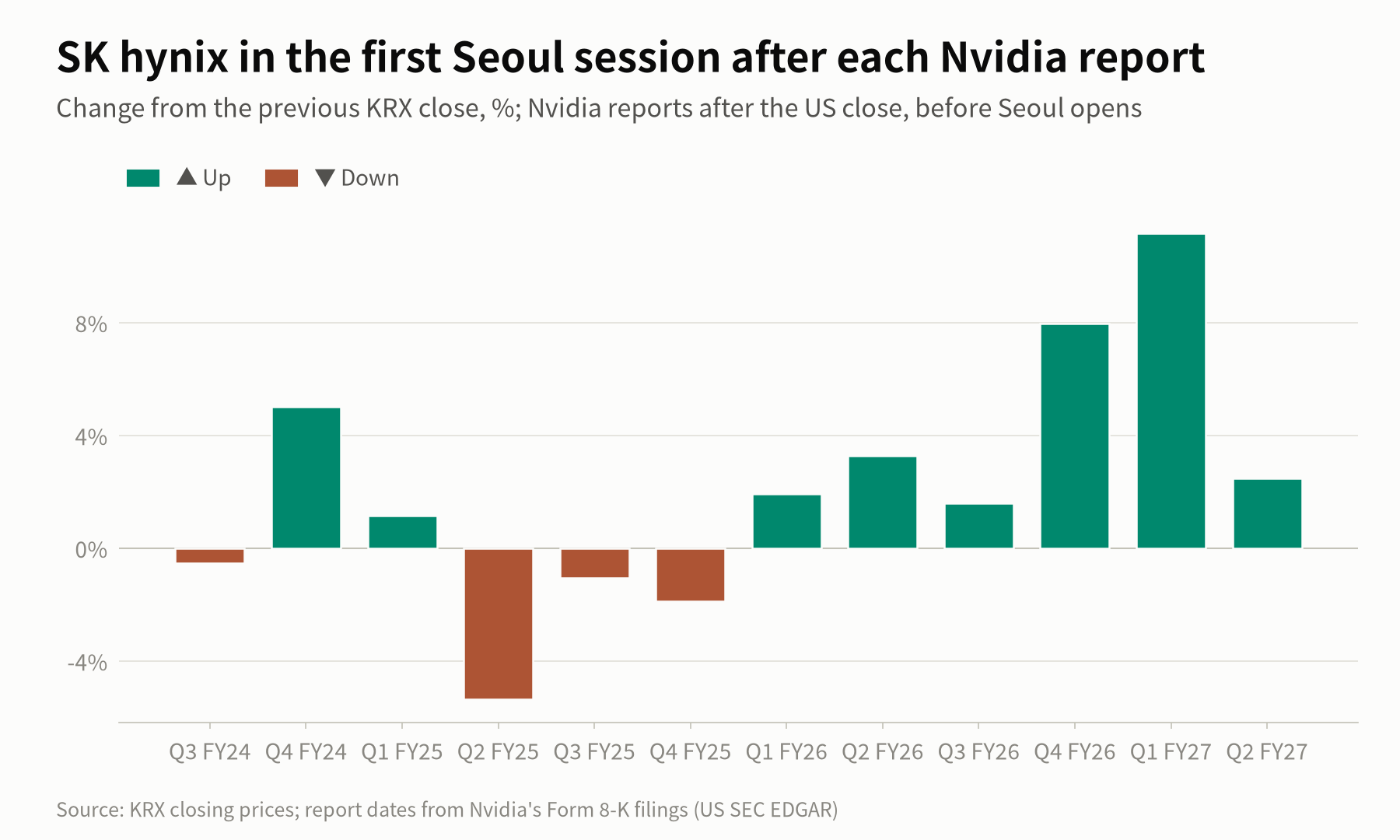
A few things stand out:
- SK hynix rose after 8 of the 12 reports, including the last 6. Samsung rose after 8 and Micron after 7.
- The memory stocks often went the other way from Nvidia. After the four reports from August 2025 to May 2026, Nvidia fell in its next regular session each time, while SK hynix rose each time, by 1.60% to 11.17%. Over all 12, SK hynix moved the same way as Nvidia’s next session 7 times, Samsung 8 times and Micron 6 times.
- Big Nvidia moves did not carry over evenly. After the February 2024 report, Nvidia rose 16.39% and SK hynix 5.03%, but Samsung only 0.14%.
These are single sessions, and each stock had its own news on those days; the moves show timing, not cause. SK hynix’s and Samsung’s sessions also come before Nvidia’s, so they trade on the report and on the after-hours reaction, not on Nvidia’s regular-session close.
What should a reader take from it?
That Nvidia’s report is one of the few scheduled events that the memory makers’ investors all watch, because Nvidia is a large and named buyer of all three. It does not say which way they will move. For who makes DRAM, NAND and HBM, see Who Makes What in Memory; for how the US chip index weighs Nvidia against the memory makers, see the SOX heatmap explainer.
Sources
- NVIDIA annual report (Form 10-K) for fiscal 2026
- NVIDIA quarterly report (Form 10-Q) for the quarter ended July 26, 2026
- NVIDIA Announces Financial Results for Second Quarter Fiscal 2027 (August 26, 2026)
- NVIDIA company filings (Form 8-K earnings dates)
- NVIDIA 3rd Quarter FY27 Financial Results (event listing)
- NVIDIA and SK hynix Announce Multiyear Technology Partnership to Advance Memory for AI Factories (June 7, 2026)
- GTC 2026 (March 17, 2026)
- Samsung Electronics Announces First Quarter 2026 Results (April 30, 2026)
- Micron Innovates From the Data Center to the Edge With NVIDIA (March 18, 2025)
- Micron annual report (Form 10-K) for fiscal 2026
Related reading
More in Explainers
- Chip Stock Heatmap Explained: How to Read the Asia-Pacific Chips MapMarket Map
- Asia Chip Stocks From a US Account: SKHY, TSM, KXIAY and Other TickersExplainers
- Who Makes What in Memory: DRAM, NAND and HBM Across Asia and the USExplainers
- Samsung vs SK hynix: How Korea's Two Memory Giants DifferSamsung & SK hynix
- TSMC in Japan: What Is JASM, the Kumamoto Chip Plant?Explainers
- What Is HBM? High-Bandwidth Memory vs DRAM, HBM3E and HBM4Explainers
- SOXL and SOXS Explained: 3x Leveraged and Inverse Chip ETFsExplainers
- Custom AI Chips Explained: Google TPU, Amazon Trainium and ASICsExplainers
- Where Japan Fits in the Chip Supply Chain, Next to Taiwan and KoreaExplainers
- Taiwan's Chip Stocks: Who Makes WhatExplainers
- What Samsung Electronics Makes: Chips, Phones, Displays and MoreSamsung & SK hynix
- Japan's Chip Stocks: Who Makes WhatExplainers
- Chip Equipment Makers: ASML, Applied, Lam, KLA and Tokyo ElectronExplainers
- SOX Heatmap Explained: How to Read the US Chip Index MapMarket Map
- Memory Stock Map Explained: DRAM, NAND and HBM Makers in One ViewMarket Map
- S&P 500 Heatmap Explained: How to Read the US Market MapMarket Map
- How to Buy Japanese Chip Stocks: Tokyo Shares, OTC ADRs and ETFsGuides
- How to Buy Taiwan Stocks From Abroad: TWSE Shares, TSM and ETFsGuides
- What Do 3nm and 2nm Mean? Chip Process Nodes ExplainedExplainers
- US Chip Export Controls on China, ExplainedExplainers
- What Is CoWoS? TSMC's Advanced Packaging and the AI Chip BottleneckExplainers
- Foundry, Fabless and IDM: How Chipmakers Split the WorkExplainers
- Why Samsung Reports Earnings Twice, and How Other Chipmakers ReportSamsung & SK hynix
- SOXX vs SMH vs SOXQ: How Three Semiconductor ETFs DifferExplainers
- How a Stock Gets Into the S&P 500 and the Nasdaq-100Explainers
- Dow, S&P 500 and Nasdaq: What Each US Stock Index MeasuresExplainers
- US Stock Futures Overnight: What Dow, S&P 500 and Nasdaq Futures ShowExplainers
- One Chip Day, Four Closes: Seoul, Taipei, Tokyo and New YorkExplainers
- Japan's Margin Trading Data: What It Says About KioxiaExplainers
- Kioxia Outside Japan: 285A in Tokyo vs KXIAY Over the CounterExplainers
- Kioxia's 3-for-1 Split: How to Read Its Price HistoryExplainers
- Micron's Fiscal Calendar: Why Its Quarters Don't Match Samsung'sExplainers
- Nikkei 225 vs TOPIX: Why Chip Stocks Move Them So DifferentlyExplainers
- The Philadelphia Semiconductor Index (SOX) and Why Asia Watches ItExplainers
- Taiwan's 10% Daily Price Limit and Other Rules for Foreign InvestorsExplainers
- TSM vs 2330: Why TSMC's US Shares Trade Above TaipeiExplainers
- TSMC's Monthly Sales: How Taiwan's Monthly Revenue Reports WorkExplainers
- Why One Stock Moves Taiwan's Market: TSMC and the TAIEXExplainers
- How Foreign Investors Move the KOSPI, and Where to See the Daily DataExplainers
- How to Buy Korean Stocks in 2026: 4 Routes for US, Singapore, UKGuides
- How to Buy Samsung Stock Outside Korea: Shares, London GDR and ETFsGuides
- Korea Discount and the Value-up Program, Explained SimplyExplainers
- KOSPI Heatmap Explained: How to Read Korea's Market MapMarket Map
- Why MSCI Still Hasn't Upgraded Korea, and What Would Change ItExplainers
- How Samsung and SK hynix Compare in HBMSamsung & SK hynix
- SKHY vs 000660: How the Two Ways to Own SK hynix DifferSamsung & SK hynix
- Why Is the KOSPI So Volatile? Chips, Foreign Money and the WonExplainers