Taiwan's Chip Stocks: Who Makes What
Taiwan's chip stocks are built around making chips for other companies. TSMC alone is more than three-quarters of our Taiwan map, but around it sit chip designers, a second tier of foundries, the world's largest packaging house and memory makers. Here is where each of the 20 fits, from their own reports.
Taiwan is where much of the world’s chipmaking is done for someone else. TSMC, which makes chips designed by other companies, is the biggest example, but the Taiwan map on Pacific Tape shows 20 chip stocks, and most of the rest also earn their living from one step of that work: designing chips for foundries to make, packaging and testing them, or making memory.
On October 29, 2026, using that day’s preliminary closes, the 20 added up to about US$2.5 trillion. TSMC alone was 77% of it. By role, foundries were 79%, chip designers 11%, packaging and test houses 5%, memory companies 4% and the one equipment maker 1%.
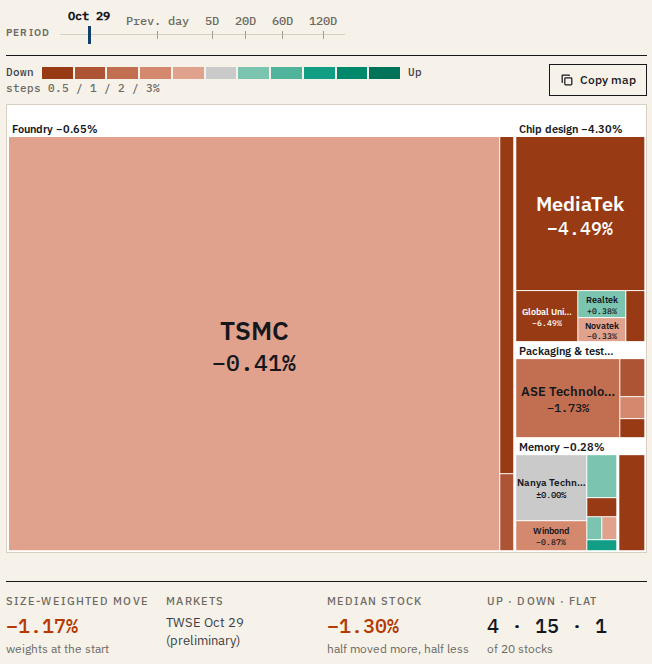
Where does each company fit?
| Role | Companies | What they do |
|---|---|---|
| Foundry | TSMC, UMC, Powerchip (PSMC) | Make chips designed by other companies |
| Chip design | MediaTek, Realtek, Novatek | Design their own chips and have foundries make them |
| Custom chip design | Global Unichip (GUC), Alchip | Design chips for other companies, often for AI and data centers |
| Packaging and test | ASE, King Yuan (KYEC), Powertech (PTI) | Package and test chips after they leave the foundry |
| Test tools | WinWay, Hon Precision | Sockets, probe cards and handlers used in chip testing |
| Memory chips | Nanya, Winbond, Macronix | Make DRAM or flash memory in their own fabs |
| Memory products | Phison, Transcend, ADATA, Innodisk | Flash controllers, and modules and drives built from bought chips |
Foundry, Fabless and IDM explains the business models behind the first rows.
The foundries
TSMC describes the model in its annual report: “As a foundry, we manufacture semiconductors using our manufacturing processes for our customers based on proprietary integrated circuit designs provided by them.” Its 2025 revenue was NT$3.81 trillion, and high-performance computing was 58% of it. Its US-listed shares, its monthly sales and its advanced packaging have their own explainers: TSM vs 2330, TSMC’s monthly revenue and What Is CoWoS?
UMC calls itself “one of the world’s largest independent semiconductor foundries,” focused on mature and specialty processes. In 2025, 28-nanometer wafers were 36.8% of its wafer sales and nothing came from 14nm or below. It names customers including Texas Instruments, Intel, MediaTek, Realtek and Novatek. Revenue was NT$237.6 billion.
Powerchip (PSMC) provides “12-inch and 8-inch wafer specialized foundry services, including specialty logic application products and memory products foundry services”: it makes DRAM and flash wafers for chip design companies, not memory under its own brand. Specialty logic was 61% of its 2025 revenue of NT$46.7 billion and memory 39%. It is transferring its Tongluo P5 fab to Micron in phases.
The chip designers
MediaTek describes itself as “a global leader in fabless semiconductor design.” It buys wafers “primarily” from foundries including TSMC, UMC and GlobalFoundries. Its 2025 revenue was NT$596.0 billion; in the fourth quarter of 2025, mobile phone chips were 59% of revenue. On its call for that quarter it said it was “very confident in achieving data center ASIC revenue of more than 1 billion US dollars in 2026.”
Realtek designs chips for wired and wireless networking, PC peripherals, consumer multimedia and cars, made by foundries including TSMC and UMC. Its 2025 revenue was NT$122.7 billion. Novatek sells display driver chips and system-on-chips; display drivers were 62.9% of its NT$100.7 billion revenue in 2025, and it calls itself, citing Omdia, “the world’s second-largest supplier of display driver ICs.”
Global Unichip (GUC) and Alchip design chips on order for other companies, the custom chips known as ASICs, and arrange their manufacturing. GUC says it works “closely with TSMC,” which is its largest shareholder with 34.84% of its shares; about 91% of GUC’s 2025 purchases came from TSMC. Its revenue was NT$34.1 billion, and North American customers were 68% of it. Alchip, incorporated in the Cayman Islands, describes itself as an ASIC service company “specializing in High-Performance Computing (HPC) and AI” infrastructure; US customers were 77.9% of its NT$30.9 billion revenue in 2025.
The packaging and test houses
ASE Technology Holding was formed in 2018 by combining Advanced Semiconductor Engineering and Siliconware Precision Industries (SPIL). Citing Gartner and Prismark, it says it “ranks as the world’s No. 1 pure-play provider of assembly and test services.” It also builds electronics for other companies through USI. Its 2025 revenue was NT$645.4 billion, of which packaging was NT$308.3 billion and testing NT$71.9 billion, and its shares also trade in New York as ASX.
King Yuan Electronics (KYEC) is mainly a test house: integrated circuit testing was 66.4% and wafer testing 30.6% of its NT$34.9 billion revenue in 2025. Powertech Technology (PTI) packages and tests chips and says it started in memory before extending into logic; packaging was 61.8% of its NT$74.9 billion revenue.
Two make the tools used in testing. WinWay sells test sockets, probe cards and other “semiconductor test interfaces”; its 2025 revenue was NT$7.9 billion. Hon Precision makes “IC test and sorting equipment,” including handlers for testing AI and server processors, and listed on the Taiwan Stock Exchange on November 27, 2025. Its 2025 revenue more than doubled to NT$30.3 billion, and AI, high-performance computing and ASIC chips were 72% of its 2025 orders.
The memory companies
Three make memory chips in their own fabs:
- Nanya Technology makes DRAM; its 2025 revenue nearly doubled to NT$66.6 billion. Companies of the Formosa Plastics group own more than half of it, led by Nan Ya Plastics with 29.28%. In April 2026 it sold new shares to SanDisk, Kioxia, Solidigm and Cisco.
- Winbond makes code-storage flash and customized DRAM in its own fabs; its subsidiary Nuvoton, which designs logic chips, was 34% of Winbond’s NT$89.4 billion revenue in 2025.
- Macronix makes NOR flash, NAND flash and ROM in its own fabs in Hsinchu; flash was 77.6% of its NT$28.9 billion revenue.
Four sell memory products without making the memory chips:
- Phison designs flash memory controllers, has them made by UMC and TSMC, and buys NAND from Kioxia, Micron and SK hynix for the drives and modules it sells. Kioxia is its largest shareholder, with 8.97%.
- Transcend, ADATA and Innodisk buy DRAM and flash chips and build memory modules, SSDs and other storage products; Innodisk focuses on industrial uses.
For how these fit beside Samsung Electronics, SK hynix, Micron and Kioxia, see Who Makes What in Memory.
Where do they trade, and what do they publish?
Seventeen of the 20 trade on the Taiwan Stock Exchange; ADATA, Phison and Innodisk trade on the Taipei Exchange (TPEx). Only three also have US listings: TSMC (TSM), UMC (UMC) and ASE (ASX), all on the New York Stock Exchange. All publish monthly revenue, because Article 36 of Taiwan’s Securities and Exchange Act requires listed companies to report the previous month’s operating figures “within the first ten days of each calendar month.” Taiwan stocks also trade within a daily price limit, explained in Taiwan’s daily price limit.
How does Taiwan compare with Japan?
The two maps barely overlap. Japan’s chip stocks are mostly the machines and materials that chipmakers buy, as Japan’s Chip Stocks: Who Makes What shows, while Taiwan’s are mostly the companies that make, package and test the chips. For buying them from outside Taiwan, see How to Buy Taiwan Stocks From Abroad.
Sources
- TSMC annual report (Form 20-F) for 2025
- UMC annual report (Form 20-F) for 2025
- ASE Technology Holding annual report (Form 20-F) for 2025
- MediaTek 2025 annual report
- MediaTek fourth quarter 2025 investor conference presentation (February 4, 2026)
- Annual reports of Taiwan-listed companies, 2025 (PSMC, GUC, Realtek, Novatek, Alchip, KYEC, Powertech, WinWay, Macronix, Phison, ADATA, Innodisk, Hon Precision)
- Nanya Technology 2025 annual report
- Winbond 2025 annual report
- Transcend 2025 annual report
- Hon Precision consolidated financial statements, 2025
- Listed company basic data (OpenAPI t187ap03_L)
- OTC company basic data (OpenAPI)
- Securities and Exchange Act, Article 36
Related reading
More in Explainers
- Chip Stock Heatmap Explained: How to Read the Asia-Pacific Chips MapMarket Map
- Asia Chip Stocks From a US Account: SKHY, TSM, KXIAY and Other TickersExplainers
- Who Makes What in Memory: DRAM, NAND and HBM Across Asia and the USExplainers
- Samsung vs SK hynix: How Korea's Two Memory Giants DifferSamsung & SK hynix
- TSMC in Japan: What Is JASM, the Kumamoto Chip Plant?Explainers
- What Is HBM? High-Bandwidth Memory vs DRAM, HBM3E and HBM4Explainers
- SOXL and SOXS Explained: 3x Leveraged and Inverse Chip ETFsExplainers
- Custom AI Chips Explained: Google TPU, Amazon Trainium and ASICsExplainers
- Where Japan Fits in the Chip Supply Chain, Next to Taiwan and KoreaExplainers
- What Samsung Electronics Makes: Chips, Phones, Displays and MoreSamsung & SK hynix
- Japan's Chip Stocks: Who Makes WhatExplainers
- Why Nvidia's Earnings Move Memory StocksExplainers
- Chip Equipment Makers: ASML, Applied, Lam, KLA and Tokyo ElectronExplainers
- SOX Heatmap Explained: How to Read the US Chip Index MapMarket Map
- Memory Stock Map Explained: DRAM, NAND and HBM Makers in One ViewMarket Map
- S&P 500 Heatmap Explained: How to Read the US Market MapMarket Map
- How to Buy Japanese Chip Stocks: Tokyo Shares, OTC ADRs and ETFsGuides
- How to Buy Taiwan Stocks From Abroad: TWSE Shares, TSM and ETFsGuides
- What Do 3nm and 2nm Mean? Chip Process Nodes ExplainedExplainers
- US Chip Export Controls on China, ExplainedExplainers
- What Is CoWoS? TSMC's Advanced Packaging and the AI Chip BottleneckExplainers
- Foundry, Fabless and IDM: How Chipmakers Split the WorkExplainers
- Why Samsung Reports Earnings Twice, and How Other Chipmakers ReportSamsung & SK hynix
- SOXX vs SMH vs SOXQ: How Three Semiconductor ETFs DifferExplainers
- How a Stock Gets Into the S&P 500 and the Nasdaq-100Explainers
- Dow, S&P 500 and Nasdaq: What Each US Stock Index MeasuresExplainers
- US Stock Futures Overnight: What Dow, S&P 500 and Nasdaq Futures ShowExplainers
- One Chip Day, Four Closes: Seoul, Taipei, Tokyo and New YorkExplainers
- Japan's Margin Trading Data: What It Says About KioxiaExplainers
- Kioxia Outside Japan: 285A in Tokyo vs KXIAY Over the CounterExplainers
- Kioxia's 3-for-1 Split: How to Read Its Price HistoryExplainers
- Micron's Fiscal Calendar: Why Its Quarters Don't Match Samsung'sExplainers
- Nikkei 225 vs TOPIX: Why Chip Stocks Move Them So DifferentlyExplainers
- The Philadelphia Semiconductor Index (SOX) and Why Asia Watches ItExplainers
- Taiwan's 10% Daily Price Limit and Other Rules for Foreign InvestorsExplainers
- TSM vs 2330: Why TSMC's US Shares Trade Above TaipeiExplainers
- TSMC's Monthly Sales: How Taiwan's Monthly Revenue Reports WorkExplainers
- Why One Stock Moves Taiwan's Market: TSMC and the TAIEXExplainers
- How Foreign Investors Move the KOSPI, and Where to See the Daily DataExplainers
- How to Buy Korean Stocks in 2026: 4 Routes for US, Singapore, UKGuides
- How to Buy Samsung Stock Outside Korea: Shares, London GDR and ETFsGuides
- Korea Discount and the Value-up Program, Explained SimplyExplainers
- KOSPI Heatmap Explained: How to Read Korea's Market MapMarket Map
- Why MSCI Still Hasn't Upgraded Korea, and What Would Change ItExplainers
- How Samsung and SK hynix Compare in HBMSamsung & SK hynix
- SKHY vs 000660: How the Two Ways to Own SK hynix DifferSamsung & SK hynix
- Why Is the KOSPI So Volatile? Chips, Foreign Money and the WonExplainers