What Samsung Electronics Makes: Chips, Phones, Displays and More
Samsung Electronics is one company with four businesses: semiconductors, phones and home electronics, displays, and the car-tech maker Harman. In the third quarter of 2026 almost all of its profit came from chips. Here is what each business makes and how much each contributes, from Samsung's own reports.
“Samsung” can mean a phone, a television, a memory chip or a contract to make someone else’s processor. Samsung Electronics does all of these inside one listed company. Its reports split the company into four segments, and the balance between them changes a lot from year to year. In the third quarter of 2026, almost all of its operating profit came from one of them, semiconductors.
What are Samsung’s four businesses?
Samsung’s 2025 business report describes them this way:
| Segment | What it makes |
|---|---|
| DS (Device Solutions) | Semiconductors. The Memory business “manufactures and sells DRAM and NAND products”; System LSI “designs and sells mobile application processors” and camera image sensors; the Foundry business “is in charge of consignment production of semiconductors” |
| DX (Device eXperience) | “TVs, monitors, refrigerators, washing machines, air conditioners, smartphones, computers, network systems.” Results are split into MX/NW (phones and networks) and VD/DA (TVs and appliances) |
| SDC (Samsung Display) | Display panels, “including mobile OLED panels” |
| Harman | “Automotive products such as digital cockpits; car-audio products; and consumer audio products” |
Samsung Display is a subsidiary in which Samsung Electronics holds 84.8% of the voting rights, counting holdings through other subsidiaries. Harman, bought in March 2017, is wholly owned.
How much does each business earn?
For the full year 2025, in trillion won:
| Segment | Revenue | Operating profit |
|---|---|---|
| DX | 187.97 | 12.85 |
| – of which MX/NW (phones, networks) | 129.5 | 12.9 |
| – of which VD/DA (TVs, appliances) | 57.3 | −0.2 |
| DS | 130.13 | 24.86 |
| SDC | 29.84 | 4.12 |
| Harman | 15.78 | 1.53 |
| Company | 333.61 | 43.60 |
The segments add up to more than the company total because sales between Samsung’s own businesses, 30.11 trillion won in 2025, are counted in each segment and removed from the total. DX was the largest business by revenue, but DS earned the most profit.
In 2026 the gap widened sharply:
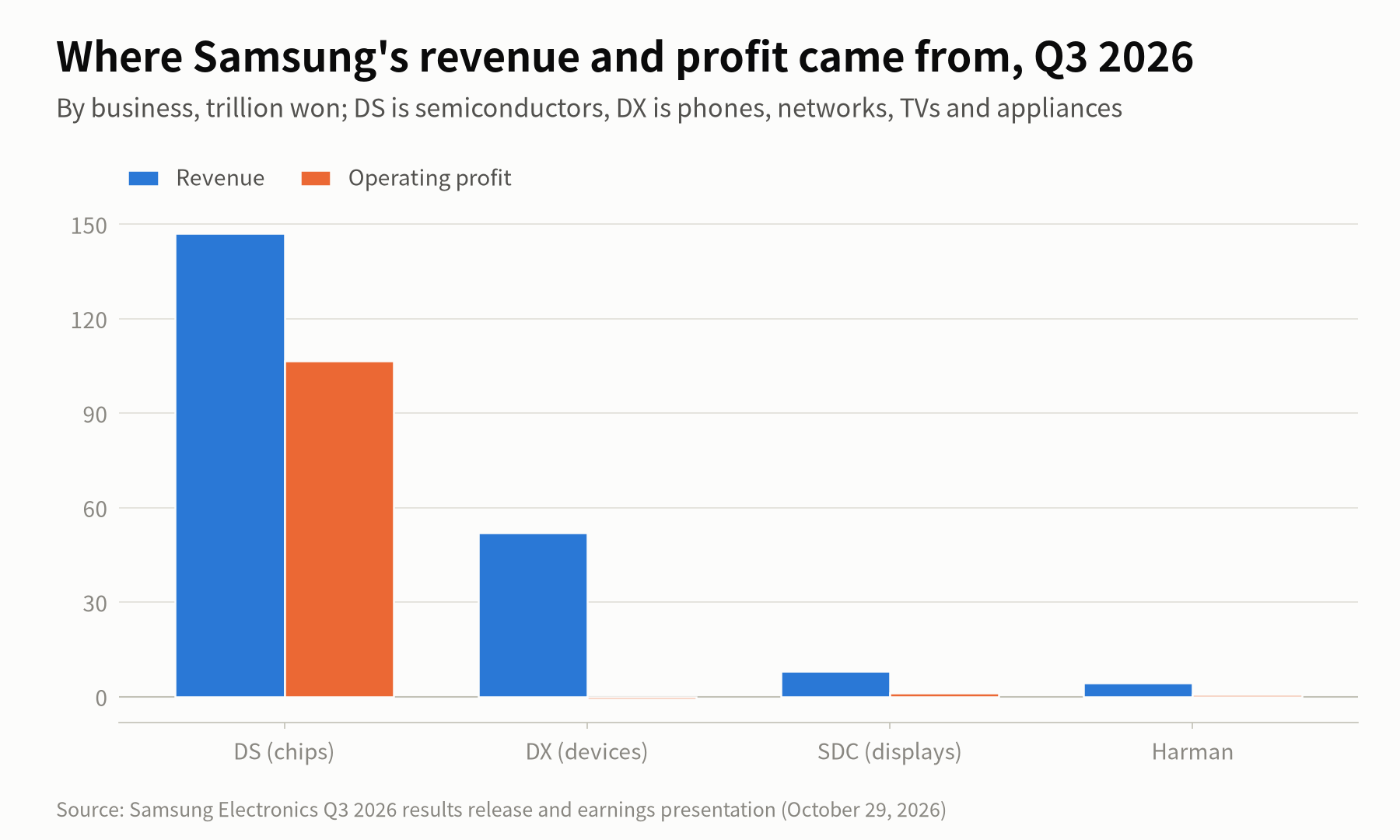
In the third quarter of 2026, DS made 106.5 trillion won of the company’s 107.4 trillion won operating profit, up from 89.2 trillion won in the second quarter. Samsung called the company “the world’s first tech company to exceed KRW 100 trillion in quarterly operating profit.” Revenue was 195.3 trillion won, of which DS was 147.1 trillion won. Phones and networks lost 0.6 trillion won on 37.7 trillion won of revenue; Samsung said their earnings “declined YoY due to cost pressures.” Over the first half of 2026, DS was 68.5% of revenue and 97.4% of operating profit, according to the half-year report.
What is inside the chip business?
Memory is the largest part. Samsung’s figures put memory at 104.1 trillion won of DS’s 130.1 trillion won revenue in 2025, about 80%, and 120.8 trillion won of 127.5 trillion won in the second quarter of 2026, about 95%, and 140.7 trillion won of 147.1 trillion won in the third, about 96%. All three include sales to other parts of Samsung. Its products are DRAM, NAND flash and high-bandwidth memory (HBM) for AI chips; in the third quarter Samsung said it “significantly scaled up sales of HBM4,” and that memory set records for quarterly revenue and operating profit.
System LSI designs chips such as the Exynos mobile processors and ISOCELL camera sensors. Samsung’s report lists the Exynos 2600, built on a 2-nanometer process, and a 200-megapixel ISOCELL sensor among its 2025 launches.
Foundry “makes customized semiconductors for fabless companies based on customer designs,” in the report’s words, the same business TSMC is in. The report lists a long-term foundry contract with Tesla, signed on July 26, 2025 and running to December 31, 2033. In the third quarter of 2026, Samsung said foundry revenue and earnings improved “on HBM base-die sales growth and expanded advanced-node sales.” Foundry, Fabless and IDM explains the business models, and What Do 3nm and 2nm Mean? covers Samsung’s process nodes.
Where does Samsung make its chips?
Most of its chipmaking is in Korea. The business report lists semiconductor sites in Giheung (Yongin), Hwaseong and Pyeongtaek, along with Onyang, Cheonan and Asan, and says memory is produced in Korea and China. Abroad it lists a fab in Xi’an, China, and Austin, Texas. Samsung’s foundry site list adds a new fab in Taylor, Texas; a Samsung Austin Semiconductor release of October 7, 2026 said the company aims to establish the Taylor fab to make 2-nanometer chips with EUV lithography, “expected to be operational by the end of 2026.” With its third-quarter results, Samsung listed “the commencement of operations at its new fab in Taylor, Texas” among its foundry plans for 2027.
Who are its customers, and who owns it?
Samsung’s 2025 report names its largest customers as Alphabet, Apple, Deutsche Telekom, Hong Kong Techtronics and Supreme Electronics, together about 15% of sales. By region, the parent company’s own sales in 2025 broke down this way:
| Region | Revenue (trillion won) | Share |
|---|---|---|
| China | 71.58 | 30.1% |
| Americas | 67.89 | 28.5% |
| Asia and Africa | 45.69 | 19.2% |
| Europe | 31.23 | 13.1% |
| Korea | 21.66 | 9.1% |
These are the parent company’s figures, 238.04 trillion won in all, not the whole group’s.
At the end of 2025 the largest shareholders were Samsung Life Insurance with 8.59%, the National Pension Service with 7.77% and Samsung C&T with 5.05%. The largest shareholder and its related parties together held 19.84% of the common shares, according to the report.
Why does this matter for reading Samsung’s numbers?
Because Samsung’s share price and results combine very different businesses. A quarter can show record profit while the phone business loses money, as in the second and third quarters of 2026. Samsung’s segment table, published with its full results each quarter, shows which business drove the total. Why Samsung Reports Earnings Twice explains when those numbers come out, and the Memory map shows Samsung’s market value beside the other memory makers’.
Sources
- Samsung Electronics 2025 business report (English)
- Samsung Electronics 2026 half-year business report (English)
- Samsung Electronics Announces Fourth Quarter and FY 2025 Results (January 29, 2026)
- 4Q 2025 earnings presentation
- Samsung Electronics Announces Second Quarter 2026 Results (July 30, 2026)
- 2Q 2026 earnings presentation
- Samsung Electronics Announces Third Quarter 2026 Results (October 29, 2026)
- 3Q 2026 earnings presentation
- Foundry manufacturing sites
- Samsung Austin Semiconductor's two campuses inject $10.9B into Central Texas economy in 2025 (October 7, 2026)
- Samsung Electronics Completes Acquisition of HARMAN (March 11, 2017)
See today’s Korea market map →
Related reading
More in Explainers
- Chip Stock Heatmap Explained: How to Read the Asia-Pacific Chips MapMarket Map
- Asia Chip Stocks From a US Account: SKHY, TSM, KXIAY and Other TickersExplainers
- Who Makes What in Memory: DRAM, NAND and HBM Across Asia and the USExplainers
- Samsung vs SK hynix: How Korea's Two Memory Giants DifferSamsung & SK hynix
- TSMC in Japan: What Is JASM, the Kumamoto Chip Plant?Explainers
- What Is HBM? High-Bandwidth Memory vs DRAM, HBM3E and HBM4Explainers
- SOXL and SOXS Explained: 3x Leveraged and Inverse Chip ETFsExplainers
- Custom AI Chips Explained: Google TPU, Amazon Trainium and ASICsExplainers
- Where Japan Fits in the Chip Supply Chain, Next to Taiwan and KoreaExplainers
- Taiwan's Chip Stocks: Who Makes WhatExplainers
- Japan's Chip Stocks: Who Makes WhatExplainers
- Why Nvidia's Earnings Move Memory StocksExplainers
- Chip Equipment Makers: ASML, Applied, Lam, KLA and Tokyo ElectronExplainers
- SOX Heatmap Explained: How to Read the US Chip Index MapMarket Map
- Memory Stock Map Explained: DRAM, NAND and HBM Makers in One ViewMarket Map
- S&P 500 Heatmap Explained: How to Read the US Market MapMarket Map
- How to Buy Japanese Chip Stocks: Tokyo Shares, OTC ADRs and ETFsGuides
- How to Buy Taiwan Stocks From Abroad: TWSE Shares, TSM and ETFsGuides
- What Do 3nm and 2nm Mean? Chip Process Nodes ExplainedExplainers
- US Chip Export Controls on China, ExplainedExplainers
- What Is CoWoS? TSMC's Advanced Packaging and the AI Chip BottleneckExplainers
- Foundry, Fabless and IDM: How Chipmakers Split the WorkExplainers
- Why Samsung Reports Earnings Twice, and How Other Chipmakers ReportSamsung & SK hynix
- SOXX vs SMH vs SOXQ: How Three Semiconductor ETFs DifferExplainers
- How a Stock Gets Into the S&P 500 and the Nasdaq-100Explainers
- Dow, S&P 500 and Nasdaq: What Each US Stock Index MeasuresExplainers
- US Stock Futures Overnight: What Dow, S&P 500 and Nasdaq Futures ShowExplainers
- One Chip Day, Four Closes: Seoul, Taipei, Tokyo and New YorkExplainers
- Japan's Margin Trading Data: What It Says About KioxiaExplainers
- Kioxia Outside Japan: 285A in Tokyo vs KXIAY Over the CounterExplainers
- Kioxia's 3-for-1 Split: How to Read Its Price HistoryExplainers
- Micron's Fiscal Calendar: Why Its Quarters Don't Match Samsung'sExplainers
- Nikkei 225 vs TOPIX: Why Chip Stocks Move Them So DifferentlyExplainers
- The Philadelphia Semiconductor Index (SOX) and Why Asia Watches ItExplainers
- Taiwan's 10% Daily Price Limit and Other Rules for Foreign InvestorsExplainers
- TSM vs 2330: Why TSMC's US Shares Trade Above TaipeiExplainers
- TSMC's Monthly Sales: How Taiwan's Monthly Revenue Reports WorkExplainers
- Why One Stock Moves Taiwan's Market: TSMC and the TAIEXExplainers
- How Foreign Investors Move the KOSPI, and Where to See the Daily DataExplainers
- How to Buy Korean Stocks in 2026: 4 Routes for US, Singapore, UKGuides
- How to Buy Samsung Stock Outside Korea: Shares, London GDR and ETFsGuides
- Korea Discount and the Value-up Program, Explained SimplyExplainers
- KOSPI Heatmap Explained: How to Read Korea's Market MapMarket Map
- Why MSCI Still Hasn't Upgraded Korea, and What Would Change ItExplainers
- How Samsung and SK hynix Compare in HBMSamsung & SK hynix
- SKHY vs 000660: How the Two Ways to Own SK hynix DifferSamsung & SK hynix
- Why Is the KOSPI So Volatile? Chips, Foreign Money and the WonExplainers