Chip Equipment Makers: ASML, Applied, Lam, KLA and Tokyo Electron
Every chip is built and checked by machines from a handful of companies. ASML prints the patterns, Applied Materials, Lam Research and Tokyo Electron lay down and etch away the layers, and KLA looks for defects. Here is who makes what, who buys it and when each company reports, from their own filings.
A chipmaker designs the chip or makes it, but the machines that make it come from a short list of suppliers. This explainer covers five of the largest: ASML in the Netherlands, Applied Materials, Lam Research and KLA in the United States, and Tokyo Electron in Japan. Their customers are the companies that run chip plants, such as TSMC, Samsung Electronics, SK hynix, Micron and Intel.
All five appear on Pacific Tape’s maps. ASML, Applied, Lam and KLA are the equipment group of the SOX map, and Tokyo Electron and the test-equipment maker Advantest are on the Japan map. By the October 27, 2026 closes, ASML was worth about US$630 billion, Applied Materials US$314 billion, Lam Research US$301 billion, KLA US$201 billion and Tokyo Electron US$140 billion.
Which machine does which step?
A wafer goes through the same few kinds of steps hundreds of times: a layer of material is put down, a pattern is printed on it, the unwanted parts are etched away, the wafer is cleaned, and the result is measured. Each company covers different steps:
| Step | What happens | Main companies here |
|---|---|---|
| Lithography | Light prints the circuit pattern | ASML |
| Coat and develop | A light-sensitive film is spread and developed around each exposure | Tokyo Electron |
| Deposition | Thin layers of insulating or conducting material are added | Applied Materials, Lam Research, Tokyo Electron |
| Etch | Material is removed along the printed pattern | Lam Research, Applied Materials, Tokyo Electron |
| Cleaning | Particles and residue are washed off between steps | Lam Research, Tokyo Electron |
| Implant, planarize | Atoms are implanted; the surface is polished flat | Applied Materials |
| Inspection and metrology | Defects are found and features measured | KLA (also Applied and ASML) |
| Testing | Finished chips are tested on the wafer and in packages | Advantest, Teradyne |
The table follows each company’s own description of its products, not a market-share ranking.
What does each company make?
ASML makes lithography systems. Its annual report says “ASML is currently the world’s only manufacturer of EUV lithography systems,” which use extreme ultraviolet light “for the most intricate, critical layers on the most advanced microchips.” Its older deep ultraviolet (DUV) machines “are the workhorses of the industry, producing the majority of layers in microchips,” and in DUV it competes “primarily with Canon and Nikon.” In 2025, ASML’s net sales were €32.67 billion: €24.47 billion from new and used systems and €8.19 billion from servicing and upgrading machines already installed. EUV machines, including the newest High-NA type, were €11.60 billion of the system sales.
Applied Materials calls itself “the leader in the materials engineering solutions used to produce virtually every semiconductor in the world.” Its chip-equipment segment covers “etch, rapid thermal processing, deposition, chemical mechanical planarization, metrology and inspection, wafer packaging, and ion implantation.” In the fiscal year ended October 26, 2025, revenue was US$28.37 billion, of which US$20.80 billion was that segment and US$6.39 billion services and spare parts.
Lam Research says it is “in a strong position with our leadership and expertise in deposition, etch, and clean markets.” Etch “create[s] chip features by selectively removing” material, and deposition “create[s] layers of dielectric (insulating) and metal (conducting) materials.” In the fiscal year ended June 28, 2026, revenue was US$23.23 billion, up 26.0%, of which US$14.89 billion was systems.
KLA sells “inspection, metrology and software products” that help chipmakers “achieve target yields throughout the entire fabrication process.” In the fiscal year ended June 30, 2026, revenue was US$13.58 billion. Wafer inspection was 49% of it, patterning tools 20% and services 23%.
Tokyo Electron makes “equipment for the four key processes of deposition, coater/developer, etch and cleaning,” plus testing and bonding equipment for the later stages. It says it has a “100% share of coater/developer for EUV lithography,” by its own estimate. In the fiscal year ended March 31, 2026, net sales were ¥2.44 trillion, and 90.2% came from outside Japan.
Two more equipment makers sit next to these on the maps. Advantest in Japan and Teradyne in the US make test systems; Teradyne’s are “used for wafer level, device package testing, and system level testing.” Teradyne’s 2025 revenue was US$3.19 billion, of which semiconductor test was US$2.52 billion. Advantest reported record quarterly sales of ¥477.7 billion for July to September 2026 and raised its forecast for the year to March 2027 to ¥1,863.0 billion, from ¥1,714.0 billion.
Who buys the tools?
A few chipmakers buy most of them. ASML’s largest customer took 23.9% of its 2025 sales, and four customers each took more than 10%, together 61.2%. Applied said two customers accounted for “approximately 19% and 15%” of its fiscal 2025 revenue, and Lam said four customers accounted for “approximately 16%, 15%, 12%, and 12%” of its fiscal 2026 revenue. ASML, Applied and Lam do not name these customers; KLA names TSMC as its only customer above 10%.
Logic and foundry plants have bought the larger share, but memory makers’ share rose in 2026:
| Company | Period | Logic and foundry | Memory |
|---|---|---|---|
| ASML (system sales) | Q3 2026 | 54% | 46% |
| Lam Research (equipment) | Quarter ended Sept. 27, 2026 | 54% (foundry 46%, logic/IDM 8%) | 46% |
| Applied Materials (chip equipment) | Quarter ended July 26, 2026 | 67% | 33% (DRAM 26%, flash 7%) |
| KLA (process control systems) | Quarter ended Sept. 30, 2026 | 72% | 28% |
| Tokyo Electron (new equipment) | April to June 2026 | 57% | 43% (DRAM 32%, non-volatile memory 11%) |
A year before, memory was 34% of Lam’s equipment revenue, and for all of 2025 it was 34% of ASML’s system sales. KLA expects memory to be about 40% of those systems in the December quarter, up from 21% in the June quarter. For which companies make DRAM, NAND and HBM, see Who Makes What in Memory.
How much comes from China?
For all five, China was the largest region in the latest full fiscal year.
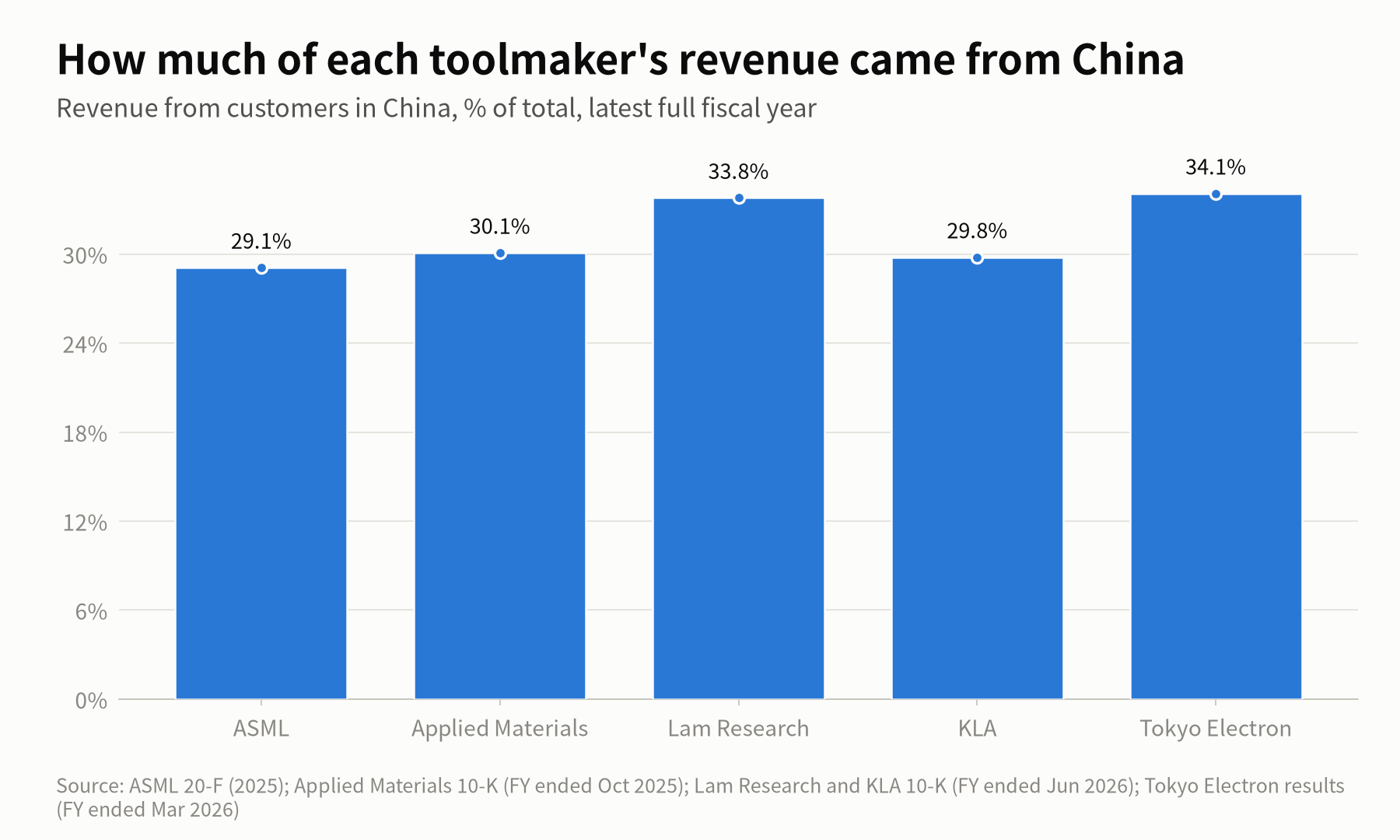
The share moves from quarter to quarter. China was 23% of ASML’s system sales in the third quarter of 2026, after 14% in the second. It was 28% of Applied’s revenue in the quarter ended July 26, 2026, down from 35% a year earlier, and 35% of Lam’s and 34% of KLA’s in the September quarter. US export rules decide which of these machines can be sold to China; US Chip Export Controls on China explains them.
When do they report?
| Company | Fiscal year ends | Latest results | Next |
|---|---|---|---|
| ASML | December | Q3 2026, October 14 | Q4: last year’s came January 28 |
| Lam Research | Late June | Quarter ended Sept. 27, released October 21 | Not yet announced |
| KLA | June 30 | Quarter ended Sept. 30, released October 28 | Not yet announced; last year’s came January 29 |
| Tokyo Electron | March 31 | April to September, released October 30 | October to December: February 5, 2027 |
| Applied Materials | Last Sunday of October | Quarter ended July 26, released August 13 | Fiscal Q4: last year’s came November 13 |
Because ASML, Lam and KLA follow calendar quarters, their results come first each season, in mid- to late January, April, July and October. Applied reports about two and a half weeks after its own fiscal quarters end, in mid-February, May, August and November. Tokyo Electron’s April-to-June quarter is the first of its fiscal year.
The companies also give a forecast for the next quarter. ASML expects fourth- quarter 2026 sales “between €14.2 billion and €15.2 billion”; Lam expects “$8.60 Billion +/- $400 Million” for the quarter ending December 27, 2026; KLA expects “$4.7 billion +/- $200 million” for the December quarter; and Tokyo Electron, whose April-to-September 2026 net sales came to ¥1.67 trillion against the ¥1.62 trillion it had forecast, expects ¥3.70 trillion in net sales and ¥1.17 trillion in operating income for the full year to March 2027.
What do the numbers say, and what don’t they?
They show who supplies each step of chipmaking, how concentrated the customers are and how much depends on China and on memory spending. They do not show market share, which these companies mostly do not disclose consistently, and a quarter’s mix can swing with a few large orders. For how chipmakers themselves divide the work, see Foundry, Fabless and IDM; for what the newest manufacturing generations need, see What Do 3nm and 2nm Mean?
Sources
- ASML annual report (Form 20-F) for 2025
- ASML Q3 2026 financial results (October 14, 2026)
- ASML Q3 2026 results presentation (October 14, 2026)
- Applied Materials annual report (Form 10-K), fiscal 2025
- Applied Materials third quarter fiscal 2026 results (August 13, 2026)
- Lam Research annual report (Form 10-K), fiscal 2026
- Lam Research September 2026 quarter results (October 21, 2026)
- Lam Research quarterly report (Form 10-Q) for the quarter ended September 27, 2026
- KLA annual report (Form 10-K), fiscal 2026
- KLA earnings shareholder letter, fourth quarter fiscal 2026
- KLA Corporation Reports Fiscal 2027 First Quarter Results (October 28, 2026)
- KLA earnings shareholder letter, September 2026 quarter
- KLA announces first quarter fiscal year 2027 earnings date (October 1, 2026)
- Integrated Report 2026
- Financial results presentation, fiscal year ended March 2026 (April 30, 2026)
- Financial results presentation, first quarter of fiscal year ending March 2027 (July 30, 2026)
- IR calendar
- Teradyne annual report (Form 10-K) for 2025
- Integrated Annual Report 2026
- FY2026 second quarter consolidated financial results (October 28, 2026)
Related reading
More in Explainers
- Chip Stock Heatmap Explained: How to Read the Asia-Pacific Chips MapMarket Map
- Asia Chip Stocks From a US Account: SKHY, TSM, KXIAY and Other TickersExplainers
- Who Makes What in Memory: DRAM, NAND and HBM Across Asia and the USExplainers
- Samsung vs SK hynix: How Korea's Two Memory Giants DifferSamsung & SK hynix
- TSMC in Japan: What Is JASM, the Kumamoto Chip Plant?Explainers
- What Is HBM? High-Bandwidth Memory vs DRAM, HBM3E and HBM4Explainers
- SOXL and SOXS Explained: 3x Leveraged and Inverse Chip ETFsExplainers
- Custom AI Chips Explained: Google TPU, Amazon Trainium and ASICsExplainers
- Where Japan Fits in the Chip Supply Chain, Next to Taiwan and KoreaExplainers
- Taiwan's Chip Stocks: Who Makes WhatExplainers
- What Samsung Electronics Makes: Chips, Phones, Displays and MoreSamsung & SK hynix
- Japan's Chip Stocks: Who Makes WhatExplainers
- Why Nvidia's Earnings Move Memory StocksExplainers
- SOX Heatmap Explained: How to Read the US Chip Index MapMarket Map
- Memory Stock Map Explained: DRAM, NAND and HBM Makers in One ViewMarket Map
- S&P 500 Heatmap Explained: How to Read the US Market MapMarket Map
- How to Buy Japanese Chip Stocks: Tokyo Shares, OTC ADRs and ETFsGuides
- How to Buy Taiwan Stocks From Abroad: TWSE Shares, TSM and ETFsGuides
- What Do 3nm and 2nm Mean? Chip Process Nodes ExplainedExplainers
- US Chip Export Controls on China, ExplainedExplainers
- What Is CoWoS? TSMC's Advanced Packaging and the AI Chip BottleneckExplainers
- Foundry, Fabless and IDM: How Chipmakers Split the WorkExplainers
- Why Samsung Reports Earnings Twice, and How Other Chipmakers ReportSamsung & SK hynix
- SOXX vs SMH vs SOXQ: How Three Semiconductor ETFs DifferExplainers
- How a Stock Gets Into the S&P 500 and the Nasdaq-100Explainers
- Dow, S&P 500 and Nasdaq: What Each US Stock Index MeasuresExplainers
- US Stock Futures Overnight: What Dow, S&P 500 and Nasdaq Futures ShowExplainers
- One Chip Day, Four Closes: Seoul, Taipei, Tokyo and New YorkExplainers
- Japan's Margin Trading Data: What It Says About KioxiaExplainers
- Kioxia Outside Japan: 285A in Tokyo vs KXIAY Over the CounterExplainers
- Kioxia's 3-for-1 Split: How to Read Its Price HistoryExplainers
- Micron's Fiscal Calendar: Why Its Quarters Don't Match Samsung'sExplainers
- Nikkei 225 vs TOPIX: Why Chip Stocks Move Them So DifferentlyExplainers
- The Philadelphia Semiconductor Index (SOX) and Why Asia Watches ItExplainers
- Taiwan's 10% Daily Price Limit and Other Rules for Foreign InvestorsExplainers
- TSM vs 2330: Why TSMC's US Shares Trade Above TaipeiExplainers
- TSMC's Monthly Sales: How Taiwan's Monthly Revenue Reports WorkExplainers
- Why One Stock Moves Taiwan's Market: TSMC and the TAIEXExplainers
- How Foreign Investors Move the KOSPI, and Where to See the Daily DataExplainers
- How to Buy Korean Stocks in 2026: 4 Routes for US, Singapore, UKGuides
- How to Buy Samsung Stock Outside Korea: Shares, London GDR and ETFsGuides
- Korea Discount and the Value-up Program, Explained SimplyExplainers
- KOSPI Heatmap Explained: How to Read Korea's Market MapMarket Map
- Why MSCI Still Hasn't Upgraded Korea, and What Would Change ItExplainers
- How Samsung and SK hynix Compare in HBMSamsung & SK hynix
- SKHY vs 000660: How the Two Ways to Own SK hynix DifferSamsung & SK hynix
- Why Is the KOSPI So Volatile? Chips, Foreign Money and the WonExplainers