Korea's 10-Day Export Data: How Chip Exports Are Counted
Korea reports its exports every ten days. Korea Customs Service publishes preliminary figures for the first 10 days and the first 20 days of each month, and the full month follows on the first day of the next. Semiconductors are the largest line in those tables, so chip investors read them closely.
Korea publishes its export figures while the month is still going. Korea Customs Service counts goods as they clear customs and releases a running total after the 10th and the 20th of each month, then a full-month figure on the first day of the next month. Semiconductors make up a large part of what Korea sells abroad, so those releases are a frequent official reading on Korean chip sales: they come every ten days, while Samsung Electronics and SK hynix report once a quarter.
The release schedule
On a fixed schedule set out by Korea Customs Service:
| Release | What it covers | When |
|---|---|---|
| Preliminary, 10-day | Days 1 to 10 of the month | The 11th |
| Preliminary, 20-day | Days 1 to 20 of the month | The 21st |
| Preliminary, full month | The whole month | The 1st of the next month |
| Final, monthly | The previous month | The 15th |
| Final, annual | The previous year | February |
The dates can move when they fall on a weekend. In October 2026 the 11th was a Sunday, and the figures for the first 10 days came out at 9:00 a.m. on Monday, October 12. The 20-day figures came out on Wednesday, October 21. On that schedule, the figures for November 1 to 10 are due on Wednesday, November 11.
On the 1st, the full month comes from the Ministry of Trade, Industry and Resources, which analyzes the customs data and adds detail by product and region. Its October 2026 release came out at 11:00 a.m. on Sunday, November 1.
What the October 2026 releases showed
| Period | Total exports | Chip exports | Chip change | Chip share |
|---|---|---|---|---|
| October 1–10 | $26.1 billion | $12.2 billion | +170.9% | 46.7% |
| October 1–20 | $61.6 billion | $27.5 billion | +222.5% | 44.7% |
| Full month (ministry) | $115.28 billion | $56.44 billion | +259.4% | — |
Changes are against the same period a year earlier. The ministry split October chip exports into memory chips, at $50.14 billion, up 360.5%, and system chips, at $5.71 billion, up 32.6%. Total exports rose 93.7% from October 2025.
The 20-day figure was a little under half of the full month for chips: $27.5 billion of $56.44 billion. The early releases cover only part of the month, so the full-month number can look quite different.
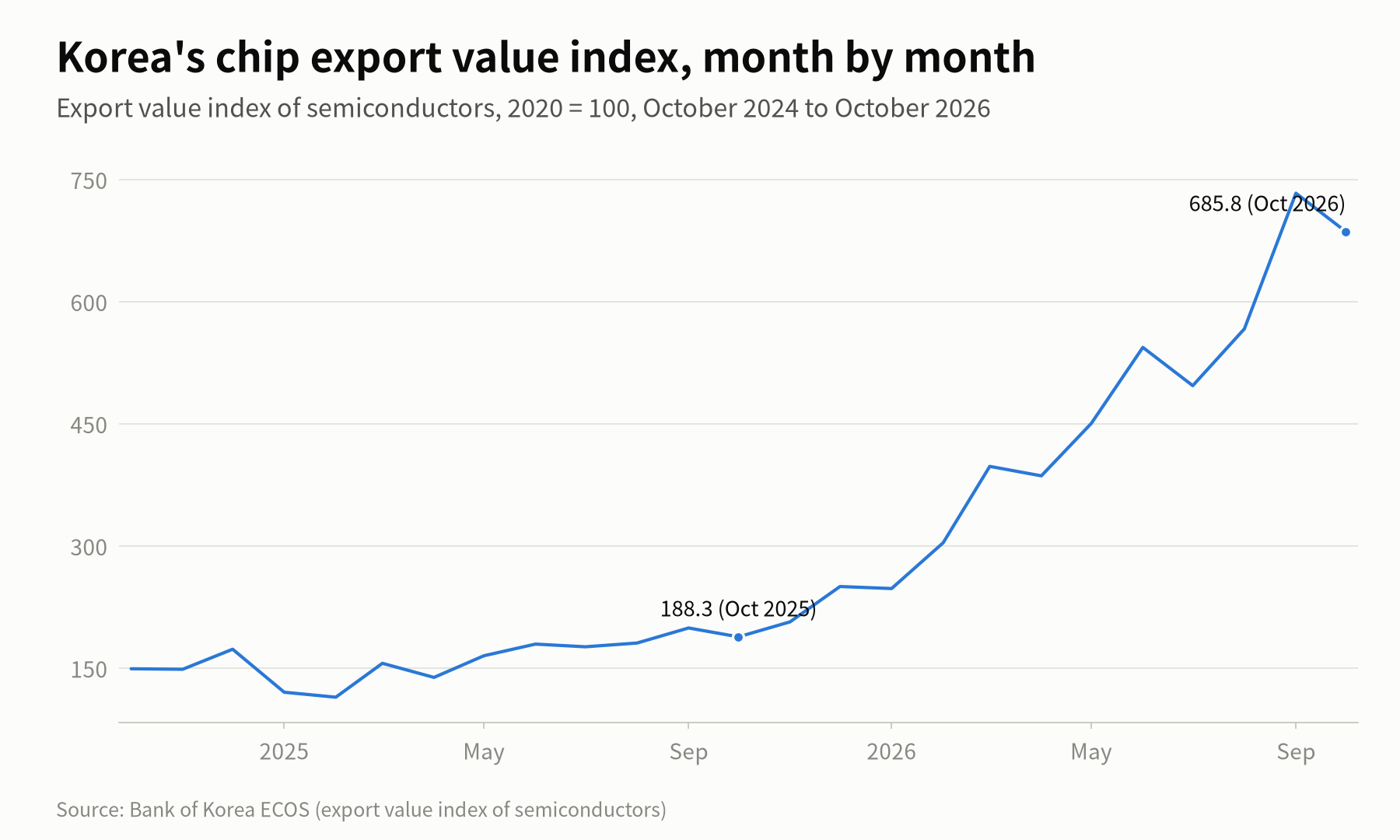
The Bank of Korea’s monthly export value index for semiconductors gives the longer view. With 2020 at 100, it stood at 188.3 in October 2025 and 685.8 in October 2026, about 3.6 times as high, after a peak of 733.0 in September.
Where did the exports go?
The releases also break exports down by destination. In the October 1–20 release, China took $16.7 billion of Korea’s exports, up 154.4%, the United States $10.8 billion, up 154.9%, and Vietnam $5.0 billion, up 74.6%. Those three took 52.7% of the total.
The ministry’s full-month release adds chip exports by destination for October 1 to 25. Chip exports to China were $14.8 billion, up 331%; to the ASEAN countries $8.6 billion, up 252%; and to the United States $5.8 billion, up 497%. A destination in these tables is where the goods were shipped, which is not always where a chip is finally used.
Why working days matter
Ten days can hold a very different number of business days from one year to the next, depending on weekends and holidays. The customs releases count working days in half-day steps, give the count for this year and last year, and add a daily average that adjusts for the difference:
| Period | Working days, 2025 | Working days, 2026 | Daily average exports, 2026 | Change |
|---|---|---|---|---|
| October 1–10 | 3.5 | 5.5 | $4.75 billion | +28.5% |
| October 1–20 | 10.5 | 13.0 | $4.74 billion | +65.9% |
In 2025 the Chuseok holiday fell in October; in 2026 it fell in September, according to the ministry. That left October 2026 with more working days, 22 against 20 for the whole month, and it is one reason the headline growth rates were so large. The ministry’s daily average for the full month was $5.24 billion, up 76.1%.
The customs releases carry their own warning: the figures are short-period statistics that can be affected by changes in working days.
What counts as “semiconductors”?
Each agency groups goods into its own item list. The customs releases say their main items follow Korea Customs Service’s classification of goods by nature. The ministry’s release reports exports for 20 major export items, of which semiconductors is one, and splits it into memory and system chips.
The chip line covers chips themselves, not the machines used to make them. Chip-making equipment appears separately, on the import side: in the October 1–20 release, imports of semiconductor-making equipment were $1.85 billion, up 93.4%.
Both agencies note that the figures are preliminary and based on the date customs accepted the declaration, and that some may be revised until the annual statistics are finalized in February 2027.
Why chip investors watch the numbers
Because chips were close to half of what Korea exported in October, and Korea is home to Samsung Electronics and SK hynix, the two largest DRAM makers by revenue in TrendForce’s second-quarter 2026 estimate. The releases give a reading on export value, which reflects both how many chips were shipped and at what price, before the companies’ next results. The ministry’s October release, for example, tied the rise in chip exports to continued AI investment by large technology companies and high memory prices. Who Makes What in Memory lists who makes which kinds of memory, and Why Samsung Reports Earnings Twice explains Samsung’s own quarterly timetable.
Three things to keep in mind:
- Value, not volume. The headline figures are in US dollars, so higher chip prices raise them even when shipments are flat.
- Korea, not the companies. The figures count goods shipped out of Korea, so chips that Korean companies make in factories abroad are not in them.
- Other series come later. The Bank of Korea publishes monthly export price and export value indexes by item on ECOS. Its export value index for semiconductors stood at 733.03 for September 2026, with 2020 = 100.
Sources
- 관세청 수출입무역통계 (Korea Customs Service trade statistics: release schedule)
- 2026년 10월 1일 ~ 10월 10일 수출입 현황 [잠정치] (October 12, 2026)
- 2026년 10월 1일 ~ 10월 20일 수출입 현황 [잠정치] (October 21, 2026)
- 2026년 10월 수출입 동향 (November 1, 2026)
- DRAM Industry Revenue Rises 59.5% QoQ in 2Q26 as Supply Expansion Continues to Lag Demand Growth (September 7, 2026)
- Export value index by item: semiconductors (statistic 403Y001)
See today’s Korea market map →
Related reading
More in Explainers
- Chip Stock Heatmap Explained: How to Read the Asia-Pacific Chips MapMarket Map
- Asia Chip Stocks From a US Account: SKHY, TSM, KXIAY and Other TickersExplainers
- Who Makes What in Memory: DRAM, NAND and HBM Across Asia and the USExplainers
- After a Big SOX Day: How Seoul, Tokyo and Taipei Chip Stocks FollowedExplainers
- Taiwan's Foreign Investor Flows: Reading TWSE's Daily Net-Buy DataExplainers
- How to Read a Japanese Kessan Tanshin (Earnings Summary)Explainers
- Advantest Explained: The Chip-Tester Maker That Moves the NikkeiExplainers
- Why US Chip Earnings Come After the Bell, and What Asia Sees NextExplainers
- TSMC's Quarterly Dividend: Ex-Dividend Dates for 2330 and TSMExplainers
- Korean Preferred Shares: Why Samsung's 005935 Trades Below Its CommonExplainers
- SOX and the Nikkei 225: How US Chip Stocks Reach Tokyo's Next SessionExplainers
- Kioxia and SanDisk: How the Two NAND Makers Share Their FabsExplainers
- Stock Split vs Reverse Split: From SOXX and SanDisk to Penny StocksExplainers
- What Is Rapidus? Japan's 2nm Chipmaker and the Companies Behind ItExplainers
- Samsung vs SK hynix: How Korea's Two Memory Giants DifferSamsung & SK hynix
- TSMC in Japan: What Is JASM, the Kumamoto Chip Plant?Explainers
- What Is HBM? High-Bandwidth Memory vs DRAM, HBM3E and HBM4Explainers
- SOXL and SOXS Explained: 3x Leveraged and Inverse Chip ETFsExplainers
- Custom AI Chips Explained: Google TPU, Amazon Trainium and ASICsExplainers
- Where Japan Fits in the Chip Supply Chain, Next to Taiwan and KoreaExplainers
- Taiwan's Chip Stocks: Who Makes WhatExplainers
- What Samsung Electronics Makes: Chips, Phones, Displays and MoreSamsung & SK hynix
- Japan's Chip Stocks: Who Makes WhatExplainers
- Why Nvidia's Earnings Move Memory StocksExplainers
- Chip Equipment Makers: ASML, Applied, Lam, KLA and Tokyo ElectronExplainers
- SOX Heatmap Explained: How to Read the US Chip Index MapMarket Map
- Memory Stock Map Explained: DRAM, NAND and HBM Makers in One ViewMarket Map
- S&P 500 Heatmap Explained: How to Read the US Market MapMarket Map
- How to Buy Japanese Chip Stocks: Tokyo Shares, OTC ADRs and ETFsGuides
- How to Buy Taiwan Stocks From Abroad: TWSE Shares, TSM and ETFsGuides
- What Do 3nm and 2nm Mean? Chip Process Nodes ExplainedExplainers
- US Chip Export Controls on China, ExplainedExplainers
- What Is CoWoS? TSMC's Advanced Packaging and the AI Chip BottleneckExplainers
- Foundry, Fabless and IDM: How Chipmakers Split the WorkExplainers
- Why Samsung Reports Earnings Twice, and How Other Chipmakers ReportSamsung & SK hynix
- SOXX vs SMH vs SOXQ: How Three Semiconductor ETFs DifferExplainers
- How a Stock Gets Into the S&P 500 and the Nasdaq-100Explainers
- US Stock Futures Overnight: What Dow, S&P 500 and Nasdaq Futures ShowExplainers
- One Chip Day, Four Closes: Seoul, Taipei, Tokyo and New YorkExplainers
- Japan's Margin Trading Data: What It Says About KioxiaExplainers
- Kioxia Outside Japan: 285A in Tokyo vs KXIAY Over the CounterExplainers
- Kioxia's 3-for-1 Split: How to Read Its Price HistoryExplainers
- Micron's Fiscal Calendar: Why Its Quarters Don't Match Samsung'sExplainers
- Nikkei 225 vs TOPIX: Why Chip Stocks Move Them So DifferentlyExplainers
- The Philadelphia Semiconductor Index (SOX) and Why Asia Watches ItExplainers
- Taiwan's 10% Daily Price Limit and Other Rules for Foreign InvestorsExplainers
- TSM vs 2330: Why TSMC's US Shares Trade Above TaipeiExplainers
- TSMC's Monthly Sales: How Taiwan's Monthly Revenue Reports WorkExplainers
- Why One Stock Moves Taiwan's Market: TSMC and the TAIEXExplainers
- How Foreign Investors Move the KOSPI, and Where to See the Daily DataExplainers
- How to Buy Korean Stocks in 2026: 4 Routes for US, Singapore, UKGuides
- How to Buy Samsung Stock Outside Korea: Shares, London GDR and ETFsGuides
- Korea Discount and the Value-up Program, Explained SimplyExplainers
- KOSPI Heatmap Explained: How to Read Korea's Market MapMarket Map
- Why MSCI Still Hasn't Upgraded Korea, and What Would Change ItExplainers
- How Samsung and SK hynix Compare in HBMSamsung & SK hynix
- SKHY vs 000660: How the Two Ways to Own SK hynix DifferSamsung & SK hynix
- Why Is the KOSPI So Volatile? Chips, Foreign Money and the WonExplainers