Stock Split vs Reverse Split: From SOXX and SanDisk to Penny Stocks
The iShares Semiconductor ETF (SOXX) starts trading on a three-for-one split basis today, and SanDisk follows with an eight-for-one split later this month. A split changes how many shares there are and what each one costs, not what the company or fund is worth. A reverse split does the opposite, and on US exchanges it is often about staying above $1.
On November 5, 2026, the iShares Semiconductor ETF (SOXX) opens on Nasdaq at roughly one-third of its old price. Nothing went wrong: the fund split each share into three. SanDisk will do something similar on a bigger scale later this month, and every year some small companies go the other way and merge their shares. This explainer covers both moves, why companies make them, and how to read the price charts on either side.
What is a stock split?
A stock split turns each existing share into more shares, and the price of each share falls in proportion. In a three-for-one split, an investor with 10 shares at $300 ends up with 30 shares at about $100. The holding is worth about the same $3,000, and the company’s market value does not change because of the split.
In Korea a split is called an aekmyeon bunhal, a par-value split, because it cuts the nominal value printed on each share. Samsung Electronics’ 2018 split is the best-known example. Its board decided on January 31, 2018 to cut the par value of each share from 5,000 won to 100 won, a 50-for-1 split that took the count of common shares from 128,386,494 to 6,419,324,700. The split took effect on May 3, 2018, and the new shares were listed on May 4, according to the company’s filings. The stated purpose in the filing was to increase the number of shares in circulation.
What is a reverse split?
A reverse split, also called a share consolidation, goes the other way: several shares become one, and the price of each share rises in proportion. In a one-for-ten reverse split, 1,000 shares at $0.50 become 100 shares at about $5. Again the holding is worth about the same, about $500 in this case.
Korea calls this aekmyeon byeonghap, a par-value consolidation. In the US it is most often a sign that the share price has fallen a long way, as the penny-stock section below explains.
SOXX on November 5
SOXX follows ICE’s NYSE Semiconductor Index, a basket of US-listed chip stocks. Its trust filed a supplement with the SEC on October 23, 2026 saying its board had approved a three-for-one forward split, with a record date of November 3 and a distribution date of November 4. The split “will be recognized at the commencement of trading on The Nasdaq Stock Market LLC on November 5, 2026,” the filing says.
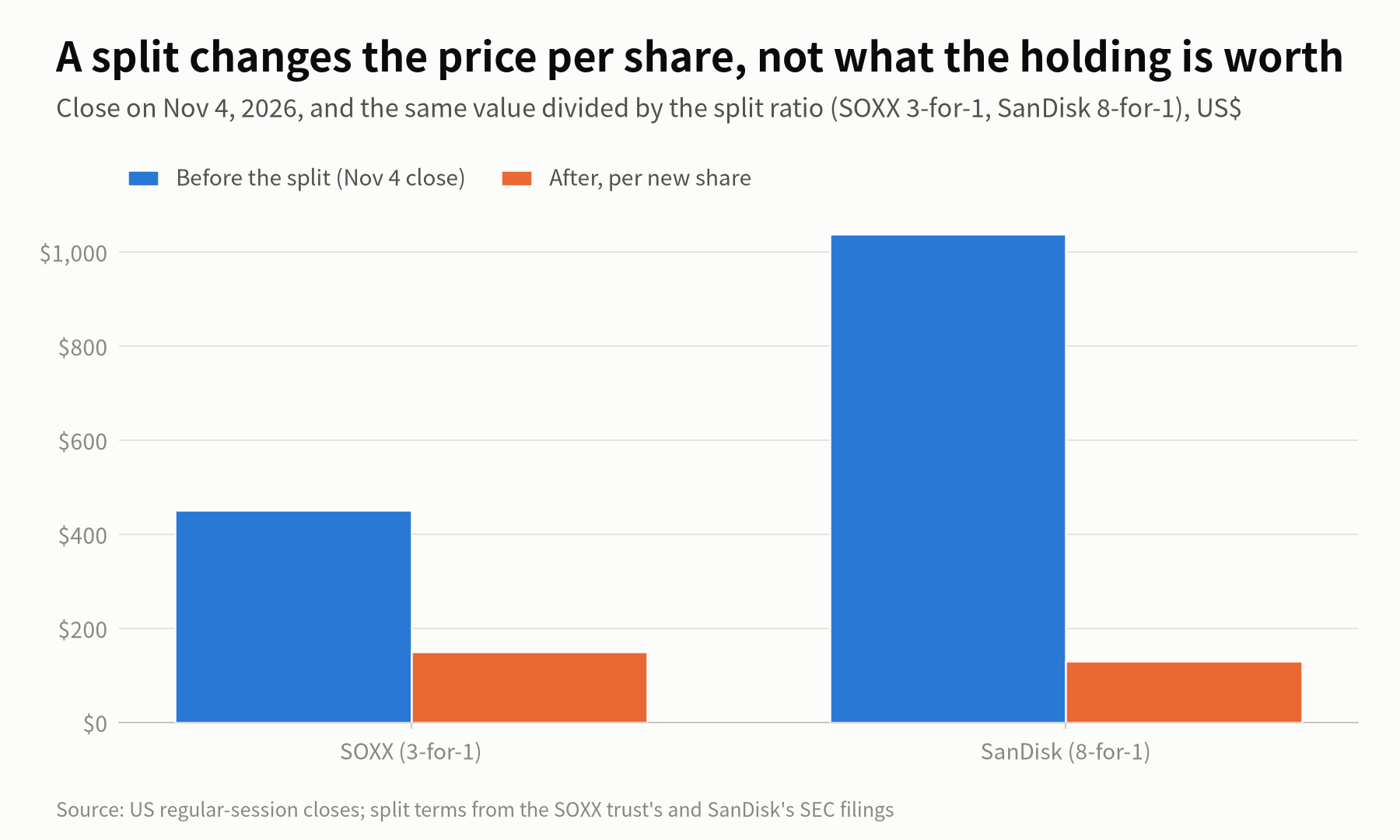
SOXX closed at $450.41 on November 4. Divided by three, that is about $150.14, the level to compare against when the fund opens on its new basis. A chart that does not adjust for the split will show a two-thirds drop on November 5 that is not a loss. SOXX vs SMH vs SOXQ compares SOXX with the other two large US chip ETFs.
When SanDisk’s 8-for-1 split takes effect
SanDisk announced an eight-for-one forward split on October 29, 2026, in an SEC filing made the same day as its quarterly results. Holders of record at the close of business on November 9 will receive seven additional shares for each share they hold, to be issued after the market close on Thursday, November 19. Trading on a split-adjusted basis is expected to begin at the open on Friday, November 20, under the same ticker, SNDK. The number of shares SanDisk is allowed to issue rises from 450 million to 3.6 billion.
SanDisk closed at $1,037.40 on November 4. Divided by eight, that is about $129.68 a share.
Side by side, the two splits look like this: SOXX’s November 4 close of $450.41 becomes about $150.14 for each of three new units, and SanDisk’s $1,037.40 becomes about $129.68 for each of eight new shares. In both cases a holder’s total stays the same on the day of the split.
Why do companies split their shares?
The common reason is to lower the price of a single share or of the smallest amount an investor can buy. How much that matters depends on the market.
- Japan. Domestic stocks trade in units of 100 shares, according to Japan Exchange Group, so the real entry price is 100 times the share price. Kioxia split each share into three on October 1, 2026. It said the aim was to lower the amount needed per trading unit and widen its investor base, and it noted the Tokyo Stock Exchange’s request that an investment unit cost less than 500,000 yen. Kioxia’s 3-for-1 split shows how to read its price history.
- Korea. Samsung Electronics, as above, cited increasing the shares in circulation. Korean stocks trade in single shares, so the split lowered the price of one share by a factor of 50.
- Taiwan. Funds split too. The Yuanta/P-shares Taiwan Top 50 ETF (0050) split its units four for one in June 2025: TWSE closing prices show NT$188.65 on June 10, 2025 and NT$47.57 on June 18, with no trading in between.
- The US. Stocks trade in single shares, so a split lowers the price of one share. A price-weighted index is one place where the share price itself counts: in the Dow Jones Industrial Average, a split lowers a company’s weight because the share price falls while the company stays the same size.
A split by itself does not add to earnings or assets. Any effect on demand for the shares is a separate question from the arithmetic.
Why penny stocks combine shares
On US exchanges, the main reason is the $1 rule. Nasdaq requires listed shares to keep a minimum bid price of $1.00. A company fails that test when its shares close below $1.00 for 30 consecutive business days. It then gets an automatic 180 calendar days to regain compliance, which means closing at $1.00 or more for at least 10 consecutive business days. A company on the Nasdaq Capital Market may receive a second 180-day period. If the price closes at $0.10 or less for 10 consecutive trading days during a compliance period, Nasdaq moves to delist the stock.
A reverse split lifts the share price above $1 in one step, without any change in the company’s value, so it is the usual fix. Nasdaq has tightened the rules on using it again and again:
- If a company has done reverse splits with a combined ratio of 250 to 1 or more over the prior two years, it gets no compliance period.
- Under a rule change the SEC approved on January 17, 2025, a company that falls below $1 after a reverse split in the prior one year also gets no compliance period, and Nasdaq issues a delisting determination.
Funds face a similar arithmetic. A leveraged or inverse ETF that loses value over time ends up with a very low share price, and sponsors periodically combine its shares. SOXL and SOXS explained covers the reverse splits of the 3x bear chip fund.
Reading a price chart across a split
Adjusted price histories divide every price before a forward split by the ratio, or multiply it for a reverse split, so the line stays continuous. A chart that is not adjusted shows a cliff on the split date.
| Security | Market | Ratio | First trading on the new basis |
|---|---|---|---|
| Samsung Electronics (005930) | Korea Exchange | 50-for-1 split | May 4, 2018 |
| Yuanta/P-shares Taiwan Top 50 ETF (0050) | Taiwan Stock Exchange | 4-for-1 split | June 18, 2025 |
| Kioxia (285A) | Tokyo Stock Exchange | 3-for-1 split | September 29, 2026 |
| iShares Semiconductor ETF (SOXX) | Nasdaq | 3-for-1 split | November 5, 2026 |
| SanDisk (SNDK) | Nasdaq | 8-for-1 split | November 20, 2026 (expected) |
Kioxia’s split took effect on October 1, but Tokyo trading moved to the new basis on September 29, as the Kioxia explainer describes. When you compare a price from before a split with one after it, check whether both are on the same basis, and divide or multiply by the ratio if they are not.
Sources
- iShares Trust: supplement on the iShares Semiconductor ETF (SOXX) three-for-one split (Form 497, October 23, 2026)
- Sandisk: Form 8-K, Item 8.01 Other Events (eight-for-one stock split, October 29, 2026)
- Samsung Electronics: 주식분할 결정 (decision on stock split, January 31, 2018)
- Samsung Electronics: quarterly report for the first quarter of 2018 (May 15, 2018)
- Notice Regarding Stock Split and According Partial Amendment to Articles of Incorporation (July 31, 2026)
- Trading Unit, Trading Rules of Domestic Stocks
- Daily closing prices (Yuanta/P-shares Taiwan Top 50 ETF, 0050)
- Order Granting Approval of a Proposed Rule Change to Modify the Application of the Minimum Bid Price Compliance Periods (Release No. 34-102245, SR-NASDAQ-2024-045, January 17, 2025)
- Nasdaq closing prices (SOXX, SanDisk)
Related reading
More in Explainers
- Chip Stock Heatmap Explained: How to Read the Asia-Pacific Chips MapMarket Map
- Asia Chip Stocks From a US Account: SKHY, TSM, KXIAY and Other TickersExplainers
- Who Makes What in Memory: DRAM, NAND and HBM Across Asia and the USExplainers
- After a Big SOX Day: How Seoul, Tokyo and Taipei Chip Stocks FollowedExplainers
- Taiwan's Foreign Investor Flows: Reading TWSE's Daily Net-Buy DataExplainers
- How to Read a Japanese Kessan Tanshin (Earnings Summary)Explainers
- Advantest Explained: The Chip-Tester Maker That Moves the NikkeiExplainers
- Why US Chip Earnings Come After the Bell, and What Asia Sees NextExplainers
- Korea's 10-Day Export Data: How Chip Exports Are CountedExplainers
- TSMC's Quarterly Dividend: Ex-Dividend Dates for 2330 and TSMExplainers
- Korean Preferred Shares: Why Samsung's 005935 Trades Below Its CommonExplainers
- SOX and the Nikkei 225: How US Chip Stocks Reach Tokyo's Next SessionExplainers
- Kioxia and SanDisk: How the Two NAND Makers Share Their FabsExplainers
- What Is Rapidus? Japan's 2nm Chipmaker and the Companies Behind ItExplainers
- Samsung vs SK hynix: How Korea's Two Memory Giants DifferSamsung & SK hynix
- TSMC in Japan: What Is JASM, the Kumamoto Chip Plant?Explainers
- What Is HBM? High-Bandwidth Memory vs DRAM, HBM3E and HBM4Explainers
- SOXL and SOXS Explained: 3x Leveraged and Inverse Chip ETFsExplainers
- Custom AI Chips Explained: Google TPU, Amazon Trainium and ASICsExplainers
- Where Japan Fits in the Chip Supply Chain, Next to Taiwan and KoreaExplainers
- Taiwan's Chip Stocks: Who Makes WhatExplainers
- What Samsung Electronics Makes: Chips, Phones, Displays and MoreSamsung & SK hynix
- Japan's Chip Stocks: Who Makes WhatExplainers
- Why Nvidia's Earnings Move Memory StocksExplainers
- Chip Equipment Makers: ASML, Applied, Lam, KLA and Tokyo ElectronExplainers
- SOX Heatmap Explained: How to Read the US Chip Index MapMarket Map
- Memory Stock Map Explained: DRAM, NAND and HBM Makers in One ViewMarket Map
- S&P 500 Heatmap Explained: How to Read the US Market MapMarket Map
- How to Buy Japanese Chip Stocks: Tokyo Shares, OTC ADRs and ETFsGuides
- How to Buy Taiwan Stocks From Abroad: TWSE Shares, TSM and ETFsGuides
- What Do 3nm and 2nm Mean? Chip Process Nodes ExplainedExplainers
- US Chip Export Controls on China, ExplainedExplainers
- What Is CoWoS? TSMC's Advanced Packaging and the AI Chip BottleneckExplainers
- Foundry, Fabless and IDM: How Chipmakers Split the WorkExplainers
- Why Samsung Reports Earnings Twice, and How Other Chipmakers ReportSamsung & SK hynix
- SOXX vs SMH vs SOXQ: How Three Semiconductor ETFs DifferExplainers
- How a Stock Gets Into the S&P 500 and the Nasdaq-100Explainers
- US Stock Futures Overnight: What Dow, S&P 500 and Nasdaq Futures ShowExplainers
- One Chip Day, Four Closes: Seoul, Taipei, Tokyo and New YorkExplainers
- Japan's Margin Trading Data: What It Says About KioxiaExplainers
- Kioxia Outside Japan: 285A in Tokyo vs KXIAY Over the CounterExplainers
- Kioxia's 3-for-1 Split: How to Read Its Price HistoryExplainers
- Micron's Fiscal Calendar: Why Its Quarters Don't Match Samsung'sExplainers
- Nikkei 225 vs TOPIX: Why Chip Stocks Move Them So DifferentlyExplainers
- The Philadelphia Semiconductor Index (SOX) and Why Asia Watches ItExplainers
- Taiwan's 10% Daily Price Limit and Other Rules for Foreign InvestorsExplainers
- TSM vs 2330: Why TSMC's US Shares Trade Above TaipeiExplainers
- TSMC's Monthly Sales: How Taiwan's Monthly Revenue Reports WorkExplainers
- Why One Stock Moves Taiwan's Market: TSMC and the TAIEXExplainers
- How Foreign Investors Move the KOSPI, and Where to See the Daily DataExplainers
- How to Buy Korean Stocks in 2026: 4 Routes for US, Singapore, UKGuides
- How to Buy Samsung Stock Outside Korea: Shares, London GDR and ETFsGuides
- Korea Discount and the Value-up Program, Explained SimplyExplainers
- KOSPI Heatmap Explained: How to Read Korea's Market MapMarket Map
- Why MSCI Still Hasn't Upgraded Korea, and What Would Change ItExplainers
- How Samsung and SK hynix Compare in HBMSamsung & SK hynix
- SKHY vs 000660: How the Two Ways to Own SK hynix DifferSamsung & SK hynix
- Why Is the KOSPI So Volatile? Chips, Foreign Money and the WonExplainers