Why US Chip Earnings Come After the Bell, and What Asia Sees Next
US chip companies almost all release their quarterly results minutes after the New York Stock Exchange and Nasdaq close at 4 p.m. Eastern time. In Seoul and Tokyo that is about 6 a.m. the next day, three hours before their markets open.
When a big US chipmaker reports, the numbers usually appear a few minutes after the New York Stock Exchange and Nasdaq close at 4 p.m. Eastern time. By then Seoul, Taipei and Tokyo are closed too, and asleep. So for investors in Asia, US chip earnings are something that happens overnight and shows up at the next morning’s open.
What the SEC requires
The SEC sets what a company must disclose, not the hour. When a US-listed company announces its results for a completed quarter, Item 2.02 of Form 8-K says it must “disclose the date of the announcement or release, briefly identify the announcement or release and include the text of that announcement or release as an exhibit.” Form 8-K reports are due within four business days of the event. A results report under Item 2.02 is “furnished” rather than “filed,” so unless the company says otherwise it is not treated as filed under Section 18 of the Securities Exchange Act.
A second rule shapes how the news goes out. Regulation FD says that when a company intentionally discloses material nonpublic information to market professionals or investors, it must make that information public “simultaneously.” That is why results go to everyone at once in a press release and an 8-K, rather than to analysts first. Nvidia, for example, says its results will be “publicly announced” before its conference call starts.
When the big chipmakers reported last time
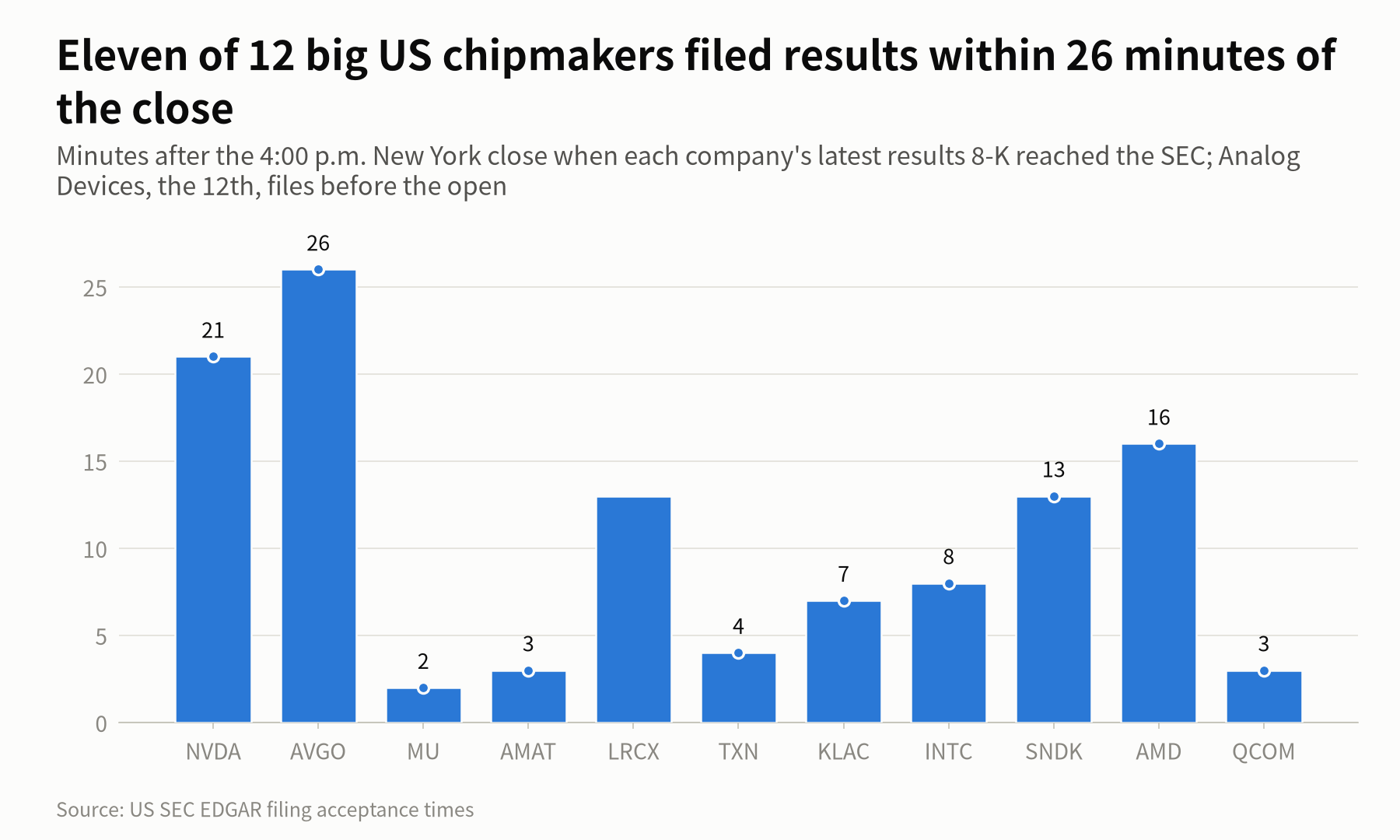
EDGAR records the minute each filing reached the SEC. For the most recent quarterly results of 12 large US chip companies, it shows this:
| Company | Latest results 8-K (US date) | Reached the SEC (New York) | Seoul and Tokyo |
|---|---|---|---|
| Nvidia | Aug 26, 2026 | 4:21 p.m. | 5:21 a.m., Aug 27 |
| Broadcom | Sep 2, 2026 | 4:26 p.m. | 5:26 a.m., Sep 3 |
| Micron | Sep 30, 2026 | 4:02 p.m. | 5:02 a.m., Oct 1 |
| Applied Materials | Aug 13, 2026 | 4:03 p.m. | 5:03 a.m., Aug 14 |
| Lam Research | Oct 21, 2026 | 4:13 p.m. | 5:13 a.m., Oct 22 |
| Texas Instruments | Oct 21, 2026 | 4:04 p.m. | 5:04 a.m., Oct 22 |
| KLA | Oct 28, 2026 | 4:07 p.m. | 5:07 a.m., Oct 29 |
| Intel | Oct 29, 2026 | 4:08 p.m. | 5:08 a.m., Oct 30 |
| SanDisk | Oct 29, 2026 | 4:13 p.m. | 5:13 a.m., Oct 30 |
| AMD | Nov 3, 2026 | 4:16 p.m. | 6:16 a.m., Nov 4 |
| Qualcomm | Nov 4, 2026 | 4:03 p.m. | 6:03 a.m., Nov 5 |
| Analog Devices | Aug 19, 2026 | 7:03 a.m. | 8:03 p.m., Aug 19 |
Eleven of the 12 filed between 4:02 and 4:26 p.m. The pattern holds over time: across each company’s last four results filings, all of the 11 reached the SEC between 4:00 and 4:31 p.m. New York time. Analog Devices is the exception in the other direction. Its last four results filings reached the SEC between 7:01 and 7:03 a.m., before the 9:30 a.m. open.
No rule makes companies choose these hours. Reporting outside the regular session means the numbers arrive when that session is shut, and the first trading on them comes in the extended sessions or at the next open.
Counted in minutes after the 4:00 p.m. close, the 11 ranged from 2 minutes for Micron to 26 for Broadcom.
What trades in New York after the close?
Nasdaq lists pre-market trading from 4:00 to 9:30 a.m. and after-hours trading from 4:00 p.m. to 8:00 p.m. New York time, around the regular session from 9:30 a.m. to 4:00 p.m. So a chipmaker’s shares can move on its results within minutes, but in the after-hours session rather than the regular one, whose 4 p.m. price is the official close.
Overnight trading is coming to some US exchanges too. In a filing dated September 15, 2026, the NYSE said several exchanges, including NYSE Arca, intend to offer overnight trading sessions from 9:00 p.m. to 4:00 a.m. New York time from December 6, 2026. US index futures already trade through the night; US Stock Futures Overnight explains them.
What time is that in Seoul, Taipei and Tokyo?
Korea, Taiwan and Japan do not change their clocks, so the gap moves with US daylight saving time. It ended at 2 a.m. on Sunday, November 1, 2026, according to NIST, and returns on Sunday, March 14, 2027. Until then:
| New York (Eastern) | Seoul and Tokyo | Taipei |
|---|---|---|
| 4:00 p.m., regular close | 6:00 a.m. next day | 5:00 a.m. next day |
| 4:20 p.m., typical results filing | 6:20 a.m. next day | 5:20 a.m. next day |
| 5:00 p.m., typical results call | 7:00 a.m. next day | 6:00 a.m. next day |
| 8:00 p.m., after-hours ends | 10:00 a.m. next day | 9:00 a.m. next day |
During US daylight saving time, each of those is one hour earlier in Asia, which is why the summer filings in the first table landed around 5 a.m. in Seoul. Either way, the results are out about three hours before the Korea Exchange and the Tokyo Stock Exchange open at 9 a.m., and Taiwan’s market opens at 9 a.m. local time too. Seoul, Taipei and Tokyo therefore trade on US chip results in their regular session before New York does. One Chip Day, Four Closes sets out the whole day’s order.
Applied Materials and Nvidia this month
- Applied Materials has said it will report its fourth-quarter and fiscal 2026 results on Thursday, November 12. Its last four results filings reached the SEC at 4:03 p.m. New York time. At that time of day, November 12 in New York is 6:03 a.m. on Friday, November 13 in Seoul and Tokyo.
- Nvidia says it will host a conference call on Tuesday, November 17, at 2 p.m. Pacific time (5 p.m. Eastern) for its third quarter of fiscal 2027, which ended on October 25, 2026. It says its results will be publicly announced “at approximately 1:20 p.m. PT,” which is 4:20 p.m. in New York and 6:20 a.m. on Wednesday, November 18 in Seoul and Tokyo. The call starts at 7:00 a.m. there.
Why Nvidia’s Earnings Move Memory Stocks looks at how Asian memory makers have traded on those reports. Not every company keeps calendar quarters, either: Micron’s Fiscal Calendar explains why its quarters do not line up with Samsung’s.
Points to keep in mind
The table shows when each 8-K reached the SEC; a company’s press release can carry a slightly different time. After-hours prices are a first reaction, and they do not change the official close. In Asia, the regular session the next morning is usually the first full trading day on the news.
Sources
- Form 8-K, general instructions and Item 2.02 Results of Operations and Financial Condition
- 17 CFR 243.100, Regulation FD: general rule regarding selective disclosure
- EDGAR company filings (8-K, Item 2.02): NVIDIA, AMD, Intel, Qualcomm, Applied Materials, Lam Research, KLA, Micron, Broadcom, Texas Instruments, Sandisk, Analog Devices
- NVIDIA Sets Conference Call for Third-Quarter Financial Results (October 28, 2026)
- Applied Materials to Report Fourth Quarter and Fiscal 2026 Results on Nov. 12, 2026 (October 22, 2026)
- Stock Market Trading Hours for Nasdaq
- Holidays and Trading Hours
- Notice of filing and immediate effectiveness, SR-NYSE-2026-43 (Release No. 34-106380, September 15, 2026)
- Daylight Saving Time
Related reading
- Why Nvidia's Earnings Move Memory Stocks Explainers
- How to Read a Japanese Kessan Tanshin (Earnings Summary) Explainers
- US Chip Export Controls on China, Explained Explainers
More in Explainers
- Chip Stock Heatmap Explained: How to Read the Asia-Pacific Chips MapMarket Map
- Asia Chip Stocks From a US Account: SKHY, TSM, KXIAY and Other TickersExplainers
- Who Makes What in Memory: DRAM, NAND and HBM Across Asia and the USExplainers
- After a Big SOX Day: How Seoul, Tokyo and Taipei Chip Stocks FollowedExplainers
- Taiwan's Foreign Investor Flows: Reading TWSE's Daily Net-Buy DataExplainers
- How to Read a Japanese Kessan Tanshin (Earnings Summary)Explainers
- Advantest Explained: The Chip-Tester Maker That Moves the NikkeiExplainers
- Korea's 10-Day Export Data: How Chip Exports Are CountedExplainers
- TSMC's Quarterly Dividend: Ex-Dividend Dates for 2330 and TSMExplainers
- Korean Preferred Shares: Why Samsung's 005935 Trades Below Its CommonExplainers
- SOX and the Nikkei 225: How US Chip Stocks Reach Tokyo's Next SessionExplainers
- Kioxia and SanDisk: How the Two NAND Makers Share Their FabsExplainers
- Stock Split vs Reverse Split: From SOXX and SanDisk to Penny StocksExplainers
- What Is Rapidus? Japan's 2nm Chipmaker and the Companies Behind ItExplainers
- Samsung vs SK hynix: How Korea's Two Memory Giants DifferSamsung & SK hynix
- TSMC in Japan: What Is JASM, the Kumamoto Chip Plant?Explainers
- What Is HBM? High-Bandwidth Memory vs DRAM, HBM3E and HBM4Explainers
- SOXL and SOXS Explained: 3x Leveraged and Inverse Chip ETFsExplainers
- Custom AI Chips Explained: Google TPU, Amazon Trainium and ASICsExplainers
- Where Japan Fits in the Chip Supply Chain, Next to Taiwan and KoreaExplainers
- Taiwan's Chip Stocks: Who Makes WhatExplainers
- What Samsung Electronics Makes: Chips, Phones, Displays and MoreSamsung & SK hynix
- Japan's Chip Stocks: Who Makes WhatExplainers
- Why Nvidia's Earnings Move Memory StocksExplainers
- Chip Equipment Makers: ASML, Applied, Lam, KLA and Tokyo ElectronExplainers
- SOX Heatmap Explained: How to Read the US Chip Index MapMarket Map
- Memory Stock Map Explained: DRAM, NAND and HBM Makers in One ViewMarket Map
- S&P 500 Heatmap Explained: How to Read the US Market MapMarket Map
- How to Buy Japanese Chip Stocks: Tokyo Shares, OTC ADRs and ETFsGuides
- How to Buy Taiwan Stocks From Abroad: TWSE Shares, TSM and ETFsGuides
- What Do 3nm and 2nm Mean? Chip Process Nodes ExplainedExplainers
- US Chip Export Controls on China, ExplainedExplainers
- What Is CoWoS? TSMC's Advanced Packaging and the AI Chip BottleneckExplainers
- Foundry, Fabless and IDM: How Chipmakers Split the WorkExplainers
- Why Samsung Reports Earnings Twice, and How Other Chipmakers ReportSamsung & SK hynix
- SOXX vs SMH vs SOXQ: How Three Semiconductor ETFs DifferExplainers
- How a Stock Gets Into the S&P 500 and the Nasdaq-100Explainers
- US Stock Futures Overnight: What Dow, S&P 500 and Nasdaq Futures ShowExplainers
- One Chip Day, Four Closes: Seoul, Taipei, Tokyo and New YorkExplainers
- Japan's Margin Trading Data: What It Says About KioxiaExplainers
- Kioxia Outside Japan: 285A in Tokyo vs KXIAY Over the CounterExplainers
- Kioxia's 3-for-1 Split: How to Read Its Price HistoryExplainers
- Micron's Fiscal Calendar: Why Its Quarters Don't Match Samsung'sExplainers
- Nikkei 225 vs TOPIX: Why Chip Stocks Move Them So DifferentlyExplainers
- The Philadelphia Semiconductor Index (SOX) and Why Asia Watches ItExplainers
- Taiwan's 10% Daily Price Limit and Other Rules for Foreign InvestorsExplainers
- TSM vs 2330: Why TSMC's US Shares Trade Above TaipeiExplainers
- TSMC's Monthly Sales: How Taiwan's Monthly Revenue Reports WorkExplainers
- Why One Stock Moves Taiwan's Market: TSMC and the TAIEXExplainers
- How Foreign Investors Move the KOSPI, and Where to See the Daily DataExplainers
- How to Buy Korean Stocks in 2026: 4 Routes for US, Singapore, UKGuides
- How to Buy Samsung Stock Outside Korea: Shares, London GDR and ETFsGuides
- Korea Discount and the Value-up Program, Explained SimplyExplainers
- KOSPI Heatmap Explained: How to Read Korea's Market MapMarket Map
- Why MSCI Still Hasn't Upgraded Korea, and What Would Change ItExplainers
- How Samsung and SK hynix Compare in HBMSamsung & SK hynix
- SKHY vs 000660: How the Two Ways to Own SK hynix DifferSamsung & SK hynix
- Why Is the KOSPI So Volatile? Chips, Foreign Money and the WonExplainers