Advantest Explained: The Chip-Tester Maker That Moves the Nikkei
Advantest is a Tokyo company that makes test systems, the machines that check whether a finished chip works before it is shipped. AI processors and high-bandwidth memory have made that job bigger and harder, and the company's sales and profits have hit records. Its high share price also makes it one of the heaviest stocks in the Nikkei 225.
Chips are tested before they leave the factory, often more than once: on the wafer, again after they are packaged, and sometimes as part of a module. Advantest makes the machines that do much of that work. It is not a household name, but it is one of the largest companies in Japan’s chip industry and one of the stocks that moves the Nikkei 225 most.
What Advantest makes
Test systems, mainly. The company’s own description of its main segment lists “test systems for SoC semiconductor devices, test systems for memory semiconductor devices, test handlers and mechatronic-applied products for handling semiconductor devices, and device interfaces,” along with system-level test equipment. An SoC, or system on chip, is a processor-type chip such as a GPU or a smartphone processor. A test handler moves chips in and out of the tester, and a device interface connects each chip to it.
Its annual report describes the split between the two main tester types. For SoC chips it builds modular systems with interchangeable boards, so one tester can be set up for many kinds of devices. For memory it builds specialized machines that test large numbers of identical chips at once.
A second, smaller segment covers support services, consumables such as test interface boards, and other products. In the six months to September 30, 2026, the test system segment had ¥770.2 billion of the company’s ¥845.2 billion in net sales, and services and others ¥75.0 billion.
Advantest was founded in Tokyo in 1954 and entered the chip-tester market in 1969, according to its annual report. It bought Verigy, a US tester maker, in 2011. Chip Equipment Makers Explained shows where testing sits among the steps of making a chip.
Who are its customers?
Chipmakers around the world, but mostly outside Japan: 99.4% of its net sales in the six months to September came from overseas customers. Advantest does not name its largest customers in its results. Its annual report says “a small number of top customers account for a substantial portion of net sales,” and lists that as a risk.
By its own estimate, Advantest had 65% of the chip-tester market in calendar 2025, up from 58% in 2024. The same report puts the SoC tester market at US$6.9 billion and the memory tester market at US$2.1 billion in 2025, both Advantest’s own estimates. Teradyne in the US also makes chip test systems.
How AI chips raised demand for testing
The company gives two reasons: more chips and harder chips. In its first-half report it said that “as production volumes of AI-related high-performance semiconductors increased and semiconductor complexity grew with the adoption of advanced packaging and other technologies, customers continued to invest actively in our testers.”
SoC testers led the gain, “driven primarily by rising production volumes and increasing complexity of AI-related SoC semiconductors.” Sales of memory testers for DRAM and non-volatile memory also rose as data-center investment grew. The annual report adds that chiplets, advanced packaging, high-bandwidth memory and silicon photonics create new test requirements. For the outlook, Advantest expects the tester market to reach a record in calendar 2026, “as inference AI evolves.”
Results for the half year to September
Advantest’s fiscal year ends in March, and it calls the year to March 2027 “FY2026.” It reports under IFRS. For the six months to September 30, 2026:
| Item | Six months to Sep 30, 2025 | Six months to Sep 30, 2026 | Change |
|---|---|---|---|
| Net sales | ¥526.7 billion | ¥845.2 billion | +60.5% |
| Operating income | ¥232.4 billion | ¥456.8 billion | +96.5% |
| Income before income taxes | ¥230.5 billion | ¥510.2 billion | +121.3% |
| Net income | ¥169.8 billion | ¥368.1 billion | +116.8% |
All four were records for a six-month period. A weaker yen helped: the average rate was ¥160 to the dollar, against ¥146 a year earlier. Pretax income was higher than operating income mainly because of about ¥57.0 billion of financial income, mostly valuation gains on investment securities.
The company raised its full-year forecast for net sales to ¥1,863.0 billion from ¥1,714.0 billion, and for operating income to ¥967.0 billion from ¥846.0 billion, assuming ¥150 to the dollar for the second half. For the year to March 2026 it had reported record sales of ¥1,128.6 billion, its first year above ¥1 trillion.
It also set an interim dividend of ¥49 a share, up from ¥29 a year earlier, payable December 1, 2026, and approved a buyback of up to 11 million shares or ¥280 billion between October 29, 2026 and March 24, 2027.
Why does it weigh so much in the Nikkei 225?
Because the Nikkei 225 is weighted by share price, and Advantest’s price is high. Each stock counts as its price times a price adjustment factor, divided by a divisor. With the factors and divisor Nikkei announced, Advantest was about 12.39% of the index on September 30, 2026, by Pacific Tape’s calculation.
Nikkei limits any one stock to 10% at its twice-yearly reviews. It applied a capping ratio of 0.9 to Advantest from April 1, 2026, cutting its factor from 8 to 7.2, and lowered the ratio to 0.8 from October 1, cutting the factor to 6.4. Between reviews the weight floats with the price. Nikkei 225 vs TOPIX shows the arithmetic.
The company split each share into four on October 1, 2023, according to its results for that half year.
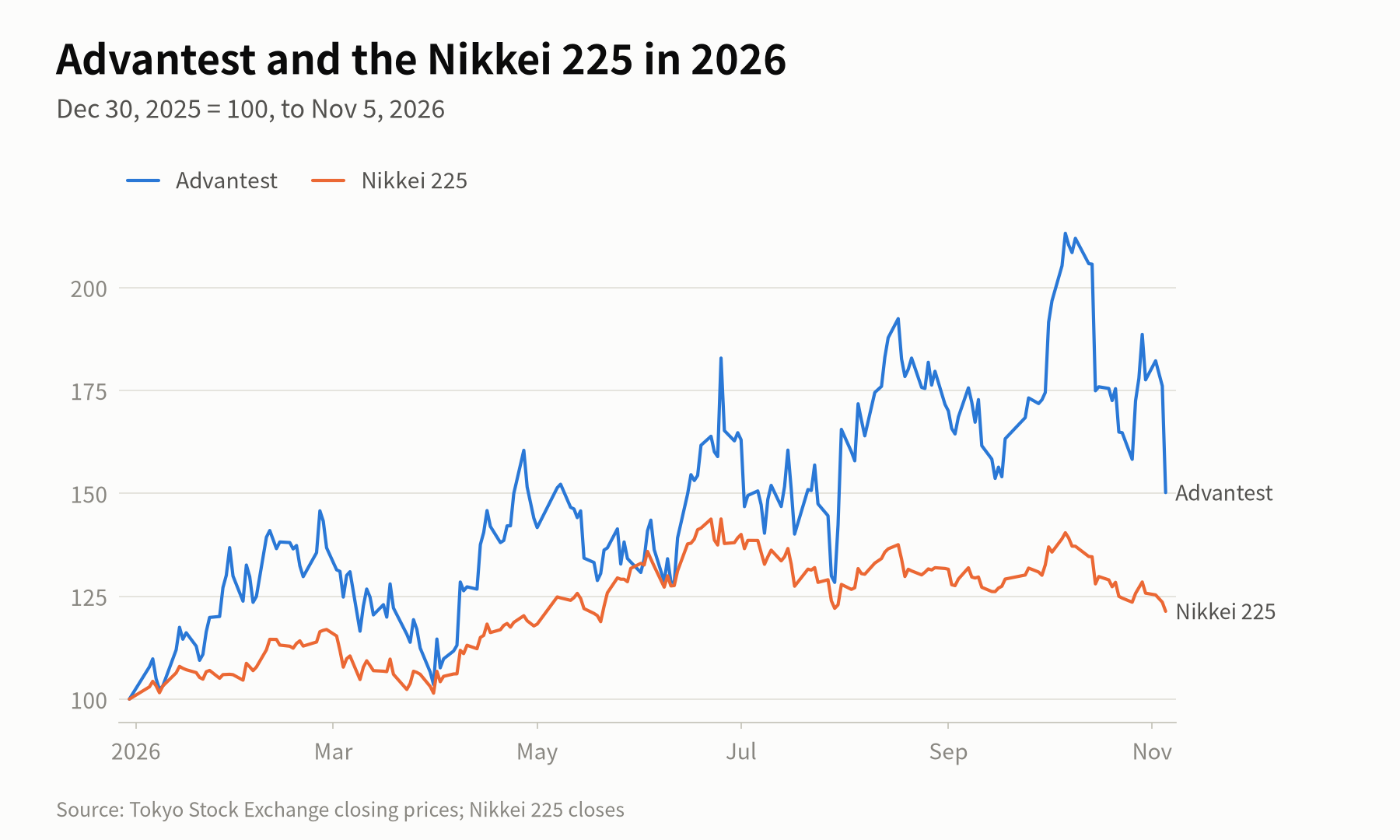
Its own moves have been larger than the index’s. From December 30, 2025 to November 5, 2026, Advantest’s share price rose 50.2% and the Nikkei 225 21.3%.
Where the stock trades
On the Prime Market of the Tokyo Stock Exchange under code 6857. Japanese stocks trade in units of 100 shares, according to Japan Exchange Group. Advantest closed at 29,485 yen on November 5, 2026, so one 100-share unit cost about 2.95 million yen. With the 721,952,905 shares outstanding, excluding treasury shares, on September 30, that close values the company at about ¥21.3 trillion.
Japan Chip Stocks: Who Makes What places Advantest among Japan’s other chip companies, and How to Buy Japanese Chip Stocks covers the ways to hold Tokyo-listed shares from abroad.
Sources
- FY2026 Second Quarter (Semi-Annual) Consolidated Financial Results (October 28, 2026)
- Interim Dividends for the Fiscal Year Ending March 31, 2027 (October 28, 2026)
- Notice Concerning the Decision on Repurchase of Treasury Shares (October 28, 2026)
- Integrated Annual Report 2026
- FY2023 Second Quarter Consolidated Financial Results (October 31, 2023)
- Regarding the Capping Ratio of Advantest in Nikkei 225 (January 30, 2026)
- Regarding the Capping Ratio of Advantest in Nikkei 225 (July 31, 2026)
- Nikkei 225's Divisor to Fall to 29.83073565 (September 29, 2026)
- Trading Unit, Trading Rules of Domestic Stocks
- TSE closing prices (Advantest)
Related reading
More in Explainers
- Chip Stock Heatmap Explained: How to Read the Asia-Pacific Chips MapMarket Map
- Asia Chip Stocks From a US Account: SKHY, TSM, KXIAY and Other TickersExplainers
- Who Makes What in Memory: DRAM, NAND and HBM Across Asia and the USExplainers
- After a Big SOX Day: How Seoul, Tokyo and Taipei Chip Stocks FollowedExplainers
- Taiwan's Foreign Investor Flows: Reading TWSE's Daily Net-Buy DataExplainers
- How to Read a Japanese Kessan Tanshin (Earnings Summary)Explainers
- Why US Chip Earnings Come After the Bell, and What Asia Sees NextExplainers
- Korea's 10-Day Export Data: How Chip Exports Are CountedExplainers
- TSMC's Quarterly Dividend: Ex-Dividend Dates for 2330 and TSMExplainers
- Korean Preferred Shares: Why Samsung's 005935 Trades Below Its CommonExplainers
- SOX and the Nikkei 225: How US Chip Stocks Reach Tokyo's Next SessionExplainers
- Kioxia and SanDisk: How the Two NAND Makers Share Their FabsExplainers
- Stock Split vs Reverse Split: From SOXX and SanDisk to Penny StocksExplainers
- What Is Rapidus? Japan's 2nm Chipmaker and the Companies Behind ItExplainers
- Samsung vs SK hynix: How Korea's Two Memory Giants DifferSamsung & SK hynix
- TSMC in Japan: What Is JASM, the Kumamoto Chip Plant?Explainers
- What Is HBM? High-Bandwidth Memory vs DRAM, HBM3E and HBM4Explainers
- SOXL and SOXS Explained: 3x Leveraged and Inverse Chip ETFsExplainers
- Custom AI Chips Explained: Google TPU, Amazon Trainium and ASICsExplainers
- Where Japan Fits in the Chip Supply Chain, Next to Taiwan and KoreaExplainers
- Taiwan's Chip Stocks: Who Makes WhatExplainers
- What Samsung Electronics Makes: Chips, Phones, Displays and MoreSamsung & SK hynix
- Japan's Chip Stocks: Who Makes WhatExplainers
- Why Nvidia's Earnings Move Memory StocksExplainers
- Chip Equipment Makers: ASML, Applied, Lam, KLA and Tokyo ElectronExplainers
- SOX Heatmap Explained: How to Read the US Chip Index MapMarket Map
- Memory Stock Map Explained: DRAM, NAND and HBM Makers in One ViewMarket Map
- S&P 500 Heatmap Explained: How to Read the US Market MapMarket Map
- How to Buy Japanese Chip Stocks: Tokyo Shares, OTC ADRs and ETFsGuides
- How to Buy Taiwan Stocks From Abroad: TWSE Shares, TSM and ETFsGuides
- What Do 3nm and 2nm Mean? Chip Process Nodes ExplainedExplainers
- US Chip Export Controls on China, ExplainedExplainers
- What Is CoWoS? TSMC's Advanced Packaging and the AI Chip BottleneckExplainers
- Foundry, Fabless and IDM: How Chipmakers Split the WorkExplainers
- Why Samsung Reports Earnings Twice, and How Other Chipmakers ReportSamsung & SK hynix
- SOXX vs SMH vs SOXQ: How Three Semiconductor ETFs DifferExplainers
- How a Stock Gets Into the S&P 500 and the Nasdaq-100Explainers
- US Stock Futures Overnight: What Dow, S&P 500 and Nasdaq Futures ShowExplainers
- One Chip Day, Four Closes: Seoul, Taipei, Tokyo and New YorkExplainers
- Japan's Margin Trading Data: What It Says About KioxiaExplainers
- Kioxia Outside Japan: 285A in Tokyo vs KXIAY Over the CounterExplainers
- Kioxia's 3-for-1 Split: How to Read Its Price HistoryExplainers
- Micron's Fiscal Calendar: Why Its Quarters Don't Match Samsung'sExplainers
- Nikkei 225 vs TOPIX: Why Chip Stocks Move Them So DifferentlyExplainers
- The Philadelphia Semiconductor Index (SOX) and Why Asia Watches ItExplainers
- Taiwan's 10% Daily Price Limit and Other Rules for Foreign InvestorsExplainers
- TSM vs 2330: Why TSMC's US Shares Trade Above TaipeiExplainers
- TSMC's Monthly Sales: How Taiwan's Monthly Revenue Reports WorkExplainers
- Why One Stock Moves Taiwan's Market: TSMC and the TAIEXExplainers
- How Foreign Investors Move the KOSPI, and Where to See the Daily DataExplainers
- How to Buy Korean Stocks in 2026: 4 Routes for US, Singapore, UKGuides
- How to Buy Samsung Stock Outside Korea: Shares, London GDR and ETFsGuides
- Korea Discount and the Value-up Program, Explained SimplyExplainers
- KOSPI Heatmap Explained: How to Read Korea's Market MapMarket Map
- Why MSCI Still Hasn't Upgraded Korea, and What Would Change ItExplainers
- How Samsung and SK hynix Compare in HBMSamsung & SK hynix
- SKHY vs 000660: How the Two Ways to Own SK hynix DifferSamsung & SK hynix
- Why Is the KOSPI So Volatile? Chips, Foreign Money and the WonExplainers