Why Kioxia Disappointed After Earning 2 Trillion Yen in Three Months
On October 30, Japanese memory maker Kioxia reported July-September operating profit of 1.9947 trillion yen, or about 80 yen of profit for every 100 yen of revenue. Yet right after the release, its shares fell 11% in Germany. The disappointment was not about the past three months. It was about the company’s forecast that profit would stay flat over the next three.
How much Kioxia earned in July-September
Revenue was 2.48 trillion yen and operating profit was 1.9947 trillion yen. A year earlier, operating profit was 85.9 billion yen, so it grew more than 23 times. It also came in almost exactly in line with the market estimate compiled by Investing.com (1.97 trillion yen).
Prices, more than shipments, drove the profit.
- Shipments (in bits): up a little over 10% from the previous quarter
- Average price: up in the mid-20% range
- First interim dividend since listing: 90 yen per share (on a pre-split basis, before the October 1 three-for-one split)
- Policy: return all surplus cash to shareholders, as long as the company stays in a net cash position
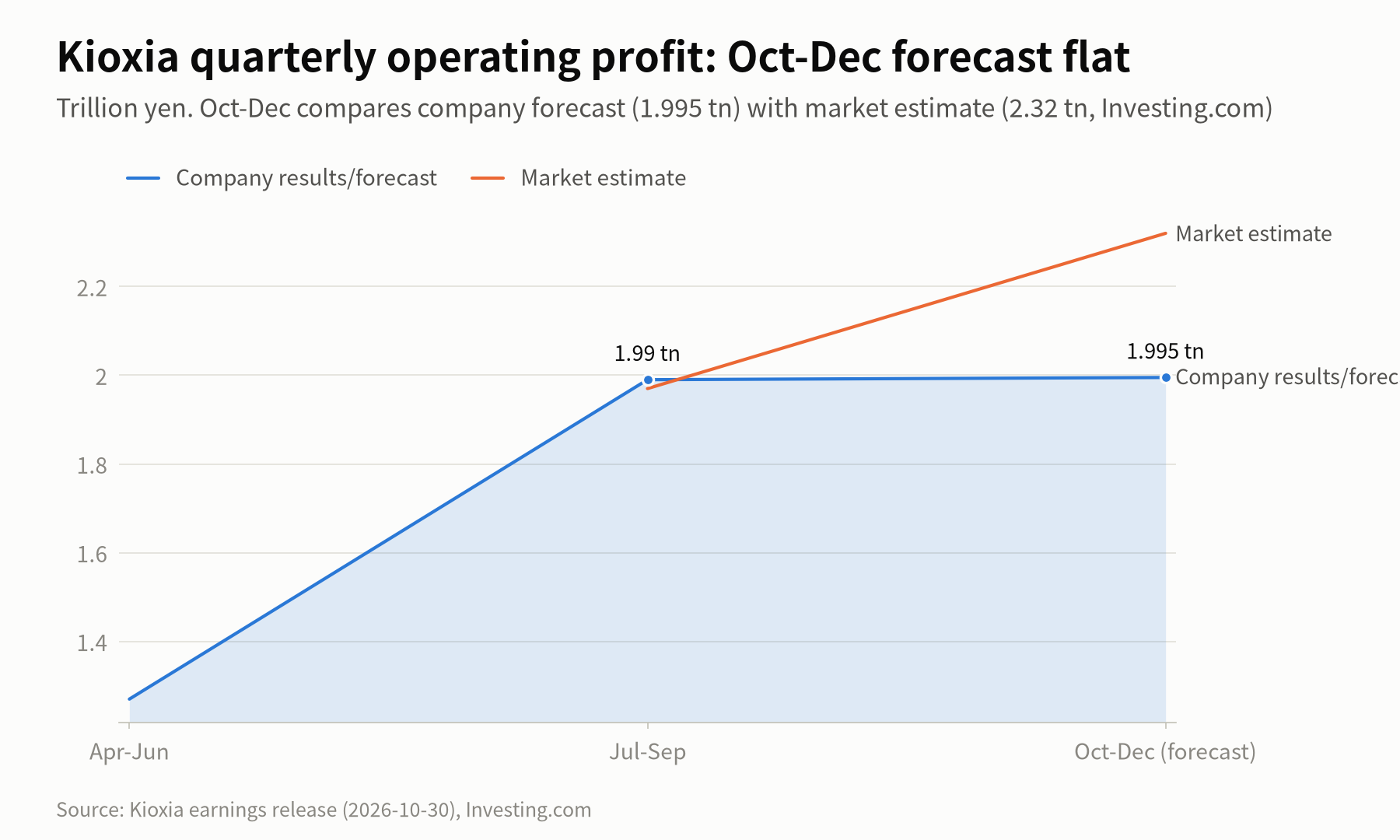
Why it disappointed: profit flat for the next three months
The company forecast October-December revenue of 2.5 trillion yen and operating profit of 1.995 trillion yen, almost the same as July-September. Market estimates were 2.32 trillion yen according to Investing.com and about 2.35 trillion yen in Bloomberg’s compilation. The company’s forecast was 14-15% below market estimates. After climbing step by step every quarter, profit is forecast to level off for the first time.
First, price increases slow sharply
The company expects the average price to rise only in the low single digits in October-December. According to the Seoul Economic Daily, average NAND prices rose about 70% in April-June and about 20% in July-September. The company explained that prices for each application keep rising, but a larger share of lower-priced products means the average rises less.
Second, shipments are not growing
The company expects October-December shipments to be about the same as in July-September. It said part of the volume originally planned for October-December went out early, in July-September, while some shipments were pushed into the next quarter. This does not mean demand has fallen, but confirming that will take another quarter.
Third, a stronger yen is already built in
The company assumed an exchange rate of 157 yen to the dollar for October-December, a stronger yen than the 161 of July-September. Because Kioxia is paid in dollars and reports its results in yen, the company expects the exchange rate to trim results by 2-3%.
When and how far the shares fell
The results came out at 6:45 p.m., after the Tokyo market closed. So the October 30 Tokyo close of 13,470 yen, down 7.14%, reflects trading before the release. After the release, the stock fell 11% on Germany’s Tradegate exchange, and in Korea, Samsung Electronics extended its losses in the after-market session on Nextrade, Korea’s alternative exchange. The Tokyo market’s first reaction comes on Monday, November 2.
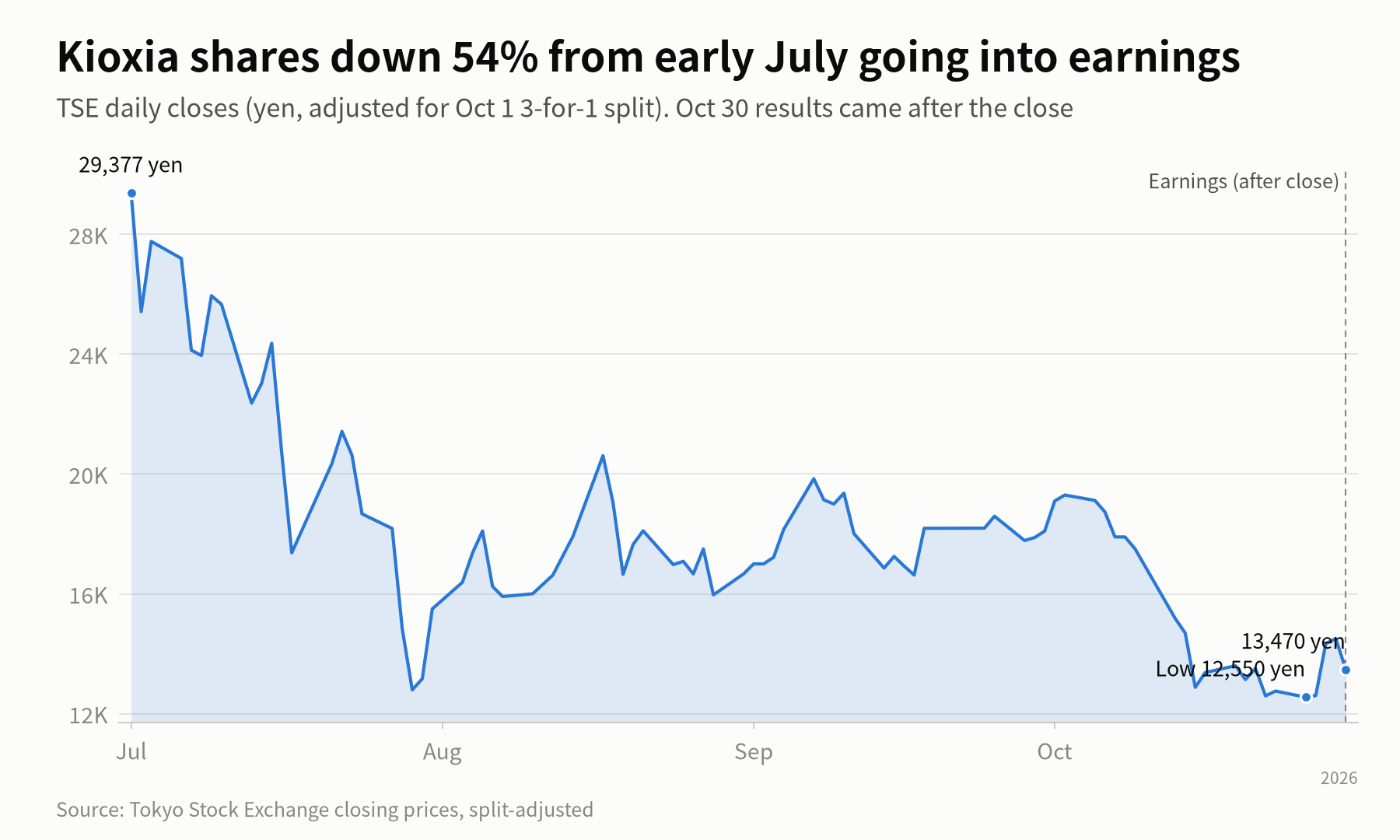
Kioxia’s shares had already dropped 54%, from 29,377 yen (split-adjusted) on July 1 to 13,470 yen on October 30. Even as profit grew, the market had been asking first how long prices would keep rising.
Is the NAND boom fading?
The company said all of next year’s production capacity is already committed to customers. It is also adding long-term supply contracts with data-center customers.
Its price outlook, however, was cautious. The chief financial officer said it was uncertain whether prices would keep rising in fiscal 2027. Kenji Yasui, head of research at UBS Securities, pushed back: “Does it make sense to say supply and demand are extremely tight and then call the price outlook uncertain?”
Four things to watch
- The first Tokyo reaction on November 2: whether the 11% drop in Germany carries over
- Average NAND prices: whether increases stay in the single digits or pick up again
- The yen-dollar rate: a yen stronger than 157 to the dollar cuts profit further
- Competitors: the next results from SanDisk, Samsung Electronics and SK hynix, which compete for the same customers
In short, these results were strong numbers, stalled momentum. An 80% profit margin is still a boom, but what the market had been paying for was a boom that kept getting steeper.
This post reflects information as of October 31, 2026, and is not investment advice on any particular stock or product.
Frequently asked questions
Q1. Can Kioxia shares be traded from Korea?
A1. Kioxia is listed on the Tokyo Stock Exchange under the ticker 285A. Brokerage apps that support overseas stocks differ in whether they take orders on the Japanese market. The shares trade in yen, so exchange-rate moves also feed into returns.
Q2. Do Kioxia’s results affect Samsung Electronics and SK hynix shares?
A2. Because they are all in the memory industry, investor sentiment toward them often moves together, and this time too Samsung Electronics slid further in the after-market session right after the release. But both companies have large DRAM and HBM businesses, so their earnings structure differs from that of Kioxia, which makes only NAND.
Q3. The results matched expectations, so why call them a disappointment?
A3. Stock prices reflect the next results before the past ones. July-September matched expectations, but the October-December profit forecast came in 14-15% below market estimates, which was read as a sign that growth had stalled.
Sources: Kioxia fiscal 2026 second-quarter results (October 30, 2026), Investing.com (October 30, 2026), Bloomberg (October 30, 2026), Seoul Economic Daily (October 30, 2026), Edaily (October 30, 2026), Tokyo Stock Exchange closing prices (split-adjusted)
Information only, not investment advice.
Related reading
More in Blog
- Caterpillar as an AI Stock: Why Midterm Data Center Curbs Hit It
- US Chip Stocks Rebound, but AI Leaders Win Back the Least
- The SOX Plunge: 3 Reasons Only Chips Fell After the Midterms
- Chip Stocks Tonight: Three Things to Watch as AMD Reports
- After the SOX Plunge: Three Checkpoints for This Week
- AI Spending Over Earnings: 3 Reasons TSMC Shares Slipped
- The KOSPI's Roller Coaster Won't Stop. Is the Nikkei on It Too?
- SanDisk's 4.6x Revenue Outlook: What It Signals for Kioxia
- Is Samsung Handing a Key HBM Chip to TSMC?