US Chip Stocks Rebound, but AI Leaders Win Back the Least
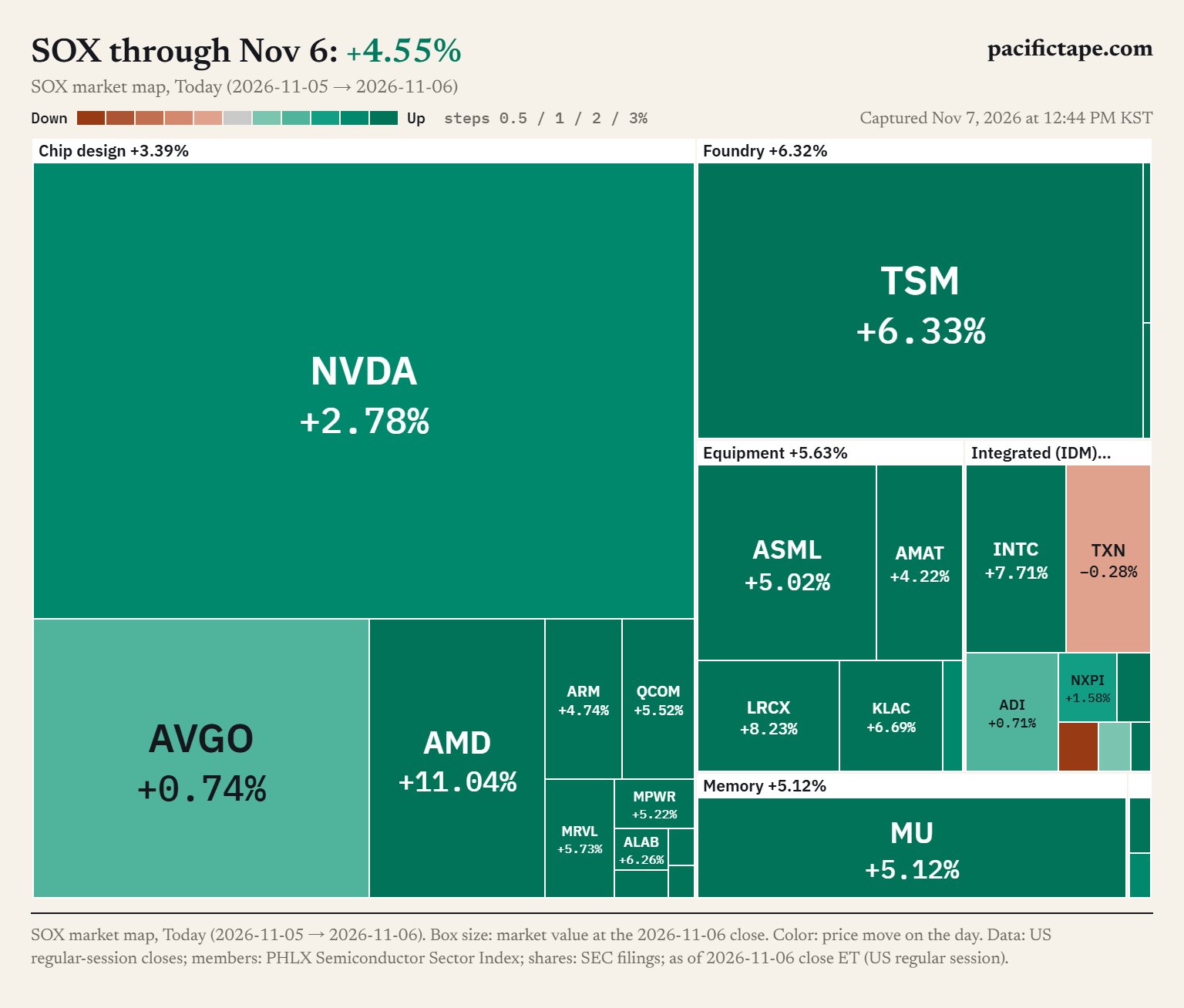
On November 6, 2026 (US time), the US chip ETF SOXX rose 3.51%, a day after falling more than 12%. Eight large chipmakers won back an average of 36% of Thursday’s losses, but the figure ranged from 6% to 67% depending on the stock. All of them rallied strongly during the session, and the closer a stock was to AI data centers, the more of that gain it gave up in the afternoon.
Scorecard for eight stocks: how much of Thursday’s drop they recovered
The figures below are Thursday’s change, Friday’s change and the share recovered, in that order.
- Intel: -10.33%, +7.71%, 67%
- AMD: -17.26%, +11.04%, 53%
- Qualcomm: -9.49%, +5.52%, 53%
- Arm: -13.08%, +4.74%, 31%
- Marvell: -16.43%, +5.73%, 29%
- Nvidia: -9.26%, +2.78%, 27%
- Micron: -17.46%, +5.12%, 24%
- Broadcom: -10.43%, +0.74%, 6%
The share recovered is Friday’s gain in dollars divided by Thursday’s loss in dollars. Because Friday’s percentage gain applies to a price that had already dropped, dividing one percentage by the other overstates the recovery. For Intel, the percentages give 75%, but in dollar terms the figure is 67%. A simple average across the eight is 36%.
Why the biggest AI names recovered the least
At their intraday highs, all of them had won back around half
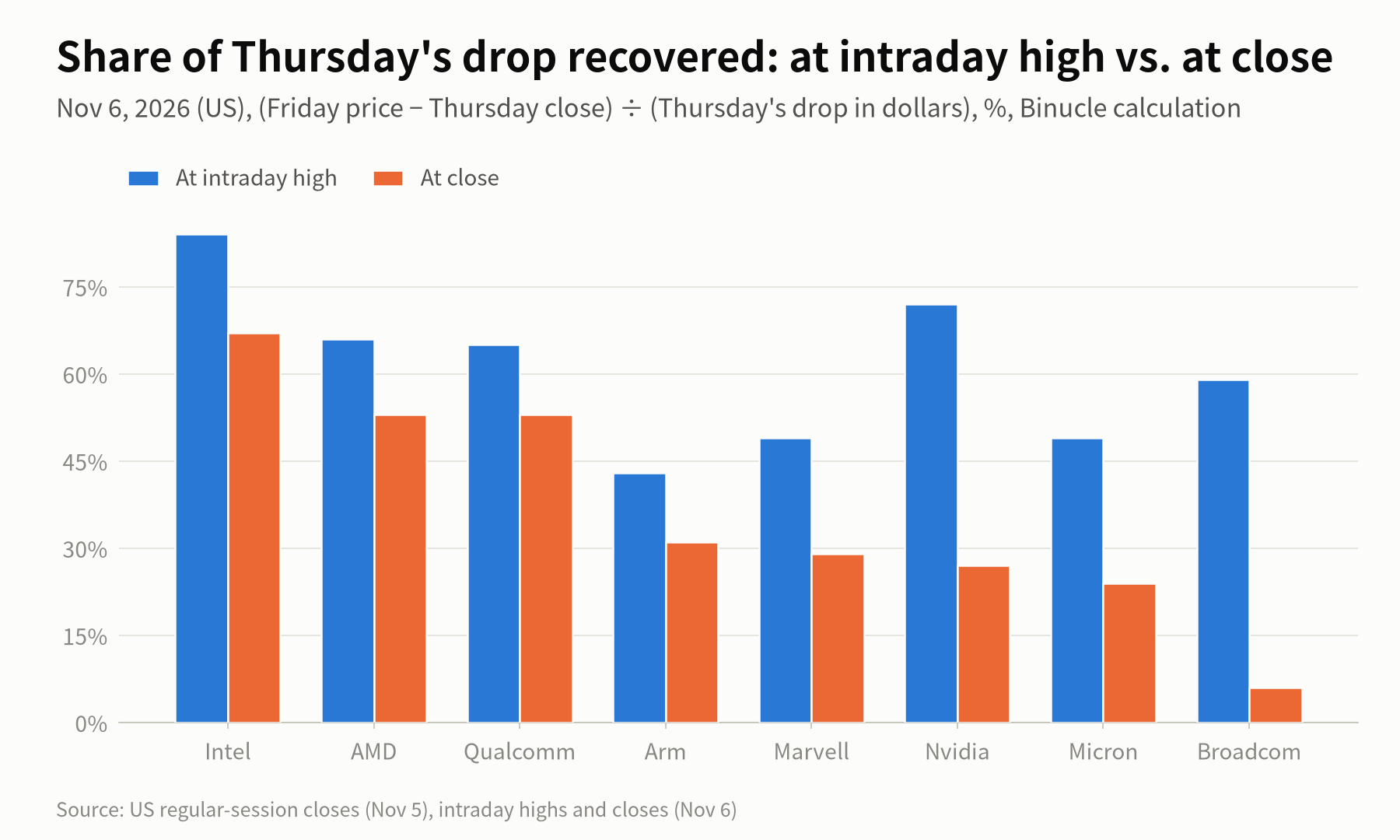
Measured at Friday’s intraday highs, all eight had recovered between 43% and 84% of their losses. Even Broadcom opened 6.7% higher and at one point had won back 59%.
The difference came from how much they held on to by the close. From their intraday highs to the close, Broadcom slipped 5.7%, Micron 4.8% and Nvidia 4.2%. That is two to three times the pullbacks at Intel (1.8%), Qualcomm (1.2%) and AMD (2.3%).
The three that slipped most get a large share of revenue from AI data centers
Broadcom’s main business is custom AI chips for big tech companies, Micron’s is memory for AI servers (HBM, or high-bandwidth memory), and Nvidia’s is AI accelerators (GPUs). This sharp drop began with concerns that regulation of AI data center construction could tighten after the US midterm elections. With those concerns not resolved in a single day, the stocks closest to data centers appear to have come under pressure again first. This is Binucle’s interpretation, based on the intraday moves.
Intel had already fallen a long way
Intel fell 45.3% from October 28 to November 5, including a one-day drop of 28.58% after its October 30 earnings report. Qualcomm’s earnings, released after the close on November 4, showed handset chip revenue down 26%, below expectations (Reuters). For both companies, their own company-specific issues had been reflected before the data center concerns, and their Thursday declines were smaller, around 10%, which made them easier to recover.
Does one day of rebound mean the sharp drop is over?
The week is still in the red
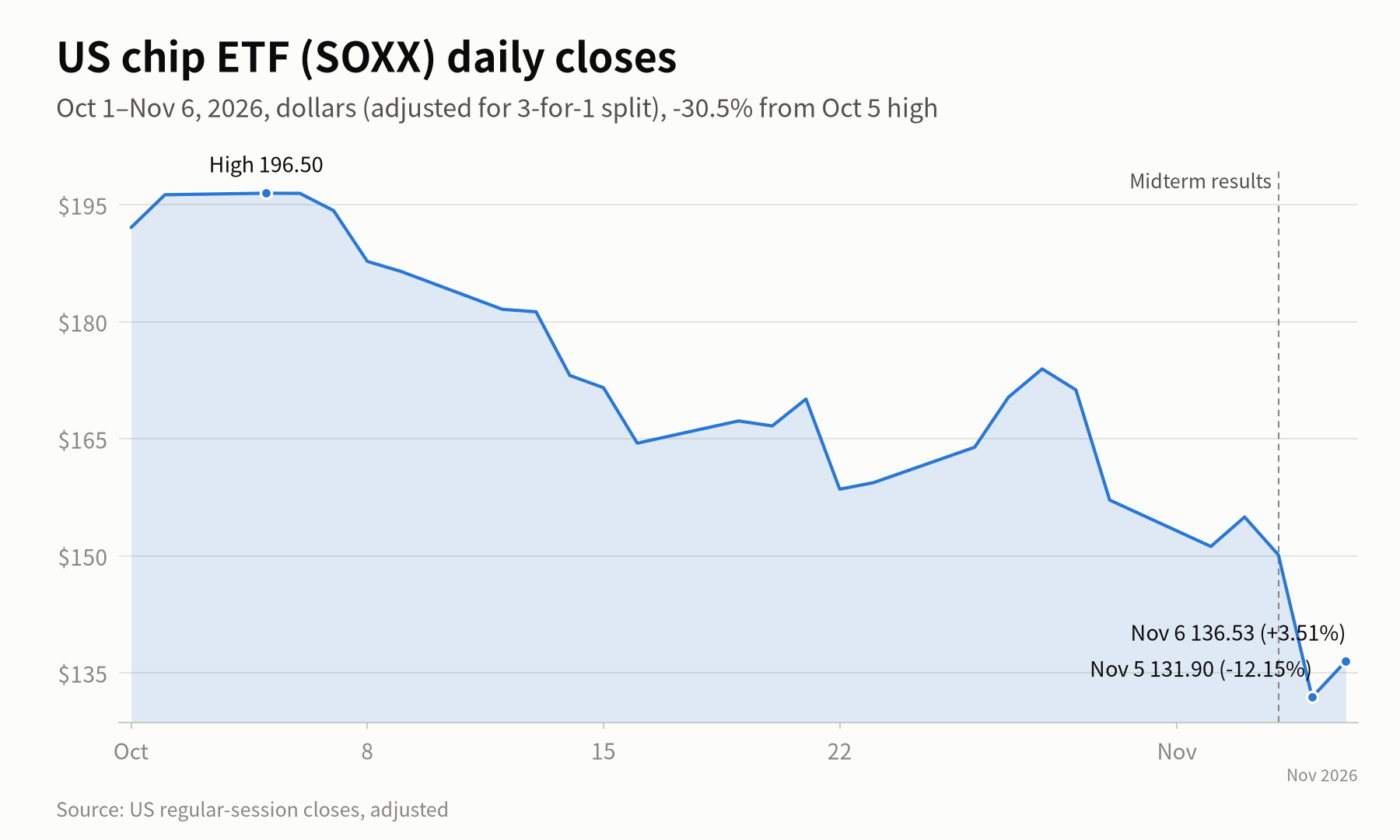
Despite Friday’s rebound, the S&P 500 fell 2.7% for the week and the Nasdaq Composite fell 3.4%. All three major indexes have now fallen for four straight weeks (UPI). SOXX closed at $136.53, 30.5% below its October 5 high of $196.50.
Interest rates remain a factor
October payrolls, released the same day, rose by 165,000, well above the Bloomberg consensus of about 65,000. The US 10-year Treasury yield rose to 4.86%. Strong job numbers raise expectations that the Fed could raise rates further, which weighs on tech stocks.
A checklist to apply to your own holdings
- How far did your chip stocks slip from their intraday highs to the close?
- What share of each company’s revenue comes from AI data centers?
- Did the company have its own bad news (earnings or guidance), or was it a sector-wide concern?
The figures in this post are based on US regular-session closes on November 6, 2026. This post is not investment advice about any particular stock or product.
Frequently asked questions
Q1. How much does a stock have to gain to make back its losses?
A1. More than the percentage it lost. After a 10% drop it takes about 11.1%, and Micron, down 17.46%, needs 21.2% to break even.
Q2. Does a chip ETF swing less than individual stocks?
A2. It reflects one company’s bad news less. But on Thursday, when the whole sector fell, SOXX also dropped 12.15%. Spreading across stocks and spreading across sectors are different things.
Q3. Did this drop push Nvidia below where it started the year?
A3. Its November 6 close of $186.64 is 0.3% above its close on the last trading day of 2025 ($186.06). In effect, it is back to almost exactly where it began the year.
Sources: US regular-session closes; lead image: pacifictape.com SOX map; US regular-session opens and intraday highs; Reuters (Qualcomm earnings, November 4, 2026); US Department of Labor (October jobs); Bloomberg (payroll forecast); Reuters and UPI (weekly index moves)
Information only, not investment advice.
Related reading
More in Blog
- Caterpillar as an AI Stock: Why Midterm Data Center Curbs Hit It
- The SOX Plunge: 3 Reasons Only Chips Fell After the Midterms
- Chip Stocks Tonight: Three Things to Watch as AMD Reports
- After the SOX Plunge: Three Checkpoints for This Week
- AI Spending Over Earnings: 3 Reasons TSMC Shares Slipped
- Why Kioxia Disappointed After Earning 2 Trillion Yen in Three Months
- The KOSPI's Roller Coaster Won't Stop. Is the Nikkei on It Too?
- SanDisk's 4.6x Revenue Outlook: What It Signals for Kioxia
- Is Samsung Handing a Key HBM Chip to TSMC?