After the SOX Plunge: Three Checkpoints for This Week
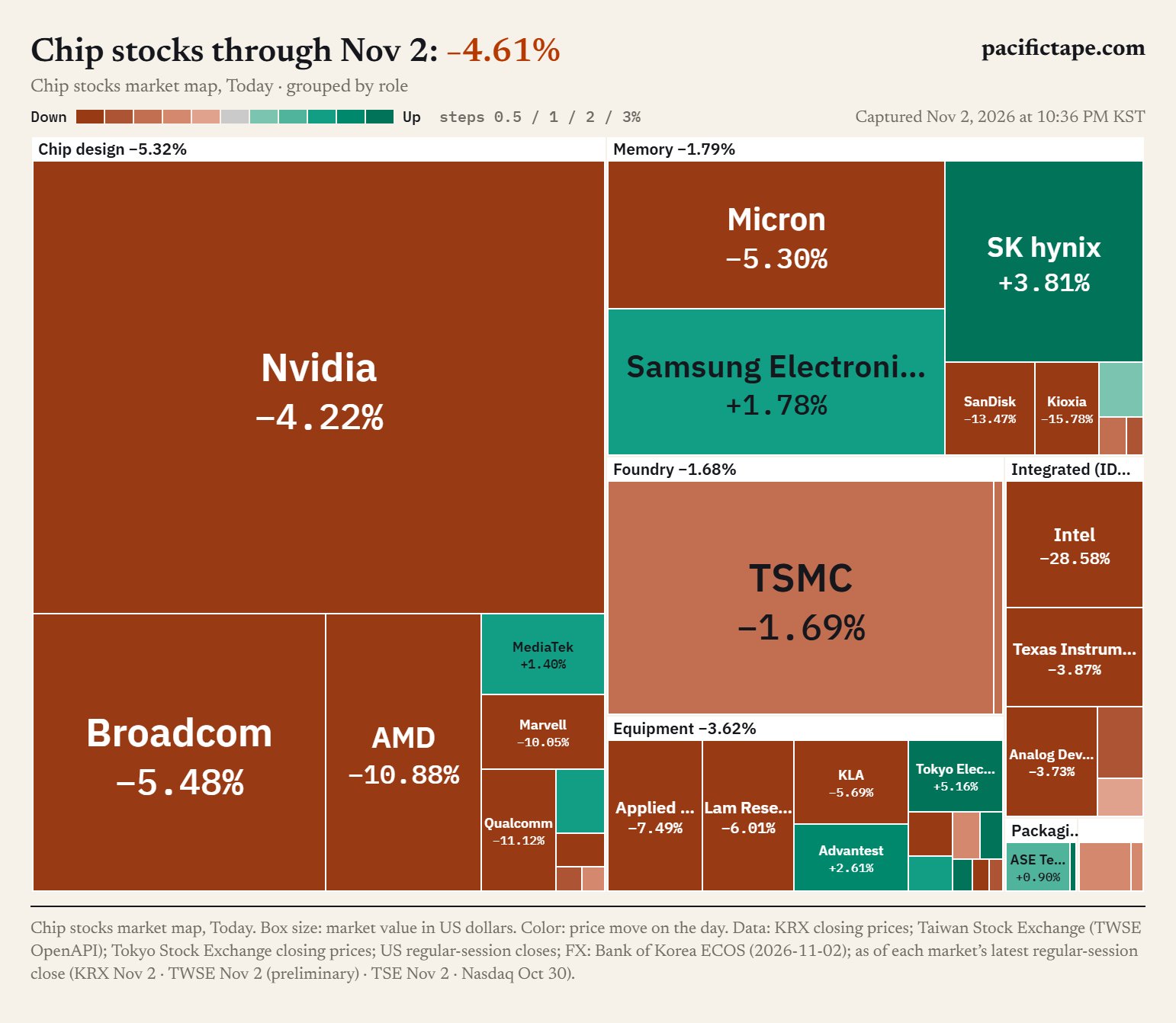
Map of chip stocks by role: US prices as of October 30 closes, Korea, Japan and Taiwan as of November 2 closes (captured 10:36 p.m., November 2)
Last Friday, October 30, the Philadelphia Semiconductor Index (SOX) fell 7.20% in a single day, and SOXX, the ETF that tracks it, ended 20.0% below its October 5 peak. The SOX’s direction this week depends on whether earnings from AMD (November 3) and Qualcomm and Arm (November 4) narrow the Intel shock down to a “PC and phone problem,” and whether the slowdown in NAND prices flagged by Kioxia spreads to US memory stocks.
SOX -7% on Friday: which stocks pulled it down
It started with Intel. Intel guided its fourth quarter below market expectations and pointed to a slowing PC market, and its shares fell 28.58% in a day. Amazon’s earnings landed the same day, and one question spread across the whole chip sector: AI spending keeps growing, but when does it start paying off?
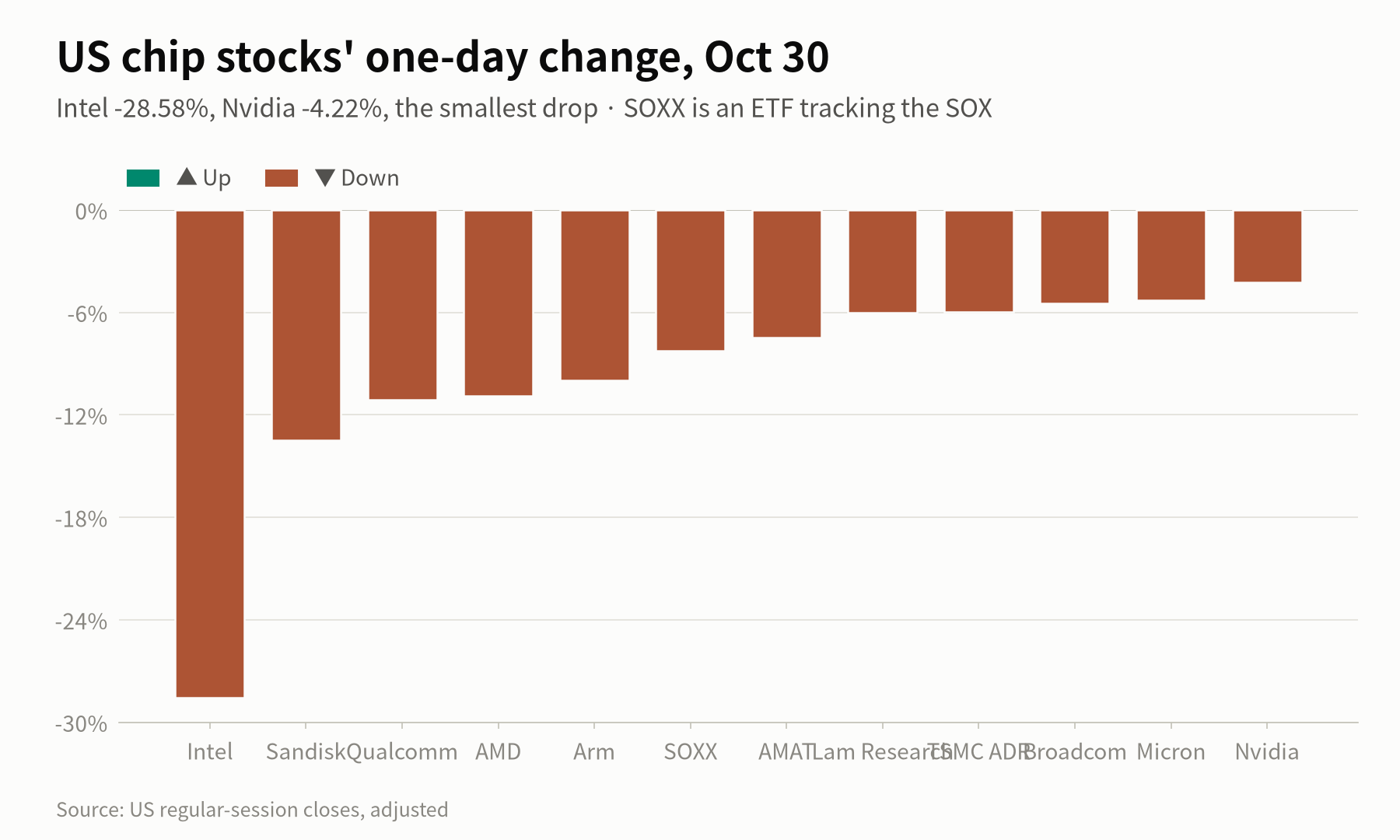
The size of the drop varied widely from stock to stock.
- PCs and CPUs: Intel -28.58%, AMD -10.88%
- Phones: Qualcomm -11.12%, Arm -9.97%
- Memory: Sandisk -13.47%, Micron -5.30%
- Equipment: Applied Materials -7.49%, Lam Research -6.01%
- Core AI: TSMC ADR -5.95%, Broadcom -5.48%, Nvidia -4.22%
- SOXX (ETF tracking the SOX): -8.24%
Nvidia, the center of AI chips, fell the least, while PC, phone and NAND names fell the most. The market did not abandon chips all at once; it started sorting them by whether a company gets AI demand directly.
SOX in October: down 20% from the peak
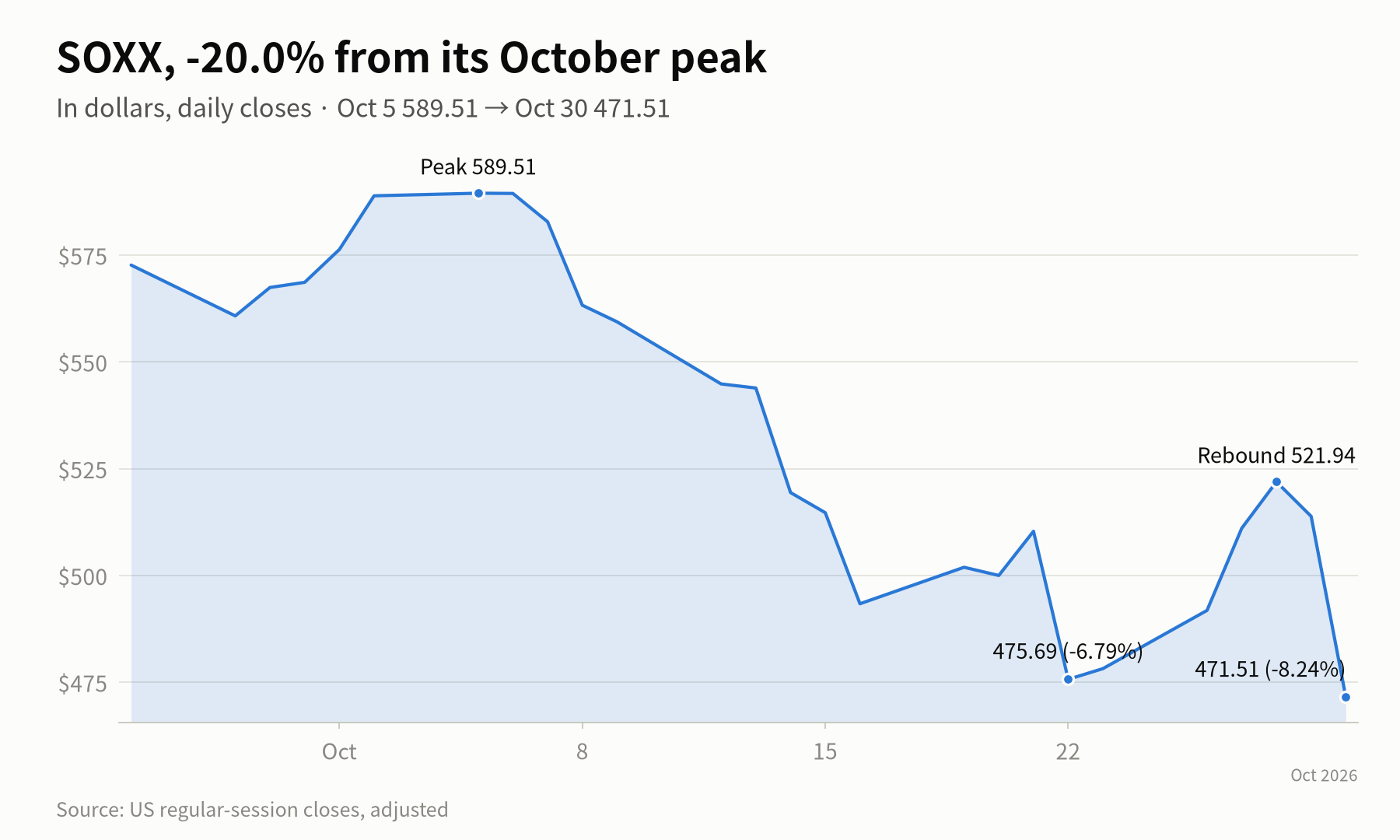
SOXX fell 17.1% over October. It had four drops of more than 4%: October 14 (-4.50%), October 16 (-4.14%), October 22 (-6.79%) and October 30 (-8.24%). In between, it rebounded three days in a row from October 26 to 28 (about 9.1% in total). A 20% drop from a peak is the line the market commonly calls entering a bear market.
Signals from Asian chip stocks before the US open
Asian markets, which closed before the US session opened, offered three clues to where the SOX may go tonight.
- NAND: Japan’s Kioxia plunged 15.78%. Its operating profit forecast for October to December was about 2 trillion yen, roughly 15% below market expectations (about 2.35 trillion yen), and it said the rise in average NAND selling prices would slow from the mid-20% range in July to September to the low single digits. That is a weight on Sandisk, a fellow NAND maker.
- Equipment: Tokyo Electron rose 5.16% after raising its full-year net profit forecast. That is the opposite signal for US equipment stocks, which fell more than 7% on Friday.
- Foundry: TSMC fell 1.69% in Taiwan, a much smaller drop than its US ADR’s fall on Friday (-5.95%).
In Korea, Samsung Electronics (+1.78%) and SK hynix (+3.81%), which had fallen first on Friday, rebounded. Asian trading ended not in an across-the-board exit from chips but in a selective one: out of NAND, and back into equipment and DRAM.
SOX this week: three checkpoints
1. AMD earnings (November 3): is AI data-center demand holding up?
AMD reports after the US close on Tuesday, November 3, which is 7 a.m. on Wednesday, November 4, Korea time. The company’s own guidance for Q3 revenue was about $13 billion (plus or minus $300 million). Because AMD fell 10.88% alongside Intel on Friday, strong data-center GPU demand and a strong fourth-quarter outlook could narrow Friday’s drop down to a “PC problem.” If AMD also comes in weak, doubts would likely move on to core AI stocks such as Nvidia.
2. Qualcomm and Arm earnings (November 4): phones and memory costs
Qualcomm and Arm report after the US close on Wednesday, November 4, which is Thursday morning, November 5, Korea time. Both fell around 10% on Friday. With rising memory prices adding to the cost of making phones, the key is how they present the outlook for year-end phone demand.
3. Memory prices: DRAM at a record, NAND stalls
October DRAM contract prices hit another record on AI server demand, but NAND prices stopped rising for the first time in 21 months. Whether Sandisk falls further this week, following Kioxia, and whether Micron, with its larger share of DRAM, holds up will show the direction of the memory sector.
Also on the calendar are the US midterm elections on Tuesday, November 3, and the October jobs report on Friday, November 6 (10:30 p.m. Korea time), both of which could add to volatility across the market.
The other view: the numbers themselves are still good
The current drop is less about weak results than about doubt over when AI spending will pay off. Korea’s October exports, led by chips, rose 93.7% from a year earlier to a record $115.3 billion, and Samsung Electronics said its HBM volume for next year is sold out. Tokyo Electron also raised its forecast. Whether this week’s earnings produce numbers that ease that doubt is the condition for a SOX rebound.
In one line
After the SOX fell 20% from its peak, the market began dividing chips into companies that get AI demand directly and those that do not. This week’s AMD, Qualcomm and Arm earnings and the moves in memory stocks will decide whether that sorting continues or turns back into a broad retreat from the whole sector.
This post reflects information as of the Asian market close on November 2, 2026, and is not investment advice on any particular stock or product.
Frequently asked questions
Is a 20% drop in the Philadelphia Semiconductor Index a bear market? A 20% drop from a peak is commonly used as the bear-market threshold. SOXX is 20.0% below its October 5 closing high (as of the October 30 close).
Why did Nvidia fall less in the SOX plunge? Friday’s bad news centered on Intel’s PC outlook and worries about phone and NAND demand. Nvidia fell 4.22%, less than Intel (-28.58%), Qualcomm (-11.12%) and AMD (-10.88%).
When do US chip companies report this week? AMD reports on Wednesday morning, November 4, Korea time, and Qualcomm and Arm on Thursday morning, November 5. The US midterm elections are on Tuesday, November 3, and the jobs report is at 10:30 p.m. on Friday, November 6.
Sources: US regular-session closes, adjusted (SOXX, Intel, AMD, Qualcomm, Arm, Sandisk, Micron, Applied Materials, Lam Research, TSMC ADR, Broadcom, Nvidia); KRX regular-session closes (Samsung Electronics, SK hynix); Taiwan Stock Exchange closes (TSMC); Tokyo Stock Exchange closes (Kioxia, Tokyo Electron); Seoul Shinmun and Electronic Times (SOX index moves); Reuters, Bloomberg, The Japan Times and Seoul Economic Daily (Kioxia forecast); AMD, Qualcomm and Arm investor notices (earnings dates); US Bureau of Labor Statistics (jobs report schedule); Yonhap News and The Korea Herald (October exports); ChosunBiz and BusinessKorea (October memory prices); Seoul Economic Daily (Samsung Electronics HBM). Lead image: pacifictape.com chip stock map (by role, captured 10:36 p.m., November 2, 2026)
Information only, not investment advice.
Related reading
More in Blog
- Caterpillar as an AI Stock: Why Midterm Data Center Curbs Hit It
- US Chip Stocks Rebound, but AI Leaders Win Back the Least
- The SOX Plunge: 3 Reasons Only Chips Fell After the Midterms
- Chip Stocks Tonight: Three Things to Watch as AMD Reports
- AI Spending Over Earnings: 3 Reasons TSMC Shares Slipped
- Why Kioxia Disappointed After Earning 2 Trillion Yen in Three Months
- The KOSPI's Roller Coaster Won't Stop. Is the Nikkei on It Too?
- SanDisk's 4.6x Revenue Outlook: What It Signals for Kioxia
- Is Samsung Handing a Key HBM Chip to TSMC?