Caterpillar as an AI Stock: Why Midterm Data Center Curbs Hit It
On November 5, the day the S&P 500 ETF (SPY) fell 4.41%, excavator maker Caterpillar (CAT) fell 6.37% to close at $553.64. In the two days starting the day after the midterm elections, it lost 11.3%. The election result was the final blow. Caterpillar had already fallen 27.6% in the month before the election, and because data center generators are at the center of its growth, the pledge to halt data center approvals struck right at its weak spot.
Caterpillar’s share price: down 47% from its peak
After a record close of $1,060.41 on June 30, Caterpillar moved up and down in the $800s from July through September. The trend turned in October. It closed at $558.63 on November 6, down 47.3% from the peak, giving back all of this year’s gains.
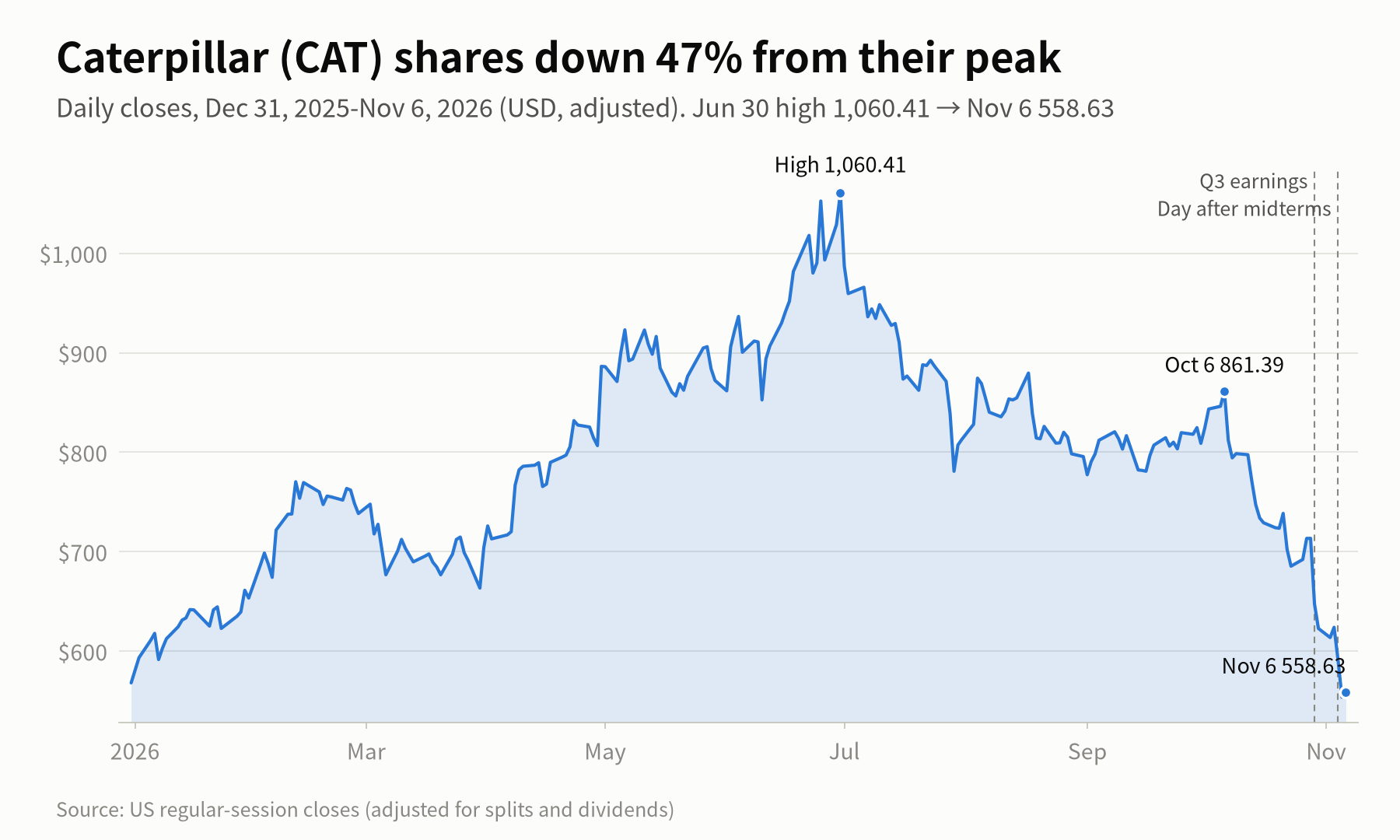
The chart shows a stair-step decline since October. On weekly closes, the stock has fallen five weeks in a row.
How an excavator maker became an AI stock
Caterpillar brings yellow excavators to mind first. But in Q3, revenue in its Power & Energy segment, which makes engines and turbines, was $8.8 billion (+18%), more than the $7.98 billion in its Construction Industries segment. Within it, Power Generation revenue rose 30% to $3.42 billion, and the company attributed the increase to turbines and large reciprocating engines (large gas engines driven by moving pistons) for data centers.
Data centers are turning to their own generators because connecting to the power grid takes too long. According to the US Lawrence Berkeley National Laboratory, power plants that came online in 2024 took a median of 55 months from grid interconnection request to operation. As a result, more data centers are generating their own power by building gas power plants on site.
Meta’s Ohio data center is a prime example. Its dedicated gas power plant uses 12 turbines from Caterpillar subsidiary Solar Turbines and 15 Caterpillar 3520 engines. Engines respond quickly when AI computing makes power use swing suddenly, and spreading the load across many units keeps the plant running if one stops.
Three reasons data center curbs after the midterms tripped up Caterpillar
1. Data centers are at the center of its growth
Caterpillar’s backlog at the end of Q3 was $78 billion, up 96% (about $38 billion) from a year earlier. The company is expanding production capacity for large reciprocating engines to three times its 2024 level, and for gas turbines to 2.5 times. With its future growth riding on data center orders, it is inevitably among the most sensitive to news that fewer data centers will be built.
2. It was already weak before the election
The stock fell 27.6%, from $861.39 on October 6 to $623.94 on November 3, election day.
- October 22, -4.88%: After Meta unveiled bigger AI spending plans, worries grew over how that money would be raised. That day gas turbine maker GE Vernova fell 10.64% and Vertiv, which makes cooling and power equipment for data centers, fell 7.81%.
- October 29, -9.25%: Q3 revenue of $20.7 billion (+17%) and adjusted earnings per share of $7.20 beat market expectations ($7.04-7.10), but the full-year outlook was not raised. It was also said that, excluding tariff refunds, the full-year adjusted operating margin would stay at the low end of the target range.
3. The election result was the final blow
In the November 3 midterms, Democrats won both the Senate and the House, and in the Texas governor’s race Democrat Gina Hinojosa defeated incumbent Governor Greg Abbott. Governor-elect Hinojosa has pledged to halt approvals of new data centers until laws to protect residents are in place, and to end tax breaks for data centers.
Texas matters. According to Goldman Sachs, more than 25% of planned US data center capacity is concentrated in Texas. So on November 4, even as SPY rose 1.65%, Caterpillar fell 5.23%, and the next day, when the whole market collapsed, it fell another 6.37%.
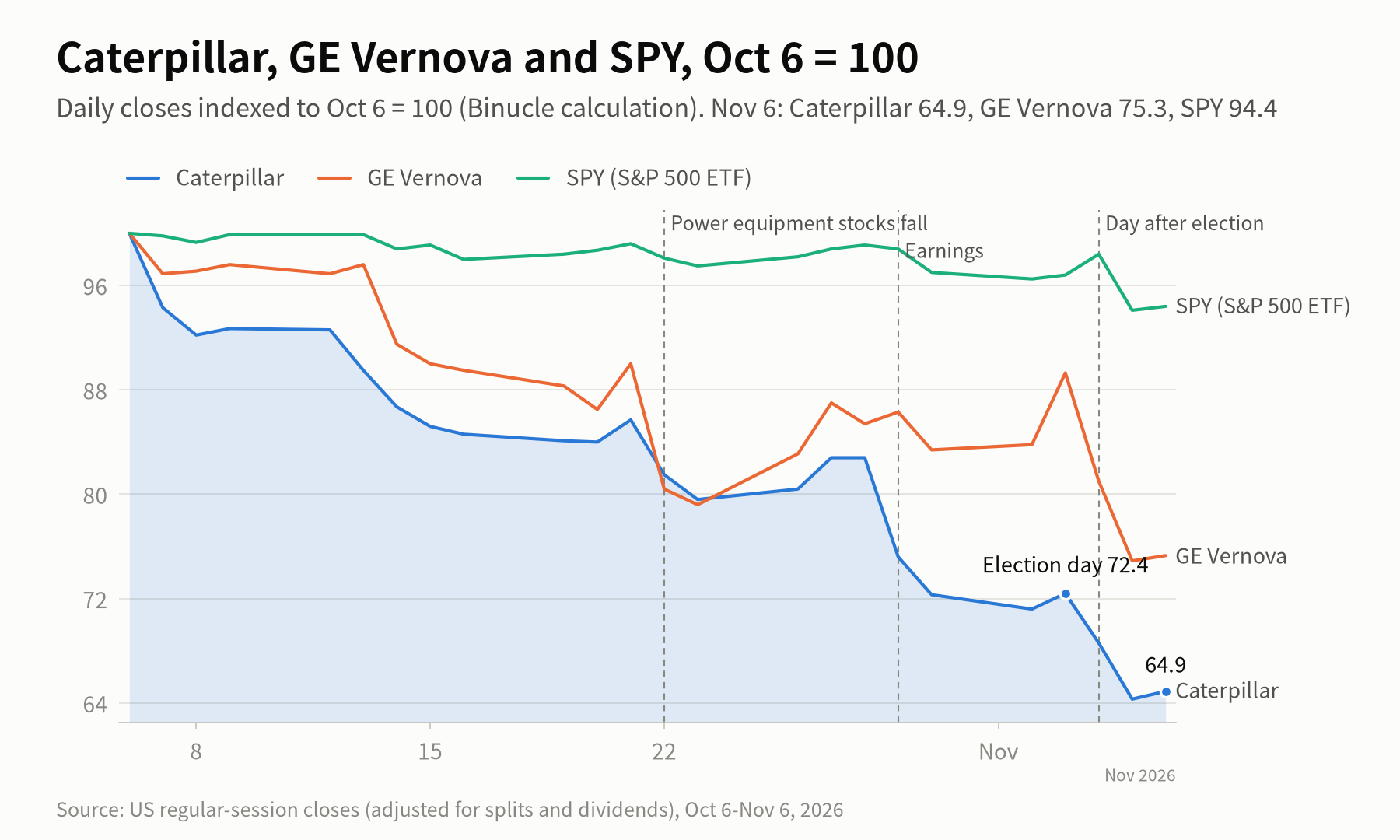
Over the same period (October 6 to November 6), SPY fell 5.6%, but Caterpillar fell 35.1% and GE Vernova 24.7%. Data center power stocks were shaken far more than the market as a whole.
Where growth could still come from
- Actual sales are growing: Sales of power generation equipment to end customers through dealers rose 75% in Q3.
- It is adding supply: It is restarting production of a discontinued 10MW-class gas engine, adding about 1.5GW, with first shipments planned for Q4.
- Orders stretch far ahead: The company said some products have orders booked through 2029.
The opposing view
- The curbs are still a pledge: Governor-elect Hinojosa’s halt on approvals is not yet law. Texas had already stopped approving grid connections for new data centers in August and was conducting an audit, so this is closer to “a risk that the pause lasts longer” than to new regulation.
- The grid wait is unchanged: Regulation aside, the fact that grid connection takes years has not changed.
- Backlog can be canceled: If big tech cuts investment, the backlog could thin quickly, and in gas turbines Caterpillar also competes with GE Vernova and Siemens Energy.
What to watch next
- The new Texas governor’s inauguration and data center bills in the state legislature in January
- Big tech’s 2027 capital spending plans
- Whether the backlog keeps growing in Q4 results
- First Q4 shipments of the restarted gas engine
In one line
What dragged Caterpillar down was not the election alone: growth expectations pinned on data centers had been cooling for more than a month when the pledge to halt data center approvals delivered the final blow.
This post reflects information as of November 6, 2026 (US market close) and is not investment advice on any particular stock or product.
Frequently asked questions
Why are the midterms bad news for Caterpillar?
Caterpillar is growing on orders for gas engines and turbines for data centers, and a pledge to halt new data center approvals has emerged in Texas and elsewhere. That said, the stock had already fallen 27.6% before the election.
What does Caterpillar have to do with data centers?
Caterpillar engines and turbines from its subsidiary Solar Turbines go into gas power plants built on data center sites. Power generation revenue rose 30% in Q3.
How big is Caterpillar’s backlog?
$78 billion at the end of Q3, up 96% from a year earlier. It is a record high, after four straight quarters of growth.
Sources: US regular-session closes (adjusted for splits and dividends); Caterpillar Q3 earnings release and earnings call (October 29, 2026); Power Engineering (Meta’s Ohio power plant); Lawrence Berkeley National Laboratory, Queued Up 2025; Manufacturing Dive (production capacity); Reuters (November 4 and 5, 2026); CNBC and Washington Post (November 5, 2026)
Information only, not investment advice.
Related reading
More in Blog
- US Chip Stocks Rebound, but AI Leaders Win Back the Least
- The SOX Plunge: 3 Reasons Only Chips Fell After the Midterms
- Chip Stocks Tonight: Three Things to Watch as AMD Reports
- After the SOX Plunge: Three Checkpoints for This Week
- AI Spending Over Earnings: 3 Reasons TSMC Shares Slipped
- Why Kioxia Disappointed After Earning 2 Trillion Yen in Three Months
- The KOSPI's Roller Coaster Won't Stop. Is the Nikkei on It Too?
- SanDisk's 4.6x Revenue Outlook: What It Signals for Kioxia
- Is Samsung Handing a Key HBM Chip to TSMC?