The KOSPI's Roller Coaster Won't Stop. Is the Nikkei on It Too?
Even a roller coaster gets dull if you ride it every day. In October through the 29th, the KOSPI 200 moved more than 3% up or down on 8 of 19 trading days. On October 30 it plunged 5% in the morning and triggered a sidecar on program selling. That same morning, Japan’s Nikkei 225 fell 2.58%, and Taiwan’s TAIEX was down as much as 2.8% at one point during the session. All of Asia fell, but the KOSPI’s drop was about twice Japan’s, and it has been that way all October. Half the index is two stocks, Samsung Electronics and SK hynix, so it reacts most strongly to news about US AI spending.
What happened in today’s KOSPI plunge
- KOSPI: 5,640.86 (-5.00%) at 10:15 a.m.
- Sidecar on program selling: triggered at 10:04 a.m., the 28th this year and the first in 11 trading days, since October 15
- Flows (10:15 a.m.): net selling of 511.1 billion won by foreign investors and 263.1 billion won by institutions
- Samsung Electronics down 5%-plus, SK hynix down 8%-plus (around 10 a.m.)
- Same morning: Nikkei 225 at 62,991.89 (-2.58%, 11:28 a.m.), TAIEX intraday low of 45,090.71 (-2.8%)
The trigger came from the US overnight. Alphabet (Google’s parent company) fell about 13% in a single day after reporting that its third-quarter free cash flow had turned to about -$9.1 billion, its biggest drop since its 2004 listing. The Nasdaq fell 1.38%. Amazon and Intel also reported earnings after the close and slipped in after-hours trading.
Free cash flow is the cash a company generates minus its capital spending. A negative figure means it is spending more on AI data centers than it is earning.
Is the Nikkei the same? Same direction, half the swings
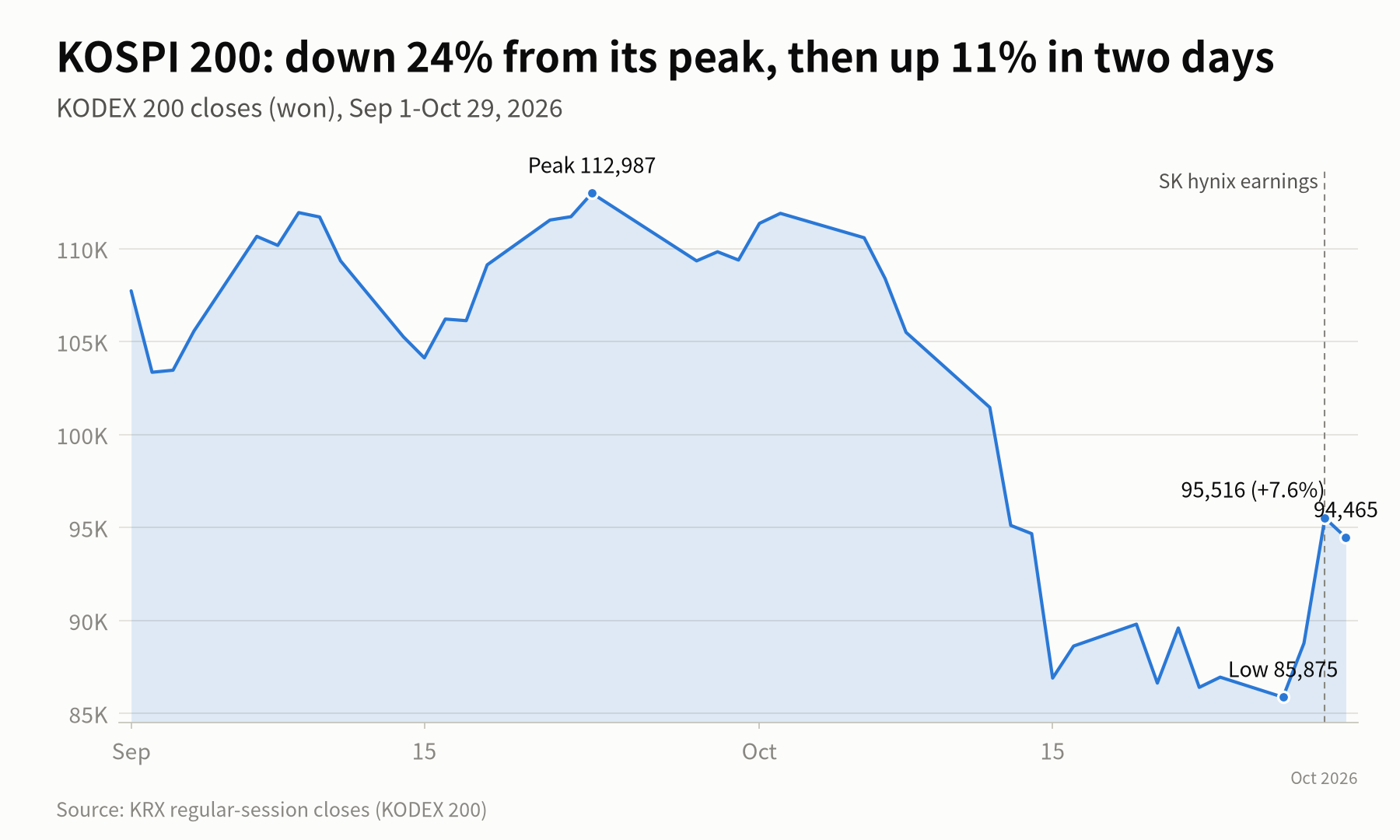
The KOSPI 200 fell 24.0% from its September 23 peak to its October 26 low, then rose 11.2% in just two days, October 27-28. On October 28 the KOSPI closed at 6,012.44, back above 6,000 for the first time in 10 trading days, but it fell 1.1% on October 29 and plunged again on October 30.
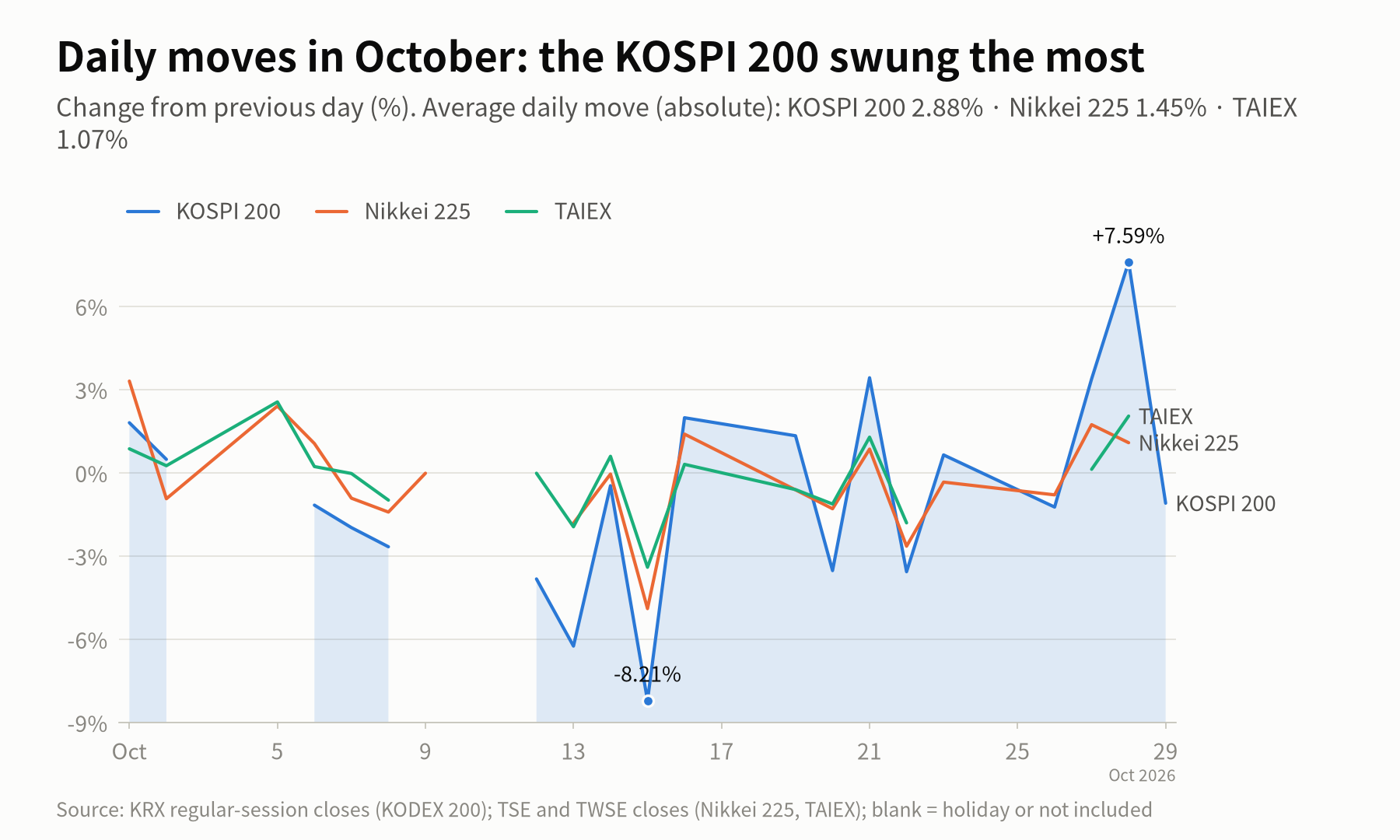
The Nikkei moved in the same direction on the same days, but its swings were half the size of the KOSPI’s. In October, the average daily move (the average of absolute changes, up or down) was 2.88% for the KOSPI 200, twice the Nikkei 225’s 1.45% and 2.7 times the TAIEX’s 1.07%. The KOSPI 200 moved more than 3% in a day on 8 days, the Nikkei on only 2 and Taiwan on only 1. The KOSPI 200’s swings were even larger than those of SOXX, the US semiconductor ETF (2.08%), so given the same chip news, Korea swung the most.
3 reasons the KOSPI rides a roller coaster
1. Half the index is two chip stocks
In the fourth week of October, Samsung Electronics and SK hynix made up an average of 50.0% of the KOSPI’s market capitalization (News1 tally). Their average daily moves in October were larger than the index’s, at 3.40% for Samsung Electronics and 4.21% for SK hynix, and the index followed the two. Holding the KOSPI has in effect come to resemble a bet on memory chips.
2. A tug-of-war between “the burden of AI spending” and “memory sold out for three years”
The same AI spending is a cost for US big tech and revenue for Korean memory makers. When SK hynix said on October 28 that its DRAM and HBM volumes were “effectively sold out for three years, through 2029,” the KOSPI rose 6.63% in a day. Two days later, on news of Alphabet’s cash burn, it plunged the other way. With each piece of news flipping the reading, the index changes direction day by day.
3. Reacting to expectations and foreign flows more than to earnings
Samsung Electronics fell 4.13% on October 29 even after reporting a record operating profit of 107.4405 trillion won. It confirmed a 30 trillion won cash dividend, but many analysts said disappointment-driven selling followed because no details came out on the remaining 55 trillion to 75 trillion won in shareholder returns. On top of that, when foreign investors unload the two stocks, there is no large group of investors to absorb the shares, so declines easily deepen.
Samsung Electronics and SK hynix after their earnings
- SK hynix: +10.89% on October 28 (1,487,000 won) → +2.62% on October 29 (1,526,000 won) → down 8%-plus on the morning of October 30
- Samsung Electronics: +9.01% on October 28 (242,000 won) → -4.13% on October 29 (232,000 won) → down 5%-plus on the morning of October 30
SK hynix held up through October 29 after announcing an operating profit of 83.3338 trillion won together with about 100 trillion won in shareholder returns, but on October 30 neither stock escaped the selling that started in the US.
3 things to watch
- US big tech capital spending and cash flow: Neither Alphabet nor Microsoft raised its capital spending outlook further. Whether the pace of spending slows will shape expectations for memory demand.
- Whether foreign net selling stops: On every down day, foreign selling concentrated on the two stocks.
- Details of Samsung Electronics’ remaining shareholder returns: If a schedule for share buybacks and cancellations comes out, the gap with SK hynix may narrow.
In one line
The rails of the KOSPI roller coaster are US AI spending news, and the car running on them is two stocks, Samsung Electronics and SK hynix. The Nikkei is on the same rails, but its swings were half as large. Even with record earnings, the KOSPI is likely to keep changing direction day by day for now, following US big tech figures and foreign flows.
This post reflects information as of the morning of October 30, 2026, and is not investment advice regarding any particular stock or product.
Frequently asked questions
Why did the KOSPI fall today? Overnight, Alphabet plunged about 13% on weaker cash flow, deepening concern about the burden of AI spending, and foreign investors and institutions sold Samsung Electronics and SK hynix.
Did the Nikkei fall like the KOSPI? The Nikkei 225 also fell more than 2% on the morning of October 30, but that was about half the KOSPI’s drop. The average daily move in October was also 1.45% for the Nikkei and 2.88% for the KOSPI 200.
What is a sidecar on program selling? It is a mechanism that halts program selling orders for five minutes when KOSPI 200 futures stay down 5% or more for one minute. It is milder than a circuit breaker, which halts all stock trading for 20 minutes (when the KOSPI stays down 8% or more for one minute).
Sources: KRX regular-session closes (KOSPI 200 as KODEX 200 closes; Samsung Electronics and SK hynix), Nikkei 225 and TAIEX closes and US regular-session closes of SOXX through October 28, Korea Exchange, SK hynix and Samsung Electronics third-quarter earnings releases, News1 (October market-cap shares), Nihon Keizai Shimbun (Nikkei intraday on October 30), CNBC (Alphabet share price and cash flow)
Information only, not investment advice.
See today’s Korea market map →
Related reading
More in Blog
- Caterpillar as an AI Stock: Why Midterm Data Center Curbs Hit It
- US Chip Stocks Rebound, but AI Leaders Win Back the Least
- The SOX Plunge: 3 Reasons Only Chips Fell After the Midterms
- Chip Stocks Tonight: Three Things to Watch as AMD Reports
- After the SOX Plunge: Three Checkpoints for This Week
- AI Spending Over Earnings: 3 Reasons TSMC Shares Slipped
- Why Kioxia Disappointed After Earning 2 Trillion Yen in Three Months
- SanDisk's 4.6x Revenue Outlook: What It Signals for Kioxia
- Is Samsung Handing a Key HBM Chip to TSMC?