NAND Outlook Up, Shares Down: Sandisk and Kioxia Report October 29-30
Sandisk in the US and Kioxia in Japan, the two companies that make only NAND flash, report results two days apart this week. On September 30, the market research firm TrendForce raised its outlook and now expects Q4 NAND contract prices to rise 15-20% from the previous quarter. Yet the two companies’ shares are about 47% and 65% below their June highs, respectively (closes on October 23). These results are the first chance to test that gap between the price outlook and the share prices against the two companies’ own numbers.
Reporting schedule
- Sandisk: results for Q1 of fiscal 2027 (July-September) after the US market close on October 29, with the call at 1:30 p.m. Pacific time.
- Kioxia: results for Q2 of fiscal 2026 (July-September) at 6:45 p.m. Japan time on October 30.
The two companies run their Japanese fabs as a joint venture and develop the same NAND technology together. For that reason, Sandisk’s numbers, which come out a day earlier, are sometimes read as a clue to Kioxia’s results.
What has changed since October 21
Our October 21 post covered TrendForce’s warning that NAND supply could exceed demand in the second half of 2027, and how, in October’s downturn, stocks’ declines did not match how much of their business is NAND. Three things have happened since then.
- A higher price outlook: At the end of June, TrendForce expected Q3 NAND contract prices to rise 10-15%. Its Q4 outlook, released September 30, is higher at 15-20%.
- A credit upgrade: On October 13, the US credit rating agency S&P raised Kioxia’s long-term credit rating one notch, from BBB- to BBB, with a “positive” outlook. Kioxia pointed to its high profitability and its net cash position, meaning it holds more cash than debt.
- Further share price declines: From October 19 to 23, Sandisk fell another 9.7% and Kioxia another 6.2%. Compared with September 28, both are about 28% lower.
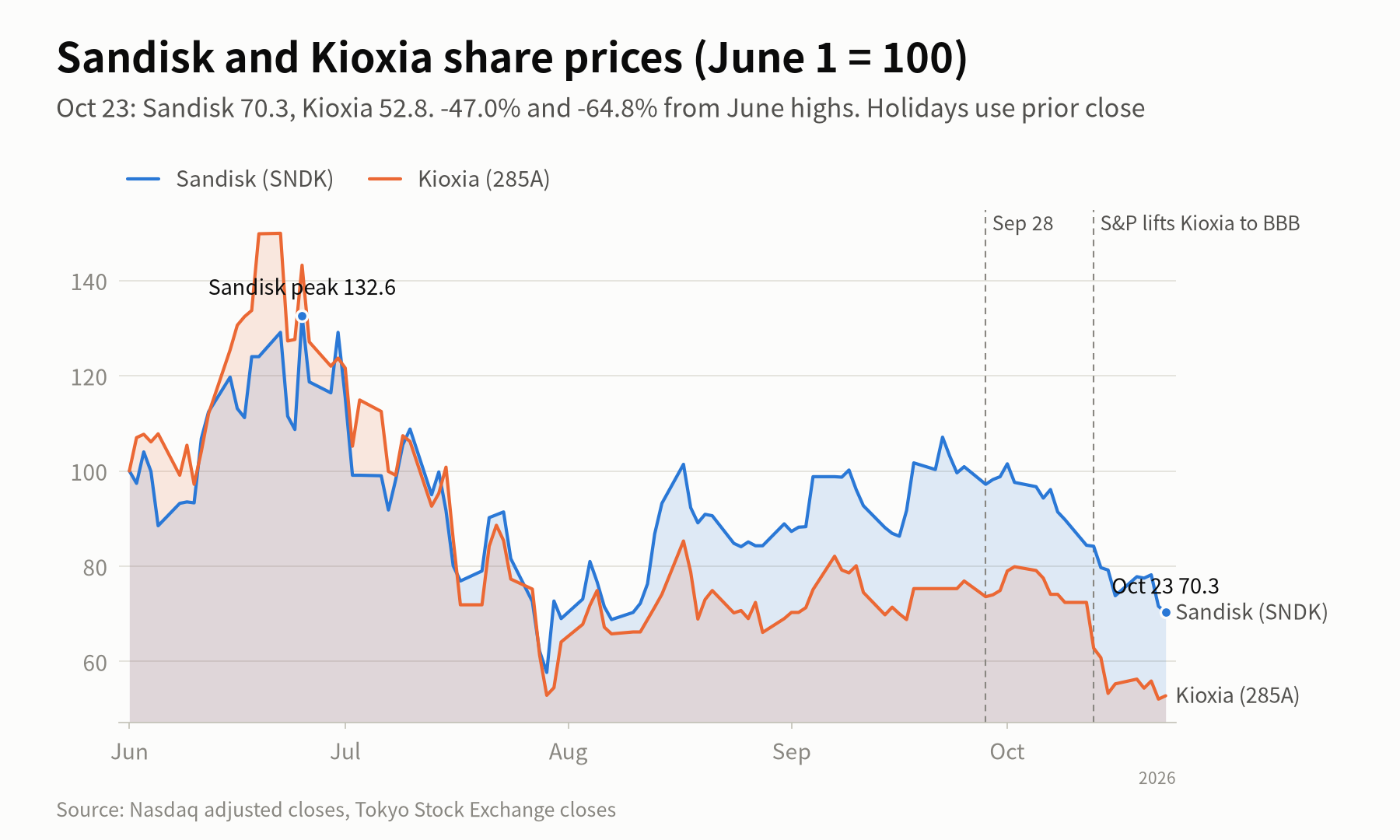
Both share prices are closing prices on each company’s market, adjusted for stock splits. Sandisk’s are also adjusted for dividends; Kioxia’s are not.
The numbers the companies have already given
Kioxia: revenue of 2.39 trillion yen
On July 31, Kioxia forecast July-September revenue of 2.39 trillion yen. That is 35.2% more than its April-June revenue (1.7671 trillion yen). Its operating profit forecast is 1.89 trillion yen, which means about 79% of revenue would remain as operating profit.
In April-June, the average sales price rose about 70% from the previous quarter, while the storage capacity sold (bits) grew only in the low single digits. Most of the increase in profit came from prices. What this release will show is whether prices drove results again in July-September, or whether shipments grew along with them.
Sandisk: revenue of $10.3 billion to $10.8 billion
On August 5, Sandisk gave revenue guidance of $10.3 billion to $10.8 billion for the July-September quarter. Its non-GAAP gross margin guidance is 83-85%, and non-GAAP earnings per share (EPS) is $44-46. Non-GAAP figures are the company’s own measures, which exclude one-time and non-cash items such as stock-based compensation.
Revenue in the previous quarter (April-June) was $8.97 billion. The midpoint of the guidance ($10.55 billion) is about 18% higher.
Where to read the NAND price outlook
Price trends differ by application
TrendForce’s Q4 outlook shows that prices for the same NAND move differently depending on what it is used in.
- Enterprise SSDs: the only memory product whose price increase TrendForce expects to be larger in Q4 than in Q3. It expects 2026 bit demand to grow more than 80% from the previous year, driven by AI inference servers and large data centers.
- PC SSDs: increases are limited as suppliers set prices flexibly.
- Smartphone storage (eMMC, UFS): negotiations have narrowed to confirming prices on small volumes.
This difference also shows in Sandisk’s numbers for the previous quarter. Data center revenue was about $2.98 billion, more than double the quarter before. Consumer revenue was $556 million, down 32% from the quarter before. The first thing to check in this release is whether that gap has widened further.
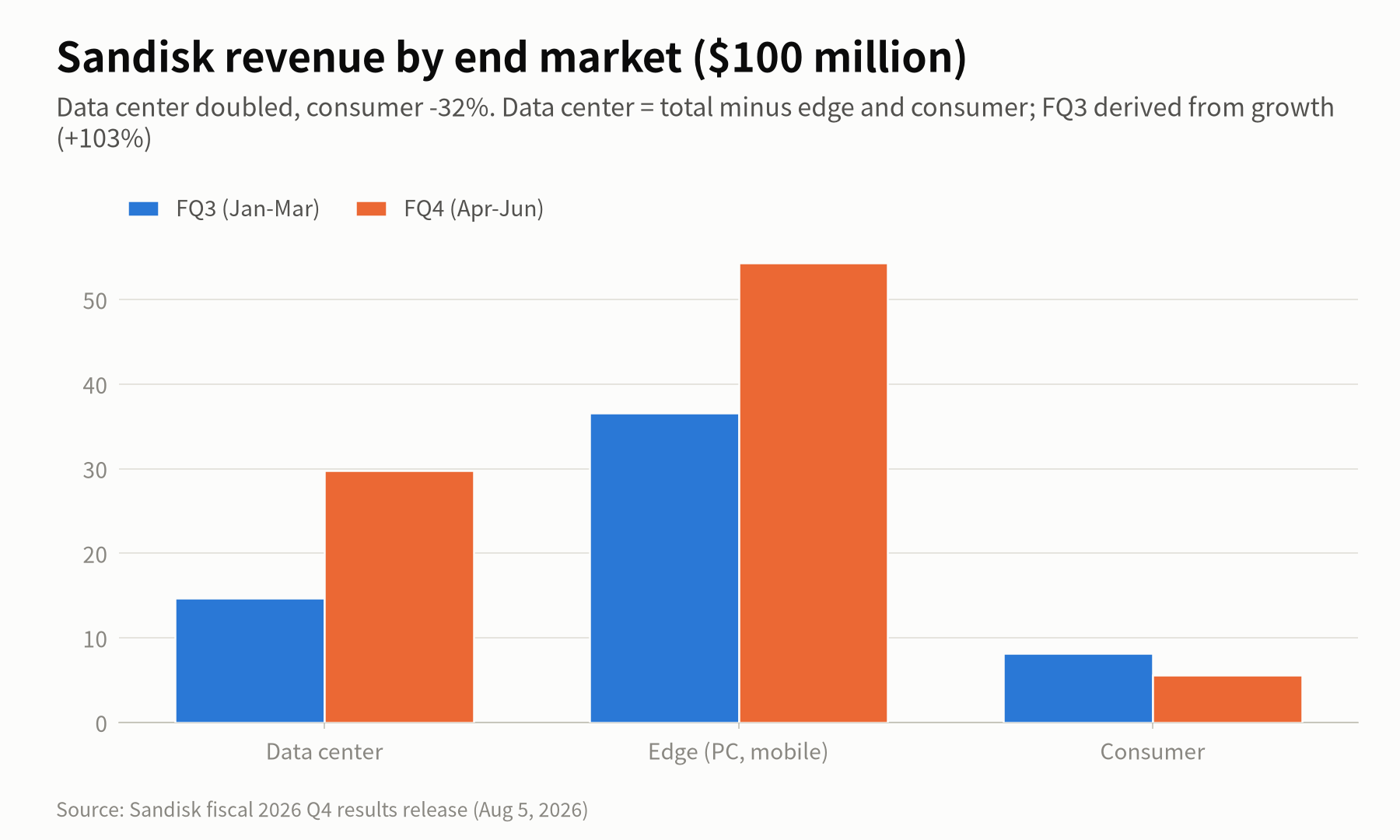
Edge (devices such as PCs and smartphones), Sandisk’s largest business, grew 48% to $5.43 billion. Data center revenue is calculated by subtracting edge and consumer revenue from the total revenue the company disclosed.
How much long-term contracts shield results from price swings
Both companies are adding multi-year supply agreements (LTAs) with customers. The more contracts they have, the less their results swing when market prices move.
- Sandisk: On its August earnings call, the company said it expects long-term contracts to account for more than half of its bit shipments in fiscal 2027 and about two-thirds in fiscal 2028. Minimum contracted revenue from 10 agreements with eight customers is $93.9 billion at floor prices. The prices come with both a floor and a ceiling.
- Kioxia: The company said it is on track toward its goal of covering 50% of its major customers’ volumes with long-term contracts in 2028.
S&P also cited long-term contracts reducing swings in results as a reason for upgrading Kioxia. On this week’s calls, whether the share of contracted volume has grown, and whether any contracts have hit their ceiling prices, will give a sense of how much further price increases would show up in results.
What to check on the supply side
Concerns about oversupply start with capacity expansion. At the end of August, Kioxia and Sandisk announced a plan to invest about 5 trillion yen (about $31 billion) together in their Yokkaichi and Kitakami fabs in Japan through 2032. The goal for Kitakami Fab 3 is first output in fiscal 2029. The two companies said they will adjust the schedule in stages depending on Japanese government subsidies and market demand.
Supply and demand outlooks differ. TrendForce said NAND supply could exceed demand in the second half of 2027. Kioxia expects demand to exceed supply in 2027 as well. S&P said the memory shortage could last until at least 2028.
Five things to check this week
- Did Kioxia’s July-September revenue reach the company’s forecast of 2.39 trillion yen?
- Did Sandisk’s gross margin come in within 83-85%?
- Does October-December guidance point the same way as TrendForce’s Q4 price outlook (a 15-20% increase)?
- Has the gap between data center and consumer revenue widened further?
- Have the share of long-term contracts and the expansion schedule changed since the August announcements?
One quarter’s results alone cannot settle supply and demand in 2027. But at a time when the price outlook is rising and the share prices are falling, the October-December outlooks the two companies give will show which of the two they are closer to.
Following the two companies from outside Korea
- Sandisk: Nasdaq in the US, ticker SNDK.
- Kioxia: Tokyo Stock Exchange, ticker 285A. It trades in yen, so the yen-dollar exchange rate also affects returns in dollar terms. There is a depositary receipt, KXIAY, on the US over-the-counter market.
Sources: TrendForce (Q4 memory contract price outlook, September 30, 2026; article on Kioxia’s Q1 results, July 31, 2026), Sandisk fiscal 2026 Q4 results release (August 5, 2026) and earnings call, Kioxia fiscal 2026 Q1 results (July 31, 2026), Kioxia notice “S&P upgrades credit rating to BBB” (October 13, 2026), TechNews (October 14, 2026), StorageReview and Herald Business (late August 2026, Japan fab investment plan), share prices: Nasdaq and Tokyo Stock Exchange closing prices
Information only, not investment advice.
Related reading
More in Blog
- Nasdaq Down Two Weeks: Can Google, Microsoft and Amazon Stop It?
- Record Quarter, 12% Drop: Why Lam Research Stock Fell
- SK hynix, Kioxia Slide: 3 Reasons Asia's Chip Stocks Fell Together
- Flying Roadster, Grounded Profit: Tesla’s Q3 in 5 Numbers
- Why Month-End Earnings Matter for NAND-Only Kioxia and Sandisk
- Shortage Until 2028 or NAND Glut? Samsung and SK hynix
- US Chip Stocks End an Eight-Day Slide, and Memory Came Back First
- How Much Can Korea's Pension Giant Move Samsung and SK hynix?
- Samsung Electronics and SK hynix Pulled the KOSPI Down 14%. Why?