Shortage Until 2028 or NAND Glut? Samsung and SK hynix
On October 20, Nomura issued a positive investment opinion on Samsung Electronics and SK hynix, saying that “memory demand will grow faster than supply through 2028.” The same day, Korean media also covered a TrendForce forecast that “NAND supply will exceed demand from the second half of next year.” The two forecasts look at different kinds of memory, so both can be right. The shortage that continues is in DRAM and HBM; the one that may ease first is in NAND. For Samsung Electronics and SK hynix, that makes NAND, not DRAM, the first factor to watch.
What the two firms said
- Nomura (October 20): It expects growth in memory demand to outpace the expansion of supply through 2028. Its reasoning rests on data centers. It estimates that new data center capacity worldwide will rise about 41%, from 22.3 gigawatts this year to 31.5 gigawatts next year. It kept its target prices at 670,000 won for Samsung Electronics and 4,700,000 won for SK hynix.
- TrendForce (July report): It found NAND supply falling 4-5% short of demand this year, but expects supply growth to overtake demand growth from the second half of 2027. In its DRAM report from the same period, it said DRAM supply would still be tight in 2027.
In other words, TrendForce never said there would be a surplus across all memory. Its glut warning concerns a single product: NAND.
Why DRAM may stay short while NAND runs into surplus
There are three reasons the two kinds of memory are heading in different directions.
- HBM uses a lot of wafers: HBM (high-bandwidth memory for AI servers) takes far more wafers than standard DRAM to make the same capacity. So even when fabs expand, DRAM output does not rise by as much. TrendForce expects new DRAM fabs to add meaningful output only in 2028.
- Nearly half of NAND demand comes from smartphones and laptops: Servers account for more than 40% of NAND demand, but smartphones and laptops still make up close to 40%. TrendForce expects smartphone production to fall 15-20% this year.
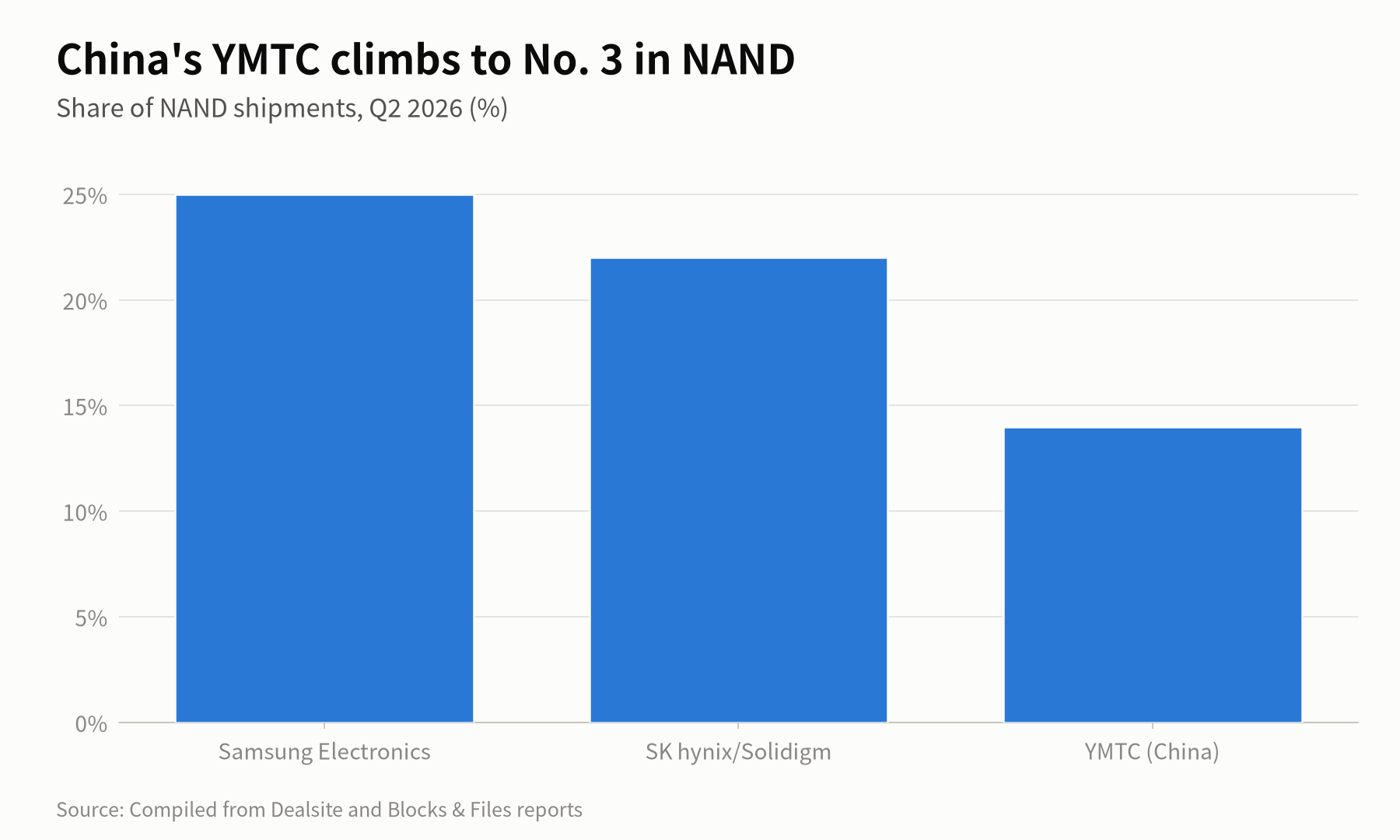
- China is adding NAND capacity: YMTC (China’s largest NAND maker) has climbed to third place worldwide, with a 14% share of Q2 shipments. It plans to start operating its third Wuhan fab at the end of this year and has said it aims to be the world’s No. 1 by the end of 2027. TrendForce expects Chinese makers’ share of NAND output to grow to nearly 19%.
Share prices have started to split along this line
In the US market, share prices moved differently depending on how much each company relies on NAND. Sandisk, a NAND specialist, fell 27.3% from its September 22 peak through October 19. Micron, which gets 73% of its revenue from DRAM, was down 17.5% from its October 1 peak.
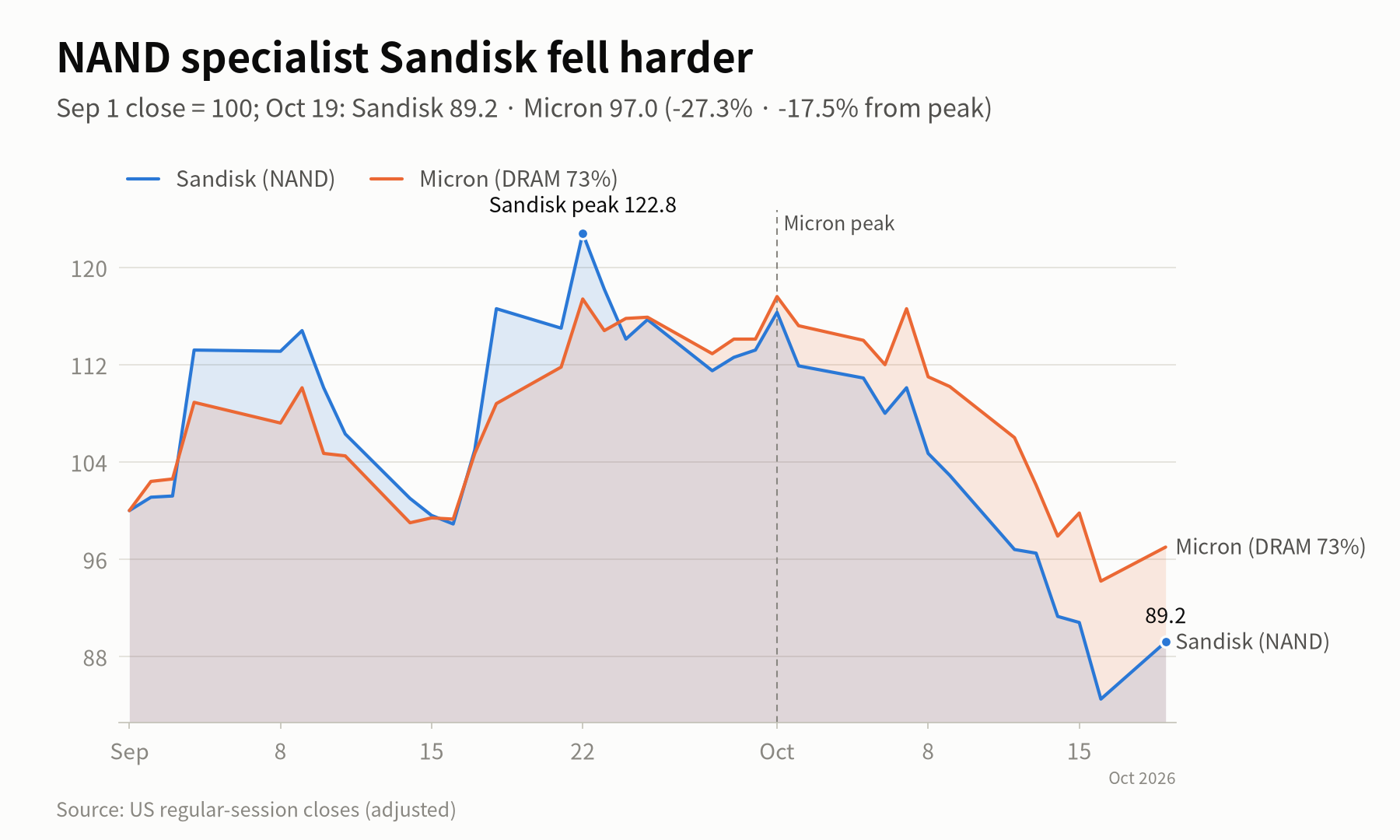
Both fell, but what stands out is that the NAND company was hit harder. In Korea, Samsung Electronics fell 2.98% and SK hynix 4.23% on October 20, closing at 211,500 won and 1,223,000 won respectively.
How much NAND matters to Samsung Electronics and SK hynix
- SK hynix: Of its Q2 revenue of 79.3187 trillion won, DRAM made up 73% and NAND 27%. NAND’s share rose from 21% in Q1.
- Samsung Electronics: It ranks first in NAND with a 25% share of Q2 shipments. If NAND prices fall, both companies are affected.
So for SK hynix, a “NAND glut” bears on roughly a quarter of revenue, and it needs to be considered separately from the outlook for DRAM, the remaining three quarters.
What could make this time different
- NAND could also stay short for longer: Taiwanese controller maker Silicon Motion warned that 2027 could be the hardest year to secure NAND, as cloud customers take supply first.
- The DRAM outlook comes with conditions too: Nomura added the caveat that it would need to revisit its demand forecast if data center investment keeps shrinking or if even funded projects are delayed.
Checklist of what to watch
- Late-October earnings: what the two companies say about NAND prices and next year’s shipment plans
- 2027 HBM contracts: whether next year’s volumes, which SK hynix said in July were “progressing smoothly” in talks, have been finalized
- YMTC’s third Wuhan fab: whether the year-end start-up schedule holds
- Smartphone shipments: whether demand for consumer devices, which account for close to 40% of NAND demand, recovers
In one line: The memory shortage forecast concerns DRAM and HBM, while the glut warning concerns NAND, so the two do not conflict; for Samsung Electronics and SK hynix, NAND is the first to be tested (27% of SK hynix revenue).
This post reflects information as of October 20, 2026, and is not investment advice regarding any specific stock or product.
Frequently asked questions
Q. If memory is oversupplied, will Samsung Electronics and SK hynix earnings turn down? TrendForce’s glut warning is limited to NAND. For DRAM, which makes up 73% of SK hynix revenue, the prevailing outlook is that supply stays tight in 2027 as well.
Q. When does the NAND oversupply begin? TrendForce expects supply growth to overtake demand growth from the second half of 2027. This year, NAND is still 4-5% short.
Q. What are Nomura’s target prices of 670,000 won and 4,700,000 won based on? They assume the memory shortage continues through 2028. Nomura judged that both stocks, trading at about 3 times their expected 2027 earnings, were priced well below what it considers their value.
Sources: Nomura (as reported by Aju Business Daily, Etoday and Financial News), TrendForce and DRAMeXchange, TechSpot, Investing.com (SK hynix Q2 earnings release), SK hynix Newsroom, Dealsite and Global Economic (YMTC), KRX regular-session closes, US regular-session closes (adjusted)
Information only, not investment advice.
See today’s Korea market map →
Related reading
More in Blog
- NAND Outlook Up, Shares Down: Sandisk and Kioxia Report October 29-30
- Nasdaq Down Two Weeks: Can Google, Microsoft and Amazon Stop It?
- Record Quarter, 12% Drop: Why Lam Research Stock Fell
- SK hynix, Kioxia Slide: 3 Reasons Asia's Chip Stocks Fell Together
- Flying Roadster, Grounded Profit: Tesla’s Q3 in 5 Numbers
- Why Month-End Earnings Matter for NAND-Only Kioxia and Sandisk
- US Chip Stocks End an Eight-Day Slide, and Memory Came Back First
- How Much Can Korea's Pension Giant Move Samsung and SK hynix?
- Samsung Electronics and SK hynix Pulled the KOSPI Down 14%. Why?