Samsung Electronics and SK hynix Pulled the KOSPI Down 14%. Why?
Over the five days from October 12 to 16, Samsung Electronics fell 17.7% and SK hynix fell 24.3%, while the KOSPI dropped more than 14%, from about 6,626 to 5,668. On Thursday (the 15th), circuit breakers were even triggered on both the KOSPI and the KOSDAQ. The two stocks did drag the index down, but as I see it, the fall was this large because there was no one to absorb what foreign investors were selling.
The week in numbers
- Monday, October 12: 6,384.24 (-3.65%). First trading day after a three-day holiday
- Tuesday, October 13: 6,035.35 (-5.46%). Sidecar triggered on program selling
- Wednesday, October 14: 6,008.81 (-0.44%)
- Thursday, October 15: 5,554.22 (-7.57%). Down as much as 9.29% intraday; circuit breakers in both markets
- Friday, October 16: 5,668.05 (+2.05%)
Compared with 7,003.74 on October 2, the index fell 20.7% over the seven trading days through the 15th (Digital Daily tally).
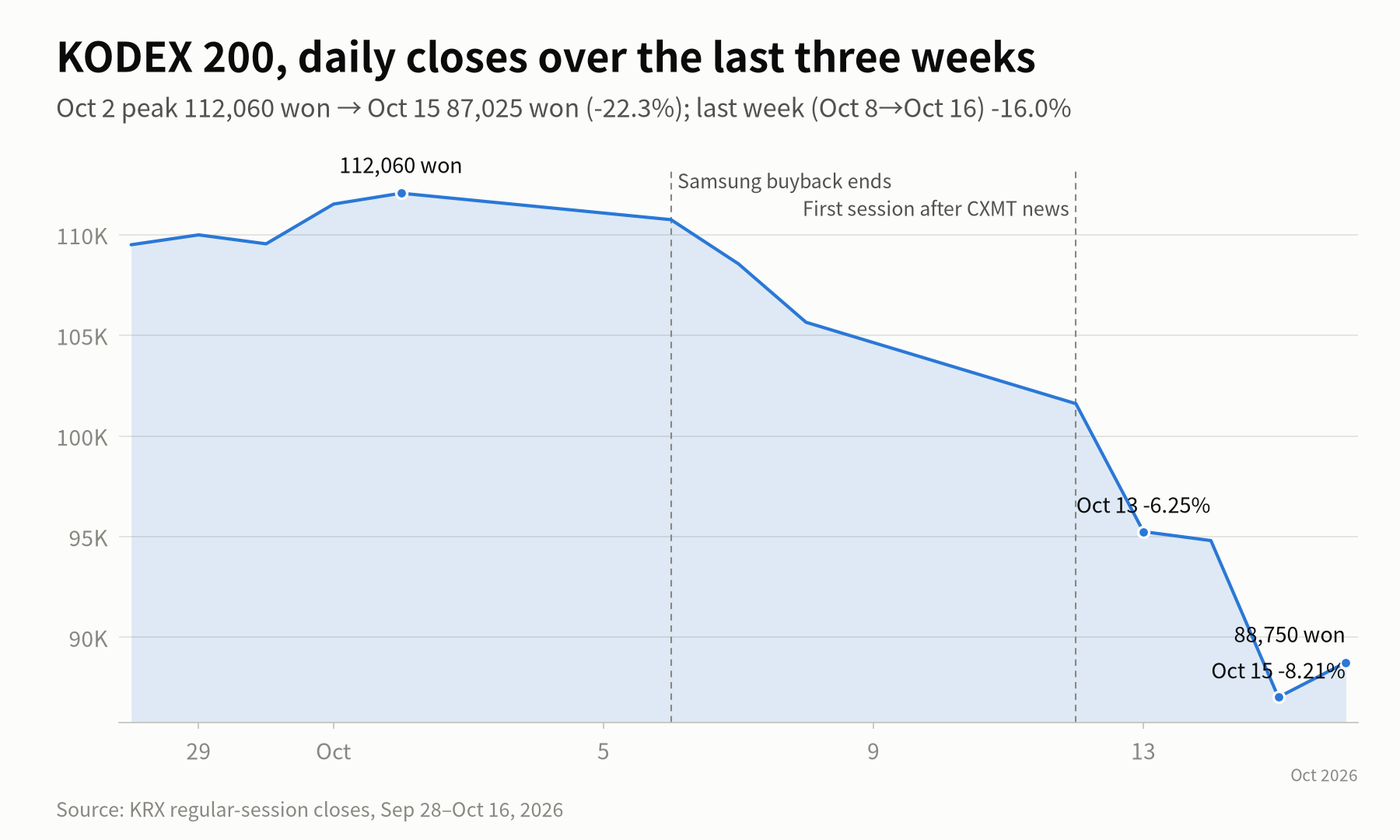
KODEX 200, which tracks the KOSPI 200, stepped down from its October 2 peak and then broke sharply twice, on October 13 and 15. Last week alone (October 8 to 16) it fell 16.0%.
The trigger was China’s CXMT
China’s ChangXin Memory Technologies (CXMT) said at a conference in Shanghai on October 10 that it would release server DRAM with a “4F²” structure, which shrinks cell area, before the end of the year. It has not yet disclosed capacity, yields or a mass-production schedule. So I see the announcement less as the cause than as the trigger that ignited doubts about AI profitability and pressure from interest rates that had already been building.
How much foreign investors sold
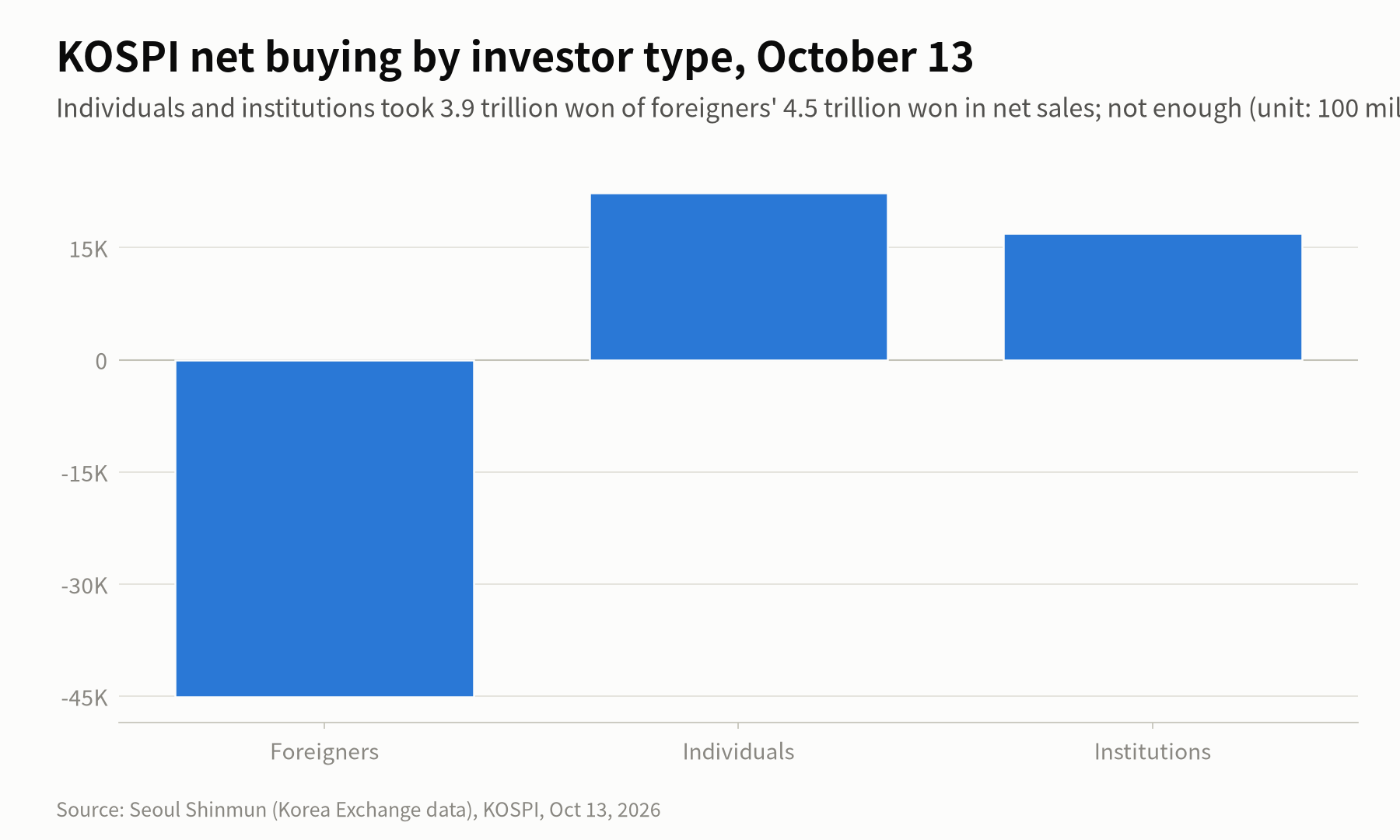
- October 13: Foreign net selling of 4.5128 trillion won on the KOSPI. Net purchases of 2.2271 trillion won by individuals and 1.6903 trillion won by institutions (Seoul Shinmun)
- October 15: Foreign net selling of about 3.6 trillion won, including 1.4573 trillion won of Samsung Electronics and 1.1112 trillion won of SK hynix (Segye Ilbo)
- October 12: Net selling of about 2 trillion won
That comes to roughly 10 trillion won in just those three days. In between, on the 14th, foreign investors also posted net sales of about 1.2 trillion won.
Why no one was there to absorb it
Foreign selling is nothing new. From August 20 to September 28, foreign investors also sold close to 20 trillion won of the two stocks. What is different this time is that the hands that used to absorb it were gone.
- Share buybacks ended: Samsung Electronics finished its share buyback on October 6, and SK hynix had completed about 90% of its own as of October 8. The companies’ buying, which had come in every day, disappeared.
- The National Pension Service had no room: During the January–June rally, the National Pension Service postponed rebalancing (the rule of selling when a holding’s weight goes above its target). At the end of July its weighting in domestic stocks was 24.87%, 4 percentage points above its 20.8% target. So even during the plunge (October 6 to 15), pension funds could not add shares and instead posted net sales of 183.2 billion won (Seoul Economic Daily). That contrasts with net purchases of 1 trillion won during the July slump.
- Only individuals were left: Individuals put more than 7 trillion won into Samsung Electronics and SK hynix in October (Segye Ilbo). On their own, though, that was not enough to absorb selling in the 4-trillion-won range in a single day.
What the pension funds sold amounts to about 5% of one day of foreign selling, so it is hard to say their selling caused the plunge. The problem, I think, lies less in what they sold than in the fact that they could not step in. Because they had not trimmed their weighting near the top, they had no capacity left to support the market once prices had fallen.
Other ways to see it, and next week’s schedule
- Earnings unchanged: Samsung Electronics’ preliminary Q3 operating profit of 107 trillion won is a record.
- Friday rebound: There are reports that on the 16th foreign investors turned to net buying for the first time in nine trading days (Global Economic Newspaper). Their net purchases came to about 340 billion won.
- The pension fund controversy: The decision to defer rebalancing was debated at the National Assembly’s audit of government agencies on the 14th, and the decision-making process has not yet been disclosed.
- Schedule: Bank of Korea Monetary Policy Board meeting on October 22, US FOMC meeting on October 27–28, and both companies’ Q3 earnings at the end of October
Bottom line: Last week CXMT pulled the trigger and foreign investors sold, but the KOSPI fell as far as it did because two supports, share buybacks and the pension funds, were missing at the same time.
This post reflects information as of October 17, 2026, and does not solicit investment in any particular stock or product.
Frequently asked questions
Q. What is a circuit breaker? It is a rule that halts trading for 20 minutes when an index stays down more than 8% on the day for one minute. On the 15th the KOSPI fell as much as 9.29% intraday, triggering it.
Q. Did National Pension Service selling drag the KOSPI down? Looking at last week alone, that is hard to argue. Pension fund net selling from October 6 to 15 came to 183.2 billion won, about 5% of a single day of foreign net selling. Their weighting was above target, however, so they could not step in with buying on the dip.
Q. Will the KOSPI climb again next week? There is no way to know. The first two things to watch are whether foreign selling eases and whether the late-October earnings hold up to expectations.
Sources: Korea Exchange (regular-session closes), Seoul Shinmun, Segye Ilbo, Digital Daily, Newspim, Seoul Economic Daily, Money Today, Kookmin Ilbo, Invest Chosun, Kyunghyang Shinmun, Seopeul, Global Economic Newspaper
Information only, not investment advice.
See today’s Korea market map →
Related reading
More in Blog
- NAND Outlook Up, Shares Down: Sandisk and Kioxia Report October 29-30
- Nasdaq Down Two Weeks: Can Google, Microsoft and Amazon Stop It?
- Record Quarter, 12% Drop: Why Lam Research Stock Fell
- SK hynix, Kioxia Slide: 3 Reasons Asia's Chip Stocks Fell Together
- Flying Roadster, Grounded Profit: Tesla’s Q3 in 5 Numbers
- Why Month-End Earnings Matter for NAND-Only Kioxia and Sandisk
- Shortage Until 2028 or NAND Glut? Samsung and SK hynix
- US Chip Stocks End an Eight-Day Slide, and Memory Came Back First
- How Much Can Korea's Pension Giant Move Samsung and SK hynix?