Record Quarter, 12% Drop: Why Lam Research Stock Fell

On October 22, 2026 (US time), shares of US chip-equipment maker Lam Research fell 11.76%. That was just one day after it reported record results: revenue of $8.22 billion, up 54% from a year earlier. It wasn’t the results that pulled the stock down but three messages: next quarter’s guidance only matched expectations, the company can’t build equipment fast enough, and there isn’t enough money to fund AI.
How good were the results?
September-quarter revenue was $8.22 billion, up 22% from the previous quarter and 54% from a year earlier. Operating margin (operating profit as a share of revenue) was 40.0%, the first time in the company’s history it has reached the 40% range. A year earlier it was 34.4%.
Other equipment stocks fell the same day.
- KLA: -9.55%
- Applied Materials: -8.16%
- ASML: -6.93%
- US semiconductor ETF (SOXX): -6.79%, its biggest one-day drop since June 23
This wasn’t the first decline. The chart below shows Lam Research’s daily closing price since June.
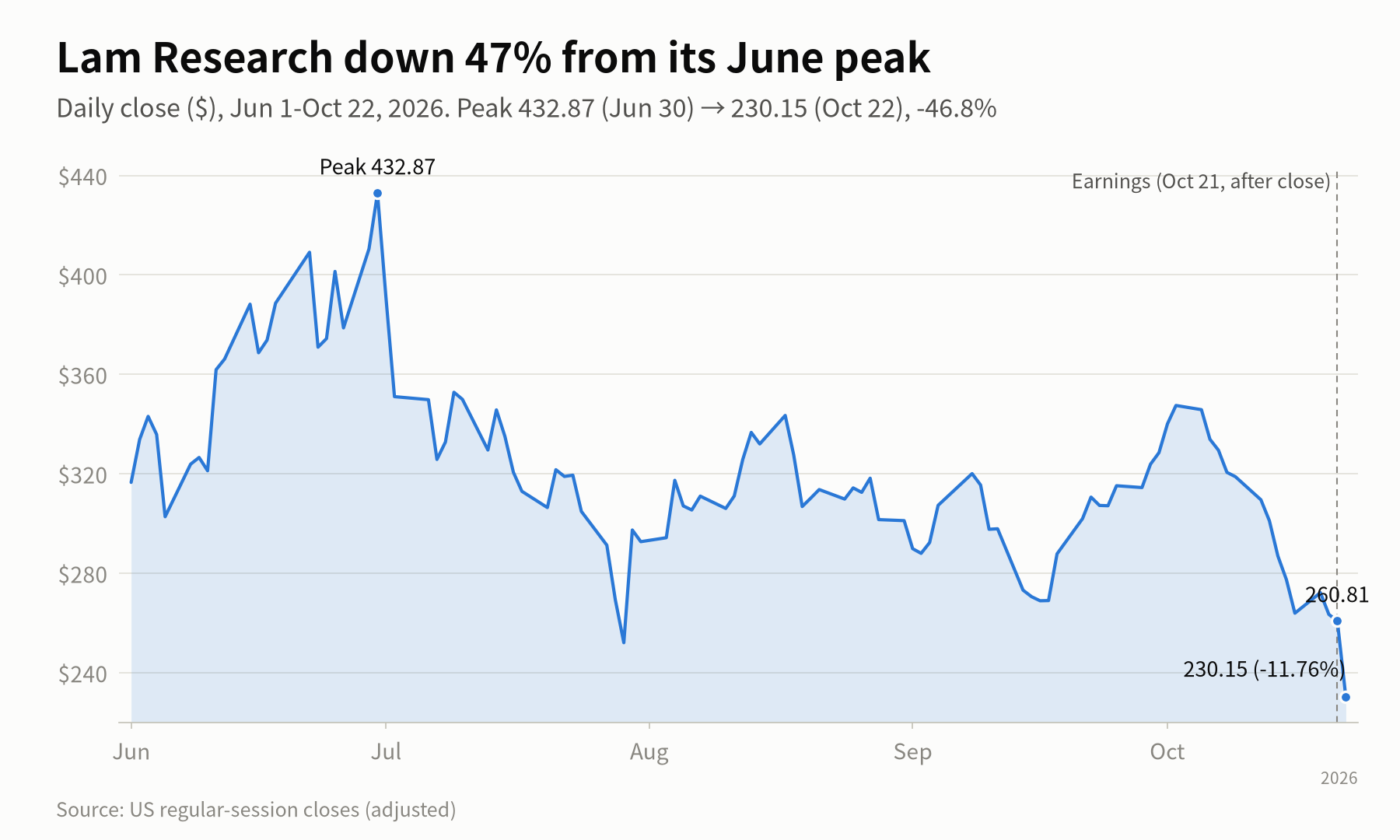
Lam Research shares had risen about 81% over the year up to its earnings day (October 21), but they were already down nearly 40% from their June 30 peak of $432.87. Add the October 22 drop, and the stock is about 47% below that peak.
Three reasons Lam Research fell 12%
1. Next quarter’s guidance only roughly matched expectations
The company guided for December-quarter revenue of $8.6 billion (±$400 million), slightly above market expectations.
Since July, equipment stocks have kept falling on worries that chip investment might peak in 2027. Easing that worry would have taken guidance well above expectations, and the numbers came nowhere near that.
2. Supply constraints and a smaller China share came together
Chief Financial Officer (CFO) Doug Bettinger said that without supply-chain constraints, guidance would have been “a little higher.” He didn’t say how much higher, and said shipments it couldn’t make in December would move into the March quarter.
In other words, the orders are there, but the company can’t build the equipment in time. Investors read this as a sign that revenue is being pushed back.
China’s share is also shrinking.
- China’s share of September-quarter revenue: 35%
- December quarter: the company said it would be “significantly lower”
3. “Not enough money for AI” came up the same day
In a CNBC interview on October 22, Nvidia Chief Executive Officer (CEO) Jensen Huang said demand from neoclouds (AI-focused cloud companies that rent out Nvidia GPUs) is enormous, but “the demand for capital is far greater than the supply of capital.”
Wells Fargo traders said the remark “revived worries that lenders’ appetite for risk is already maxed out.” CoreWeave, which builds data centers with borrowed money, fell 10.06%, and AI power stock GE Vernova fell 10.64%.
Chip equipment sits at the far end of AI spending. The chain runs data centers → chip orders → new chip plants → equipment orders, so worries about funding at the front end spread furthest here. Meta also fell 6.98% the same day as attention turned to how it funds its AI spending.
For October alone, Lam Research fell the most among equipment stocks.
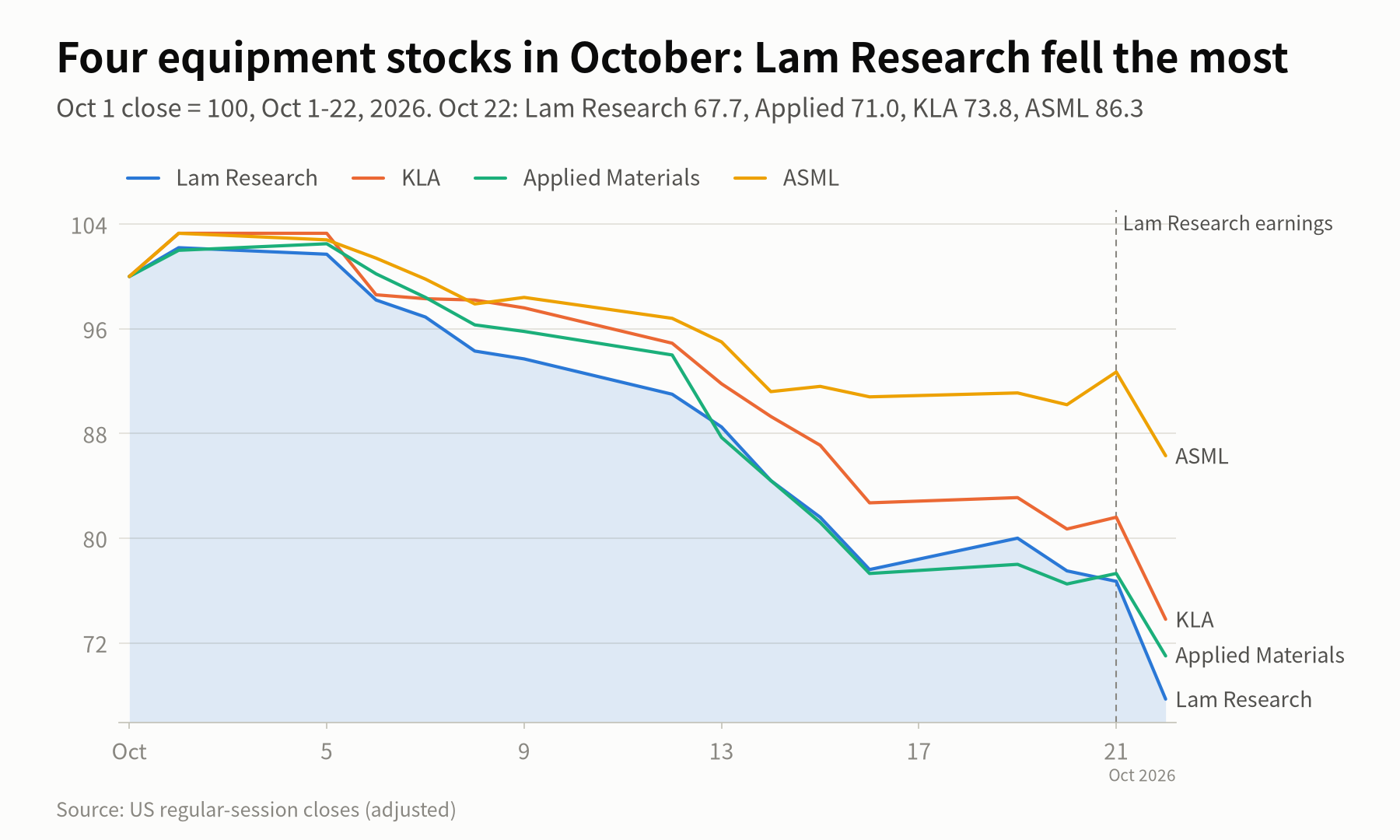
Compared with October 1, the October 22 closes were: Lam Research -32.3%, Applied Materials -29.0%, KLA -26.2%, ASML -13.7%. The whole sector was already sliding before the earnings, and the drop grew again the day after.
Was it a day the whole market fell apart?
The indexes say so. The S&P 500 fell 1.21% to 7,663.43, its worst day since July, and the Nasdaq fell 2.6% to 26,008.86, its biggest drop since June. The Dow was nearly flat.
But two out of every three S&P 500 stocks rose that day. It was a day when large AI and chip stocks dragged the index down. Demand for safe assets pushed the 10-year US Treasury yield down to around 4.96%, below 5% for the first time since September 23.
What to watch next
The company’s preliminary outlook for the 2027 wafer fab equipment market (WFE, the whole market for equipment that goes into chip plants) is more than $200 billion. That is larger than its estimate for this year (in the mid-$150 billion range), and it expects DRAM to lead the growth. It did not lower its demand outlook.
- Supply constraints: whether the delayed shipments actually go out in the March quarter
- China revenue: how much it shrinks in the December quarter, and any change in US export controls
- Big Tech capital spending: whether Microsoft and Alphabet (reporting next week) raise their spending
- AI company funding: bond yields and new loans for companies like CoreWeave
This drop didn’t happen because Lam Research failed to earn money. It was a day when the question of who can supply the money for AI spending, and at what cost, was once again priced into equipment stocks.
This post is based on information as of the close on October 22, 2026 (US time) and is not investment advice on any particular stock or product.
Frequently asked questions
Q1. Lam Research’s results were strong, so why did the stock fall?
A1. The problem was the next-quarter guidance and comments, not the results. December-quarter guidance was close to expectations, and the company mentioned both supply constraints and lower China revenue. On the same day, worries about AI funding piled on.
Q2. What kind of equipment does Lam Research make?
A2. Its main products are etch tools, which carve circuits into wafers, and deposition tools, which lay down thin films. Chips built in tall stacks of layers, like memory, need more of this equipment, which is why the company named DRAM as the area that would lead equipment demand in 2027.
Q3. Why do chip-equipment stocks move more than other chip stocks?
A3. Equipment orders come only when chipmakers add plant capacity. Even a small change in their investment plans shakes the equipment revenue outlook more, so the swings are large both up and down.
Sources: Lam Research September-quarter 2026 earnings release and earnings call (October 21, 2026), CNBC (October 22, 2026), AP (October 22, 2026), US regular-session closes (share-price and ETF moves, adjusted); lead photo: Alexandre Debiève, Unsplash, Unsplash License
Information only, not investment advice.
Related reading
More in Blog
- NAND Outlook Up, Shares Down: Sandisk and Kioxia Report October 29-30
- Nasdaq Down Two Weeks: Can Google, Microsoft and Amazon Stop It?
- SK hynix, Kioxia Slide: 3 Reasons Asia's Chip Stocks Fell Together
- Flying Roadster, Grounded Profit: Tesla’s Q3 in 5 Numbers
- Why Month-End Earnings Matter for NAND-Only Kioxia and Sandisk
- Shortage Until 2028 or NAND Glut? Samsung and SK hynix
- US Chip Stocks End an Eight-Day Slide, and Memory Came Back First
- How Much Can Korea's Pension Giant Move Samsung and SK hynix?
- Samsung Electronics and SK hynix Pulled the KOSPI Down 14%. Why?