US Chip Stocks End an Eight-Day Slide, and Memory Came Back First

On Monday, October 19, the US semiconductor ETF (SOXX) rose 1.7% to close at $501.93. That ended eight straight sessions of losses. By Bloomberg’s count, it was the Philadelphia Semiconductor Index’s longest losing streak in 18 years.
Still, the day won back less than a tenth of what was lost over those eight sessions. The rebound was led by memory chip stocks, the ones dumped hardest last week.
How far did US chip stocks fall in eight sessions?
SOXX fell 16.3%, from $589.45 on October 6 to $493.39 on October 16. Over the same stretch, the ETF that tracks the Nasdaq 100 (QQQ) fell 6.6%, so chips fell more than twice as much.
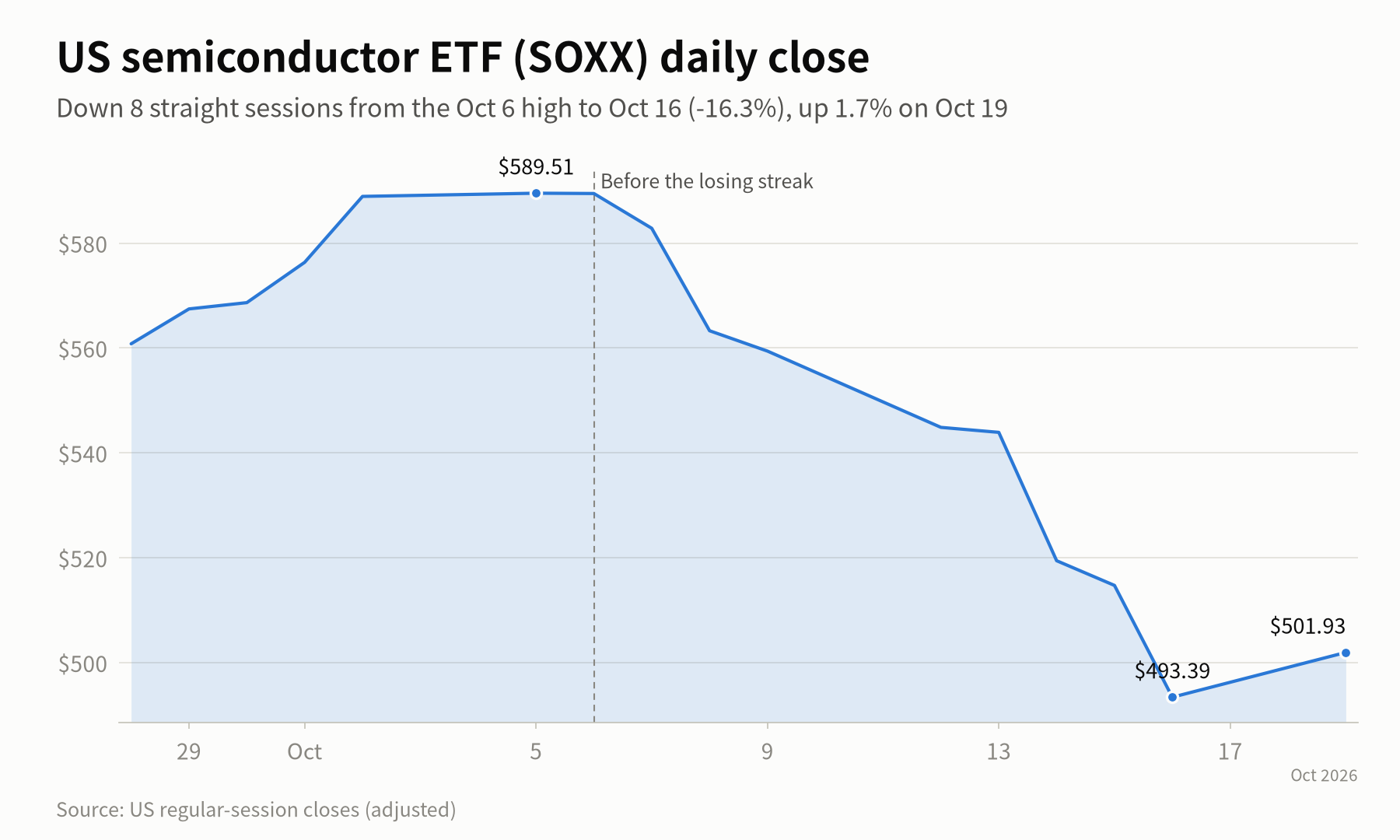
As the chart shows, the drop did not come all at once. It came in steps, with daily losses of 2.6% to 4.5% on October 8, 12, 14 and 16. The 1.7% rebound on October 19 is smaller than any one of those steps.
What rose first on Monday?
Memory: the hardest hit last week bounced the most
Micron fell 14.6% last week alone, as worries about competition from Chinese memory makers piled on. On October 19 it rose 2.97% to close at $904.90.
Storage companies rose even more. According to reports, SanDisk gained about 7% and Western Digital about 6%, and SK hynix depositary receipts traded in the US rose more than 5%.
Intel, AMD and Nvidia rose too, but
JPMorgan raised its rating on Intel from “underweight” to “neutral.” Intel was up nearly 5% during the session before closing up 2.43%. AMD rose 1.76% and Nvidia 1.38%.
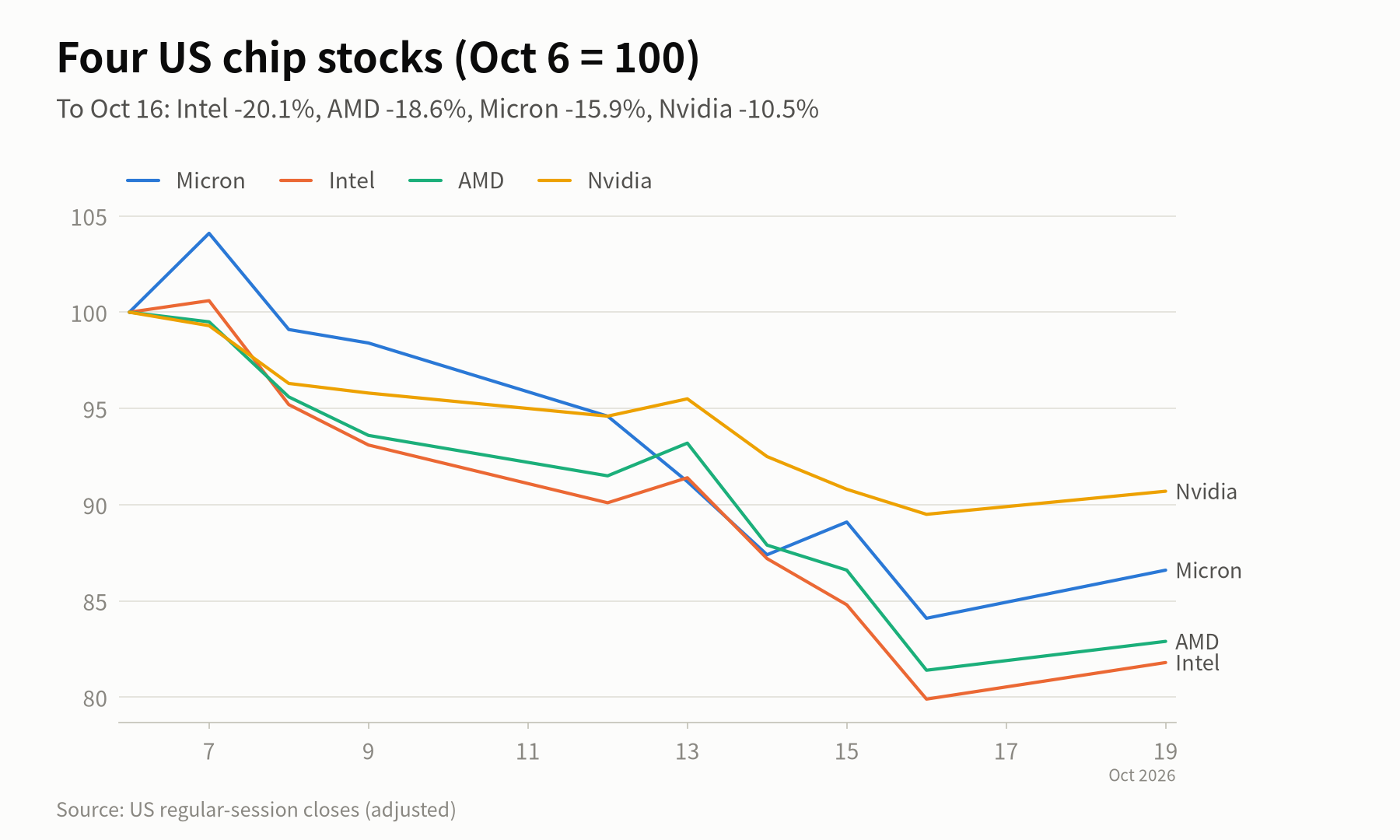
Setting October 6 at 100 shows the difference. Through October 16, Intel fell 20.1%, AMD 18.6%, Micron 15.9% and Nvidia 10.5%. Of what each had lost, Micron won back the largest share in the October 19 rebound, at 15.6%, while AMD recovered only 7.7%.
Why did chips fall so much more than the rest?
Semiconductors were the sector hedge funds unloaded most. According to data from Goldman Sachs prime brokerage (the unit that handles hedge funds’ trades), hedge funds cut US tech stocks faster in the five sessions through October 15 than at any time since its records began in 2016, and the biggest losses were in semiconductors.
It also matters that this was mostly unwinding of stocks they already held, not new bets against the sector. Even so, tech still makes up 23.5% of these portfolios. That is in the top 10% of the past five years, so there may still be more left to unwind.
Worries that money for AI data centers is being raised with debt have not gone away either. CoreWeave, which plunged 25% last week, fell another 0.44% on October 19 to close at $61.12. That is a sign that the funding pressure on chip customers has not eased.
What would it take for the chip rebound to last?
Meta earnings on October 21: is the money for chips still flowing?
Meta reports its third-quarter results after the US market close on October 21, which is 5:30 a.m. on October 22 Korea time. The market expects revenue of about $63.3 billion, roughly 23% more than a year earlier.
For chip investors, the number to watch is not revenue but next year’s capital spending plan. If big tech companies like Meta say they are not cutting AI investment, worries about demand for the chips Nvidia and Micron supply would ease. Tesla also reports results the same day.
Western Digital earnings on October 22: does the memory rebound show up in the numbers?
From the storage group that led Monday’s rebound, Western Digital reports results on October 22. The first test is whether higher memory prices are actually showing up in profits.
The Fed is silent until October 29
Ahead of the October 27-28 FOMC meeting, Fed officials are not making public remarks until October 29. That leaves earnings as the main events that could set the direction for chips this week.
This week, if more of these come up “yes”
- Does SOXX keep rising for a second and third day, beyond a one-day bounce?
- Does it hold without breaking the October 16 low ($493.39) again?
- Did Meta say it is not cutting next year’s AI capital spending?
- Did Western Digital’s results show higher memory prices turning into profits?
- Have shares of AI infrastructure companies like CoreWeave started rising again?
Figures in this post are as of the US market close on October 19. This post is not advice on any particular stock.
Sources: Bloomberg (chip index losing streak), Goldman Sachs prime brokerage (as reported by Bloomberg), Reuters (Micron’s weekly drop), Meta investor relations notice, MarketBeat (earnings estimates), US regular-session closes, adjusted (SOXX, QQQ, Micron, Intel, AMD, Nvidia and CoreWeave share prices). Lead photo: NASA, Wikimedia Commons (public domain)
Information only, not investment advice.
Related reading
More in Blog
- NAND Outlook Up, Shares Down: Sandisk and Kioxia Report October 29-30
- Nasdaq Down Two Weeks: Can Google, Microsoft and Amazon Stop It?
- Record Quarter, 12% Drop: Why Lam Research Stock Fell
- SK hynix, Kioxia Slide: 3 Reasons Asia's Chip Stocks Fell Together
- Flying Roadster, Grounded Profit: Tesla’s Q3 in 5 Numbers
- Why Month-End Earnings Matter for NAND-Only Kioxia and Sandisk
- Shortage Until 2028 or NAND Glut? Samsung and SK hynix
- How Much Can Korea's Pension Giant Move Samsung and SK hynix?
- Samsung Electronics and SK hynix Pulled the KOSPI Down 14%. Why?