Why Month-End Earnings Matter for NAND-Only Kioxia and Sandisk
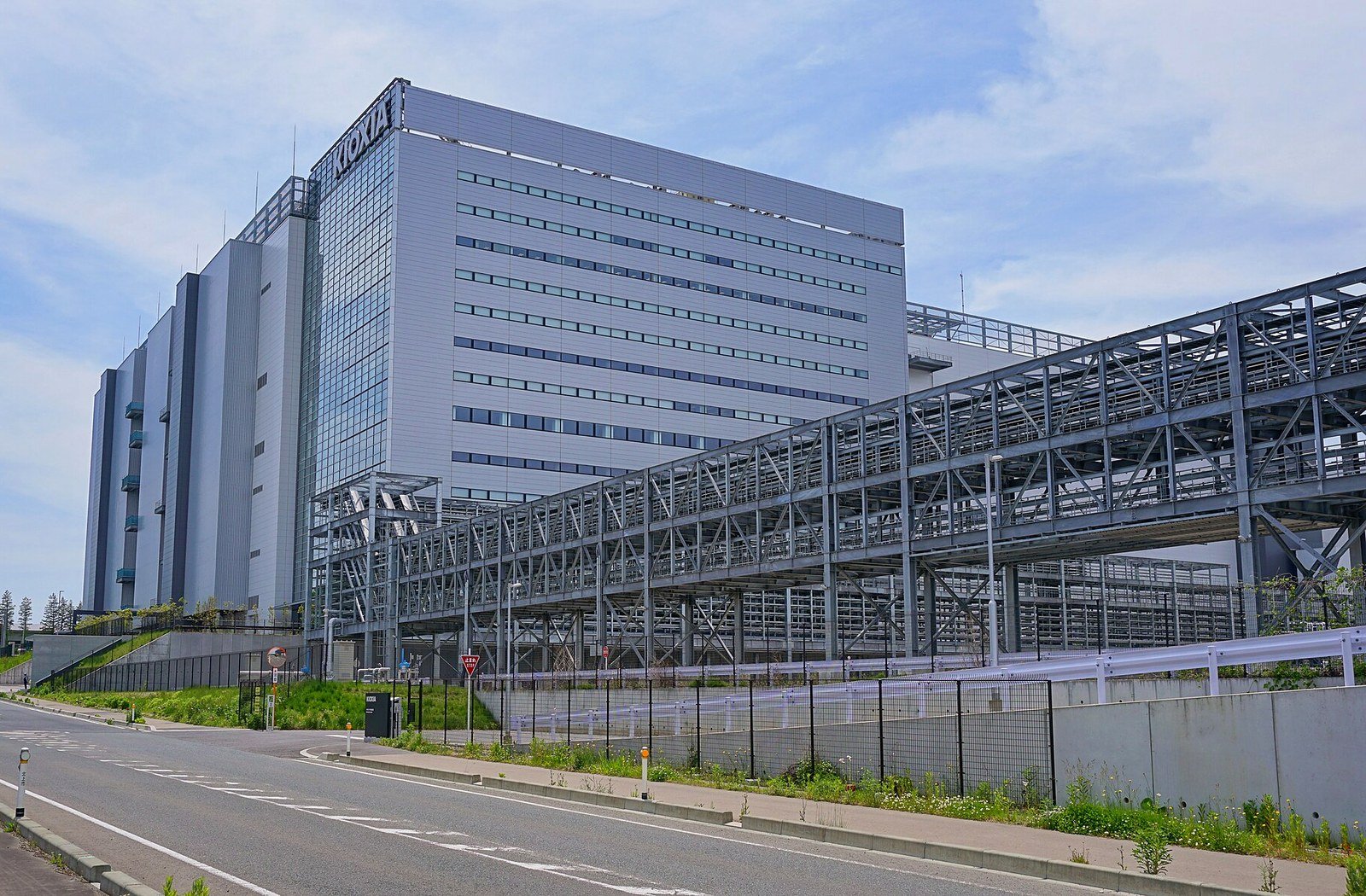
Market research firm TrendForce expects the NAND flash supply shortage to ease in the second half of 2027. If that forecast holds, the first companies affected would be the two that make only NAND: Kioxia of Japan and Sandisk of the US. Yet in the memory stock decline since late September, these two were not the hardest hit. Whether the NAND worries show up in actual numbers can first be checked in the earnings reports on October 29 (Sandisk) and October 30 (Kioxia).
What exactly TrendForce’s warning said
NAND flash is memory that keeps data even when the power is off. It goes into smartphone storage and SSDs (solid-state drives for data storage). It is a different product from DRAM, the memory a computer uses while it works.
In a July 21 report, TrendForce made two points. First, it expects NAND supply to fall 4-5% short of demand in 2026. Second, it expects supply growth to outpace demand growth in 2027, with the balance tipping toward supply in the second half of 2027.
It gave three reasons.
- Process transitions: as makers move to NAND with more stacked layers, the same fabs turn out more storage capacity (bits).
- Chinese makers: with new equipment coming in, Chinese makers’ share of global NAND bit output rises to nearly 19%.
- Weak consumer demand: servers account for more than 40% of NAND demand, and that demand is strong. But smartphones and laptops together account for close to 40% as well, and TrendForce expects production of both to decline in 2027 too.
The report did not declare a “glut.” Its wording was closer to “tight supply gradually easing.” At the same time, TrendForce expected DRAM supply to stay tight in 2027. The warning is about NAND alone, not memory as a whole.
The two NAND-only makers: Kioxia and Sandisk
Most memory companies make both DRAM and NAND. Samsung Electronics, SK hynix and Micron do. All three also supply high-bandwidth memory (HBM) for AI servers. HBM is made by stacking several layers of DRAM.
Kioxia and Sandisk are different. They make only NAND. They also share fabs: the two run a joint manufacturing venture in Japan, Flash Ventures, which Kioxia owns 50.1% and Sandisk 49.9%.
TrendForce’s Q2 NAND revenue ranking shows how big the two companies are.
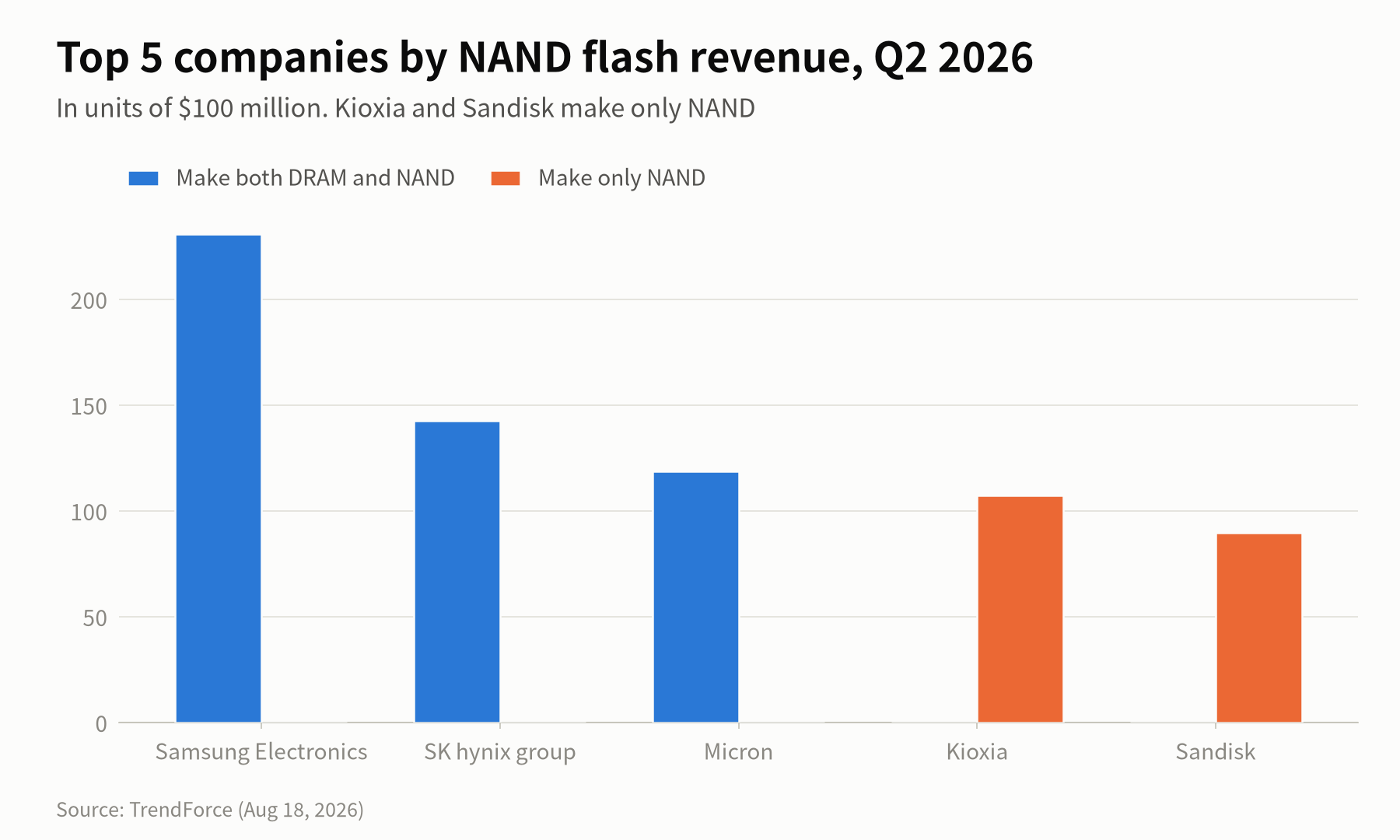
The top five companies’ combined Q2 NAND revenue was $68.87 billion, up 77% from Q1. Demand for data center SSDs was strong, and makers raised contract prices sharply. Kioxia ranked fourth with about $10.72 billion in revenue, and Sandisk fifth with about $8.97 billion.
Making only NAND means profit tracks NAND prices directly. Sandisk is a good example. According to its filing with the US Securities and Exchange Commission (SEC), Sandisk posted revenue of $8.965 billion and operating income of $7.037 billion in fiscal Q4 2026 (ended July 3). About a year and three months earlier, in fiscal Q3 2025 (ended March 28, 2025), it had an operating loss of $1.881 billion. When NAND prices rose, the loss turned into a large profit. The same structure means profit also shrinks quickly when prices fall.
At Samsung Electronics, SK hynix and Micron, DRAM and HBM can support profit even if NAND prices weaken. Kioxia and Sandisk have no such support.
But the October decline told the opposite story
If the NAND warning had been moving share prices, Kioxia and Sandisk would have fallen the most in the decline. The actual numbers were different.
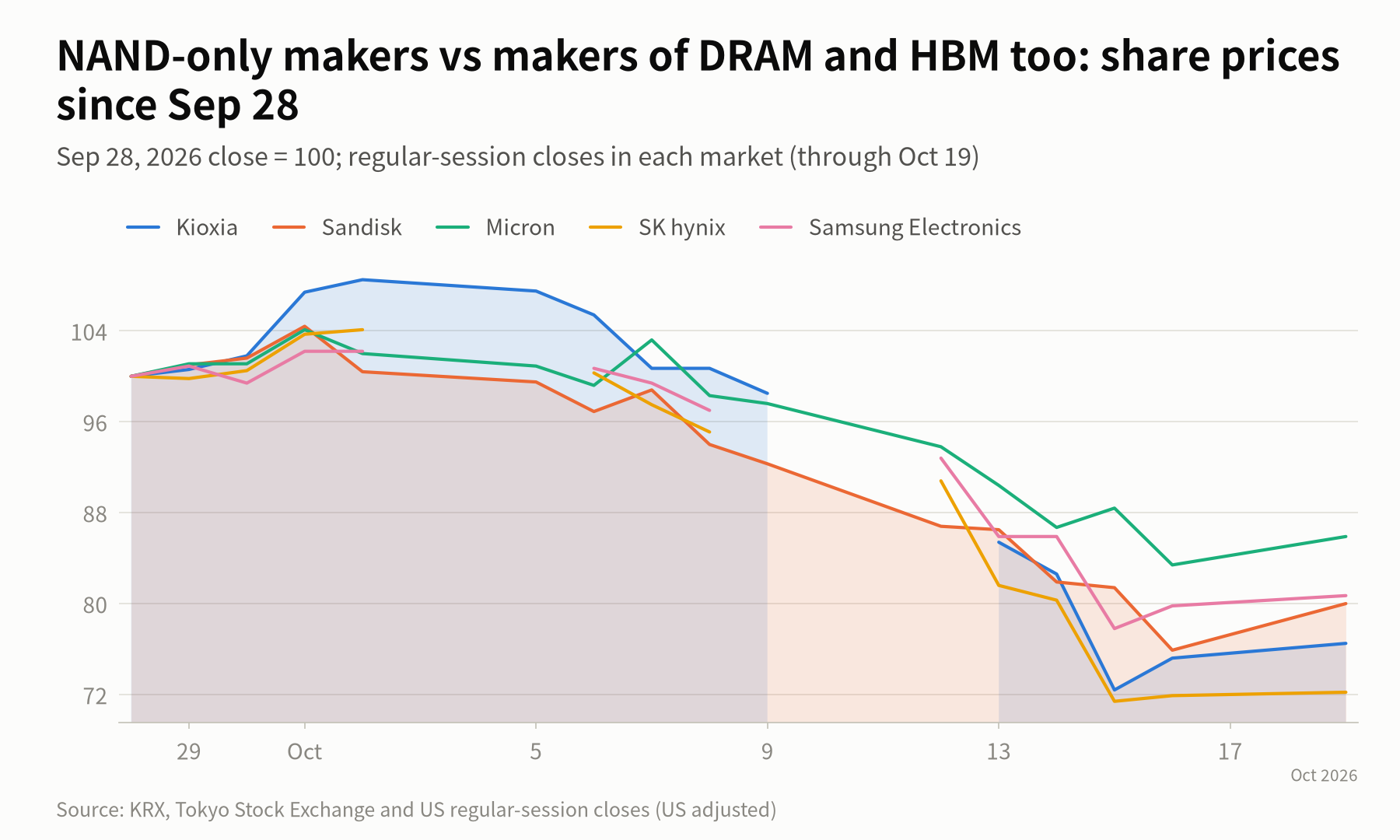
Changes from September 28 to October 19, based on closing prices in each market:
- SK hynix (Korea): -27.8%
- Kioxia (Japan, in yen): -23.5%
- Sandisk (US): -20.0%
- Samsung Electronics (Korea): -19.3%
- Micron (US): -14.1%
The biggest drop was at SK hynix, where DRAM and HBM make up a large share of the business. Exposure to NAND does not line up with the size of the drop. The numbers fit better with the view that the October decline in memory stocks had more to do with other causes than with NAND supply worries. During this period, markets were worried about the debt behind AI investment, and in Korea foreign investors kept up heavy selling.
Kioxia also faces a situation particular to the Japanese market. In Japan, margin trading, where investors borrow money from a broker to purchase shares, is common. According to Tokyo Stock Exchange data, Kioxia’s outstanding margin purchases on October 19 stood at more than 46.82 million shares, worth about 880.9 billion yen. That was the largest amount among the 4,249 listed stocks. When the share price falls, investors who borrowed to purchase may be unable to top up their collateral and may have to unload their shares. On October 19, Japan’s The Japan Times and Korea’s Seoul Economic Daily reported that this margin balance was weighing on Kioxia’s share price.
Signals on the price side are still weak, too. In the export price index the Bank of Korea publishes monthly, the flash memory index fell 0.69% in September from August. The DRAM index rose 2.26% in the same month. But the flash memory index is still 244% higher than a year earlier. One month’s figure is too early to say prices have turned. The index also tracks Korean makers’ export prices, so it is not the same as Kioxia’s or Sandisk’s selling prices.
Three things to check in the month-end results
Sandisk reports fiscal Q1 2027 results after the US market close on October 29 (1:30 p.m. Pacific time). Kioxia reports fiscal Q2 2026 (July-September) results at 6:45 p.m. Japan time on October 30. Before that, SK hynix (October 28) and Samsung Electronics (October 29) also hold earnings calls.
Whether the NAND oversupply warning is actually materializing can be checked in the following figures from the two companies.
- Next-quarter NAND price outlook: whether the two companies expect selling prices to keep rising or the increases to narrow is the most direct signal.
- Share of data center SSDs: this shows how much server demand is offsetting weak demand for smartphones and laptops. TrendForce also expected server demand to stay strong in 2027.
- Capital spending plans: how much the two companies expand capacity ties directly to the outlook for supply growth in 2027. A big increase in investment would add weight to the supply growth warning; holding back on investment would read the other way.
Either way, one quarter’s results cannot settle the supply-demand balance for the second half of 2027. But where there have so far been only forecasts and share prices, at month-end the numbers from the two NAND-only companies come out for the first time.
How to follow both companies from abroad
- Kioxia: Tokyo Stock Exchange code 285A. In the US it trades over the counter (OTC) as KXIAY; one KXIAY share equals 0.1 share of 285A. Kioxia split each share into three on October 1, so prices from before that date are comparable only once adjusted for the split.
- Sandisk: Nasdaq ticker SNDK.
- Japanese margin balances: the Tokyo Stock Exchange posts each stock’s balance as of the previous day around 4 p.m. Tokyo time every business day.
- NAND price trend: the flash memory item in the Bank of Korea’s export price index comes out every month.
Sources: TrendForce (NAND outlook, July 21, 2026; Q2 NAND revenue ranking, August 18, 2026), Sandisk SEC 10-K (filed August 17, 2026), Sandisk and Kioxia earnings date announcements, Japan Exchange Group (Tokyo Stock Exchange) margin balance data (as of October 19, 2026), Bank of Korea ECOS export price index (September 2026), The Japan Times and Seoul Economic Daily (October 19, 2026), KRX, Tokyo Stock Exchange and US regular-session closes (share prices)
Information only, not investment advice.
Related reading
More in Blog
- NAND Outlook Up, Shares Down: Sandisk and Kioxia Report October 29-30
- Nasdaq Down Two Weeks: Can Google, Microsoft and Amazon Stop It?
- Record Quarter, 12% Drop: Why Lam Research Stock Fell
- SK hynix, Kioxia Slide: 3 Reasons Asia's Chip Stocks Fell Together
- Flying Roadster, Grounded Profit: Tesla’s Q3 in 5 Numbers
- Shortage Until 2028 or NAND Glut? Samsung and SK hynix
- US Chip Stocks End an Eight-Day Slide, and Memory Came Back First
- How Much Can Korea's Pension Giant Move Samsung and SK hynix?
- Samsung Electronics and SK hynix Pulled the KOSPI Down 14%. Why?