The SOX Plunge: 3 Reasons Only Chips Fell After the Midterms

In the US session on November 5, the Philadelphia Semiconductor Index (SOX) fell nearly 10% intraday. The same day in Korea, Samsung Electronics fell 7.57% and SK hynix fell 9.46%. The midterm elections were the trigger, but the election alone doesn’t explain the drop. It came from worries about data-center regulation, bad news from Qualcomm and Micron, and a decline that had already run for more than a month before the vote, all at once.
The day after the election, Microsoft rose and chips fell
On November 4, the day after Democrats won both the Senate and the House, US stocks actually rose. The S&P 500 ETF (SPY) gained 1.65% and the Dow rose 3%. Microsoft jumped 6.68% and Amazon 6.12%.
The chip index, on the other hand, fell 3.1% to its lowest level in six months. Micron fell 7.00%, Nvidia 3.17% and the AI cloud company CoreWeave 9.90%.
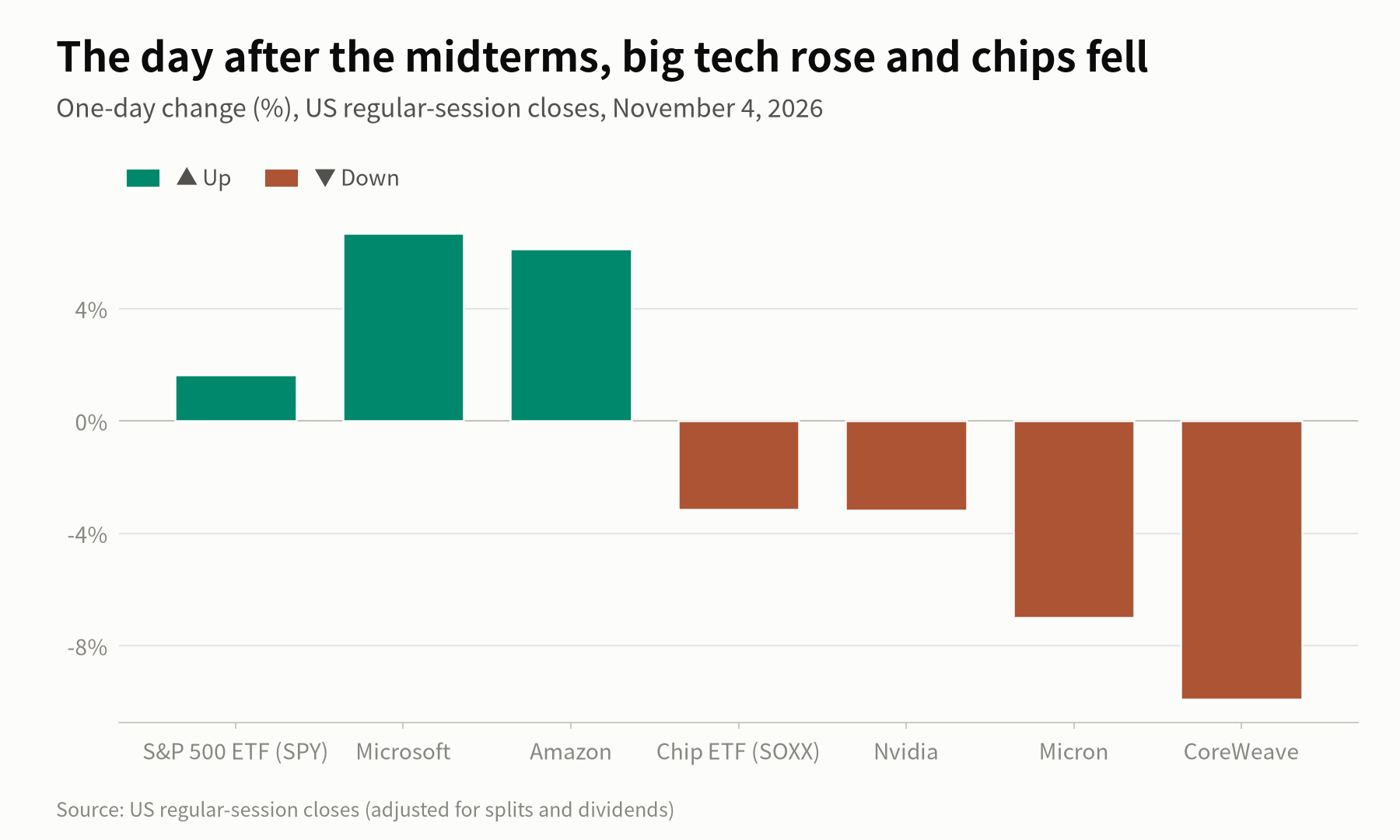
Why did stocks from the same AI trade split? The money spent on building data centers is a cost for big tech and revenue for chip companies. If construction slows, big tech saves cash, while chip companies may get fewer orders, and that calculation showed up in share prices.
Three reasons the Philadelphia Semiconductor Index plunged
1. Candidates who promised to halt data centers won
In the Texas governor’s race, Democrat Gina Hinojosa defeated incumbent Governor Greg Abbott. It is the first time since 1990 that Texas has elected a Democratic governor. Governor-elect Hinojosa has said she would halt approvals of new data centers until the state legislature passes laws to protect residents, and would also end tax breaks for data centers.
Texas matters because of its size. According to Goldman Sachs, more than 25% of the data-center capacity planned in the US is concentrated in Texas. Together with Georgia, where Democrats also won the governorship, the two states account for about a third of AI data-center investment and projects. In Ohio, at least 14 local governments have passed measures to ban or restrict data centers.
2. Bad news from Qualcomm and Micron came the same day
What deepened the drop on November 5 was news from outside the election. After the close on November 4, Qualcomm guided for adjusted earnings per share (EPS) of $2.15-$2.35 next quarter, and the midpoint of $2.25 fell short of the market’s expectation of $2.32. It also said that rising component costs, from wafers to memory, would bring its chip business’s margin down to 20-22%.
Bloomberg reported that Micron had halted construction of a $4.5 billion plant in Taiwan because of a labor dispute. Early in the US session on November 5, Qualcomm, Micron, SanDisk and AMD led chip stocks lower.
3. Chips were already down 23% before the election
The semiconductor ETF SOXX (on adjusted prices) fell 23.6%, from $196.50 on October 5 to $150.14 on November 4, the day after the election. On October 30 it lost 8.24% in a single day after Intel plunged. The election added one more piece of bad news to a market that had already weakened.
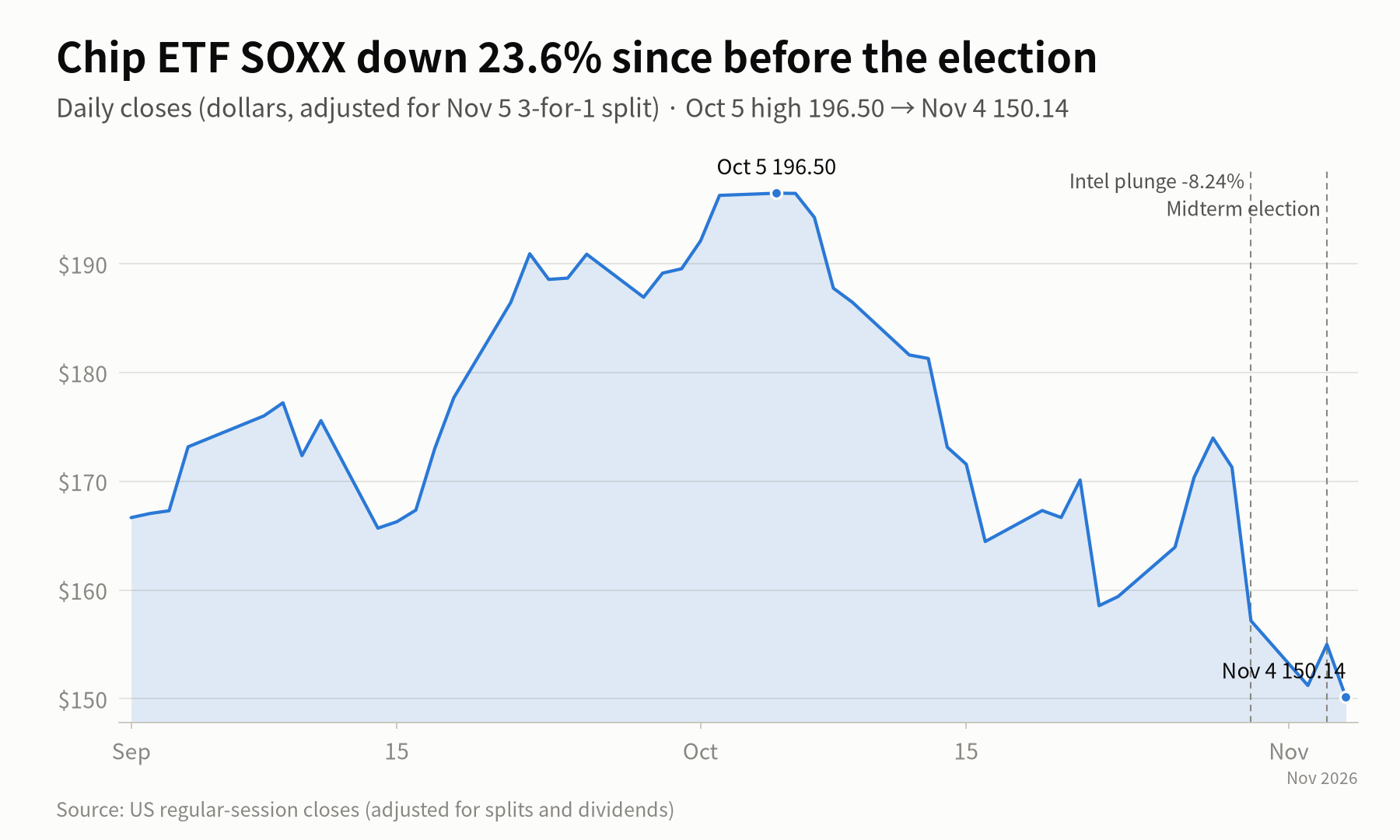
SOXX at a third of its price? Telling the split from a real drop
SOXX split each share into three from the open on November 5 (record date November 3). A share worth about $450 before the split now trades at around $150. On screens that don’t account for the split, SOXX can look as if it fell more than 60%.
The actual decline shows in the Philadelphia Semiconductor Index (SOX) itself or in split-adjusted prices. The index is not affected by the split, so its intraday drop of nearly 10% is a real decline, not an illusion.
The other view: will regulation hurt chip demand too?
- Still only a campaign promise: Governor-elect Hinojosa’s halt on approvals is not law yet. Federal legislation would also need President Trump’s signature, and overriding a veto takes two-thirds of Congress.
- Texas had already paused: On August 3, Governor Abbott halted approvals for connecting new data centers to the power grid and ordered an audit. The audit was due to finish at the end of this year. This is less a new regulation than a risk that the pause lasts longer.
- What institutions say: State Street said the result “raises the political risk premium on AI but does not derail the AI capital spending cycle as a whole.” Deutsche Bank noted that after all 20 midterm elections since World War II, the S&P 500 was higher one year later. That, however, is for the market as a whole, not for chips.
What to watch next
- The US closes on November 5: how much of its intraday drop the chip index recovered
- The US October jobs report, at 10:30 p.m. Korea time on November 6
- The new Texas governor’s inauguration and the data-center bills expected in the state legislature in January
- Whether big tech cuts its capital spending plans for next year (at the next earnings reports)
In one line
The midterms pulled the trigger on the chip plunge, but the bullets were doubts about AI investment that had built up for more than a month, plus bad news from Qualcomm and Micron.
This post reflects information as of November 5, 2026 (during the US session) and is not investment advice on any particular stock or product.
Frequently asked questions
Why are the US midterms bad news for chips?
Because in Texas, Georgia and other states Democrats won, candidates promised to halt data-center approvals and end tax breaks. The worry is that if fewer data centers are built, orders for the chips that go into them may shrink.
Is the plunge in the Philadelphia Semiconductor Index due to the SOXX split?
No. SOXX split 3-for-1 on November 5, but the index itself is not affected by the split. Split-adjusted prices or the index show the real size of the drop.
How much did Korean chip stocks fall?
On KRX regular-session closes on November 5, Samsung Electronics fell 7.57% to 201,500 won and SK hynix fell 9.46% to 1,264,000 won. The KOSPI closed down 5.28% at 5,383.80.
Sources: US regular-session closes adjusted for splits and dividends; KRX regular-session closes; Reuters (November 4 and 5, 2026); Bloomberg (November 5, 2026); iShares prospectus supplement (SEC, October 2026); Seoul Economic Daily (November 5, 2026)
Information only, not investment advice.
Related reading
More in Blog
- Caterpillar as an AI Stock: Why Midterm Data Center Curbs Hit It
- US Chip Stocks Rebound, but AI Leaders Win Back the Least
- Chip Stocks Tonight: Three Things to Watch as AMD Reports
- After the SOX Plunge: Three Checkpoints for This Week
- AI Spending Over Earnings: 3 Reasons TSMC Shares Slipped
- Why Kioxia Disappointed After Earning 2 Trillion Yen in Three Months
- The KOSPI's Roller Coaster Won't Stop. Is the Nikkei on It Too?
- SanDisk's 4.6x Revenue Outlook: What It Signals for Kioxia
- Is Samsung Handing a Key HBM Chip to TSMC?