Kioxia shares drop as outlook hints demand is leveling
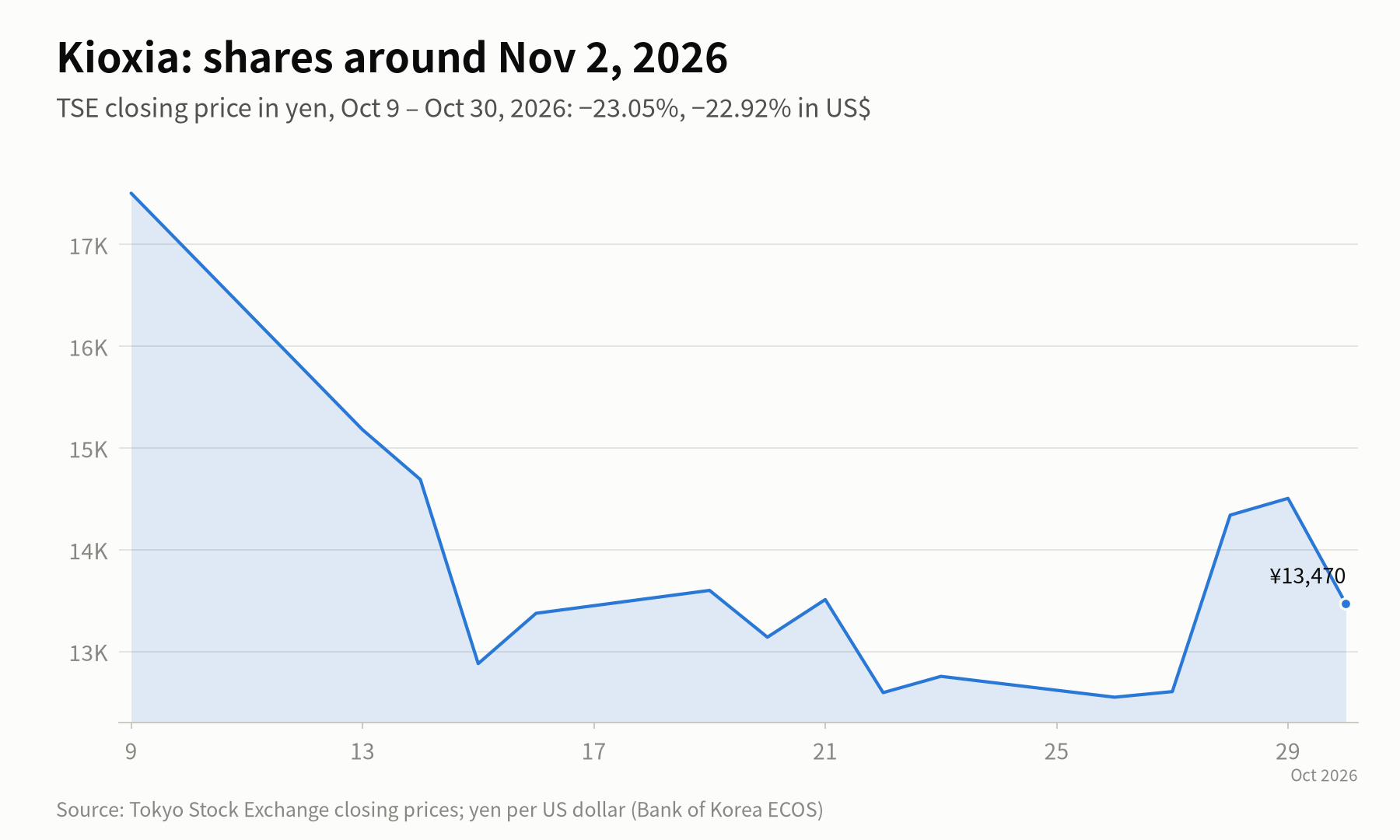
Kioxia came into Monday at ¥13,470 after losing 23.05% in three weeks, and Bloomberg tied its early drop to a profit outlook that points to flatter demand.
Kioxia (285A) dropped sharply in early trading in Tokyo on Monday, Nov 2. Bloomberg reported that investors were reacting to the memory maker’s profit outlook, which Bloomberg said suggests demand is leveling off. Its report on the stock ran at 9:26 a.m. Tokyo time.
The shares started the week at ¥13,470 (about US$85.38), their close on Friday, Oct 30. How far they had fallen by the end of Monday’s session was not known when this article was published.
The wider Tokyo market was also lower. In a report at 9:15 a.m., Bloomberg said Japanese stocks were falling, weighed down by a broad drop in technology shares and by Kioxia’s outlook. Bloomberg did not give an index level at that hour.
An outlook read as a plateau
Kioxia published consolidated results for the six months ended Sept. 30, 2026, on Oct 30. They were prepared under IFRS, the international accounting standards. Kioxia’s fiscal year ends in March, so those six months are the first half of the current year.
The view that demand is leveling off is Bloomberg’s reading of the outlook. Kioxia’s own description of its guidance has not been reported in the same terms. Investors who follow Samsung Electronics and SK hynix watch Kioxia’s outlook as an early signal on memory demand, since it reports near the start of each quarter’s results season.
The outlook landed on a stock that had already reacted badly to the release. On Oct 30 the shares fell 7.14%, from ¥14,505 to ¥13,470, as Pacific Tape reported that day. A follow-up analysis on Oct 31 looked at why strong results failed to lift the stock.
Monday’s fall extends a three-week slide
Before Monday, the shares had lost 23.05% from their Oct 9 close to their Oct 30 close. Measured in dollars the loss was 22.92%. The yen firmed slightly over the same stretch, from 158.025 to 157.76 per US dollar, which trimmed the loss for dollar-based holders.
The decline was not unbroken. On Oct 19 the stock rose 1.68% to ¥13,600. By Oct 29 it had climbed to ¥14,505, before the post-results drop on Oct 30 took it back below its Oct 19 level.
All of these prices are adjusted for Kioxia’s 3-for-1 stock split of Oct 1, 2026. Per-share figures from before that date need the same adjustment to be compared.
Seoul’s chipmakers also under pressure
The morning was weak for memory stocks in Korea, too. Chosunbiz reported before the Seoul open that Samsung Electronics and SK hynix were sliding in premarket trading, which it linked to what it called an Intel shock. Chosunbiz did not tie that move to Kioxia.
The latest official price data show memory prices still far above where they began the year, but no longer rising in step. South Korea’s export price index for flash memory, a gauge of memory-chip prices rather than Kioxia’s own, stood at 245.72 in September (2020=100). That was 0.69% below August and 95.02% above January.
The matching index for DRAM rose 2.26% from August to 289.16, and was up 96.12% since January. South Korea’s export value index for semiconductors jumped 29.42% in September from the month before, to 733.03, and was 196.08% above its January level.
Those figures cover Korean exports, not Kioxia’s sales. They show that in September, flash memory export prices dipped while DRAM prices kept climbing.
Information only, not investment advice.
Sources
Related reading
More in News
- Lam sets $25 billion share repurchase after 16% stock drop
- Chip rout deepens as KOSPI slides 6% for a second steep loss
- Micron sinks 17.5% in its worst session since 2020
- Midterm shock trips Seoul circuit breaker as chips slide
- TSMC falls to daily limit as Taiex sheds over 3,700 points
- KOSPI circuit breaker trips; Qualcomm lands SpaceX deal
- Samsung holds 38% of DRAM sales as SK hynix narrows gap
- Micron drops 7%, then a Taiwan plant pause is reported
- Chip stocks sink in KOSPI rout as SK hynix gains DRAM share
- SK hynix and Samsung slide 3-5% before Seoul open on U.S. vote