KOSPI shrugs off Intel's 28.58% plunge to close 2.24% higher
An early slide in Seoul after Intel's collapse turned into a 2.24% KOSPI gain, with pension funds and other institutions on the purchasing side.
Seoul’s main share index finished Monday, Nov 2, at 5,859.08, up 2.24% from its Oct 30 close. The KOSPI, South Korea’s benchmark index, got there from a weak start. Early in the day it was in the red after Intel shares collapsed on Friday in New York and dragged the rest of the US chip sector down with them.
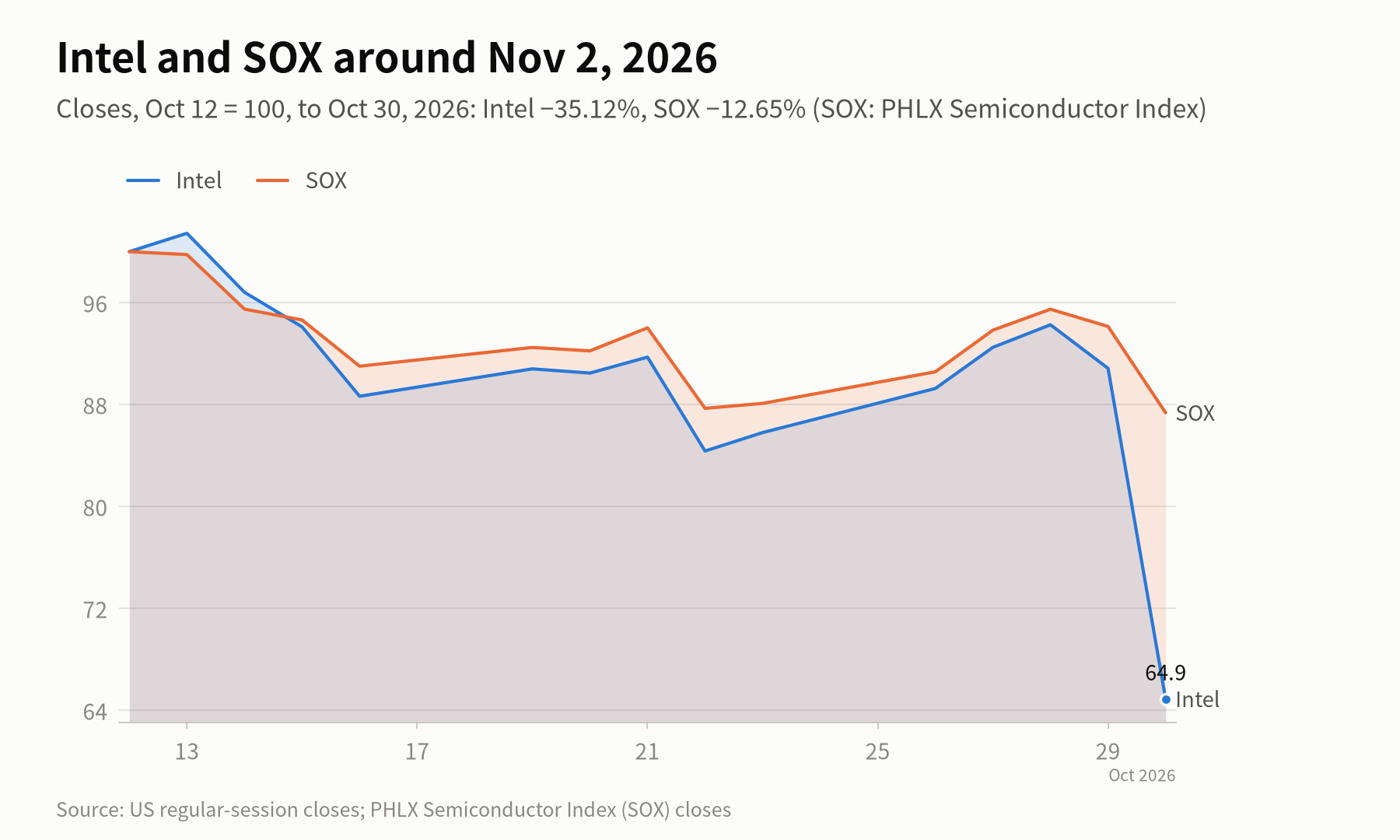
Intel ended its regular US session on Oct 30 at US$65.76. That was 28.58% below its Oct 29 close. The drop set the tone for Seoul’s opening on Monday, the first Korean session to follow it.
A 7.2% drop for US chip stocks
The damage did not stop at Intel. The PHLX Semiconductor Index, or SOX, a gauge of US-listed chip stocks, lost 7.2% on Oct 30 and closed at 10,688.80.
The broader US market slid too. Wall Street’s main indexes all ended Friday lower after quarterly results from both Intel and Amazon let investors down, The Korea Herald reported. Those results sharpened doubts over whether today’s pace of AI spending can last, according to The Korea Herald, and the S&P 500 lost 1.82%.
That combination matters for holders of Asian chip stocks. Questions about AI spending reach well beyond Intel, because spending on AI data centers is what buyers of memory and other chips are relying on. Friday’s selling in New York left Seoul facing those questions when its own market reopened on Monday.
Samsung and SK hynix slipped early
The KOSPI gave up more than 1% as trading began on Nov 2, Chosunbiz reported. It said Samsung Electronics and SK hynix were both weak in the wake of Intel’s slide.
Part of that early loss was soon recovered. At 9:15 a.m. Korea time, the index stood at 5,679.74, down 51 points or 0.89%, according to The Korea Herald.
Pension funds led the turnaround
The direction changed as the session went on. Chip giants led the KOSPI from a loss into a gain, Chosunbiz reported.
The money behind that move came from pension funds and other institutions, according to Chosunbiz. Institutions here means professional money managers rather than individuals. Retail and foreign investors were net sellers on the day, Chosunbiz reported. Net selling means a group’s sales of shares were larger than its purchases over the session. Foreign flows often move the KOSPI, so a rally made without them is worth noting.
By the close, the index had climbed from 5,679.74 at 9:15 a.m. to 5,859.08. That left it 2.24% above where it ended on Oct 30, before Intel’s plunge in New York.
Tokyo took a different path on the same day. The Nikkei 225, Japan’s main share index, ended Monday at 63,081.86, down 0.33% from its Oct 30 close.
A rebound after record exports
Monday’s rally came one day after Pacific Tape reported that chips drove Korea’s exports to a record. Neither Chosunbiz nor The Korea Herald tied Monday’s turnaround to that report. What the day did show is that a sharp drop in a large US chipmaker and a 7.2% slide in the US chip index did not keep Seoul’s chip giants down for a full session.
The moves on each side of the Pacific came from different groups of investors. In New York, Friday’s losses followed results that, according to The Korea Herald, raised fresh doubts about AI spending. In Seoul, the recovery rested on institutional money, with pension funds among the purchasers, while foreign investors and individuals were on the other side of the trade, Chosunbiz reported.
Information only, not investment advice.
Sources
- Intel slump drags South Korea stocks lower as chip worries intensify
- Seoul stocks open lower as disappointing tech earnings trigger AI spending woes
- Pension funds lift Korea stocks as chip giants lead KOSPI rebound
- PHLX Semiconductor Index (SOX) closes
- KOSPI index closes
- Nikkei 225 closes
- US regular-session closes (Intel)
Related reading
More in News
- Lam sets $25 billion share repurchase after 16% stock drop
- Chip rout deepens as KOSPI slides 6% for a second steep loss
- Micron sinks 17.5% in its worst session since 2020
- Midterm shock trips Seoul circuit breaker as chips slide
- TSMC falls to daily limit as Taiex sheds over 3,700 points
- KOSPI circuit breaker trips; Qualcomm lands SpaceX deal
- Samsung holds 38% of DRAM sales as SK hynix narrows gap
- Micron drops 7%, then a Taiwan plant pause is reported
- Chip stocks sink in KOSPI rout as SK hynix gains DRAM share
- SK hynix and Samsung slide 3-5% before Seoul open on U.S. vote